Research Integrity and Academic Fraud in Higher Education
Source:The Hindu ↗
Why It Matters
Academic and scientific fraud undermines the credibility of India's research output. Understanding this issue is critical for civil servants working on education policy, governance, and ethical administration, especially in the context of improving higher education quality and implementing NEP 2020.
Summary
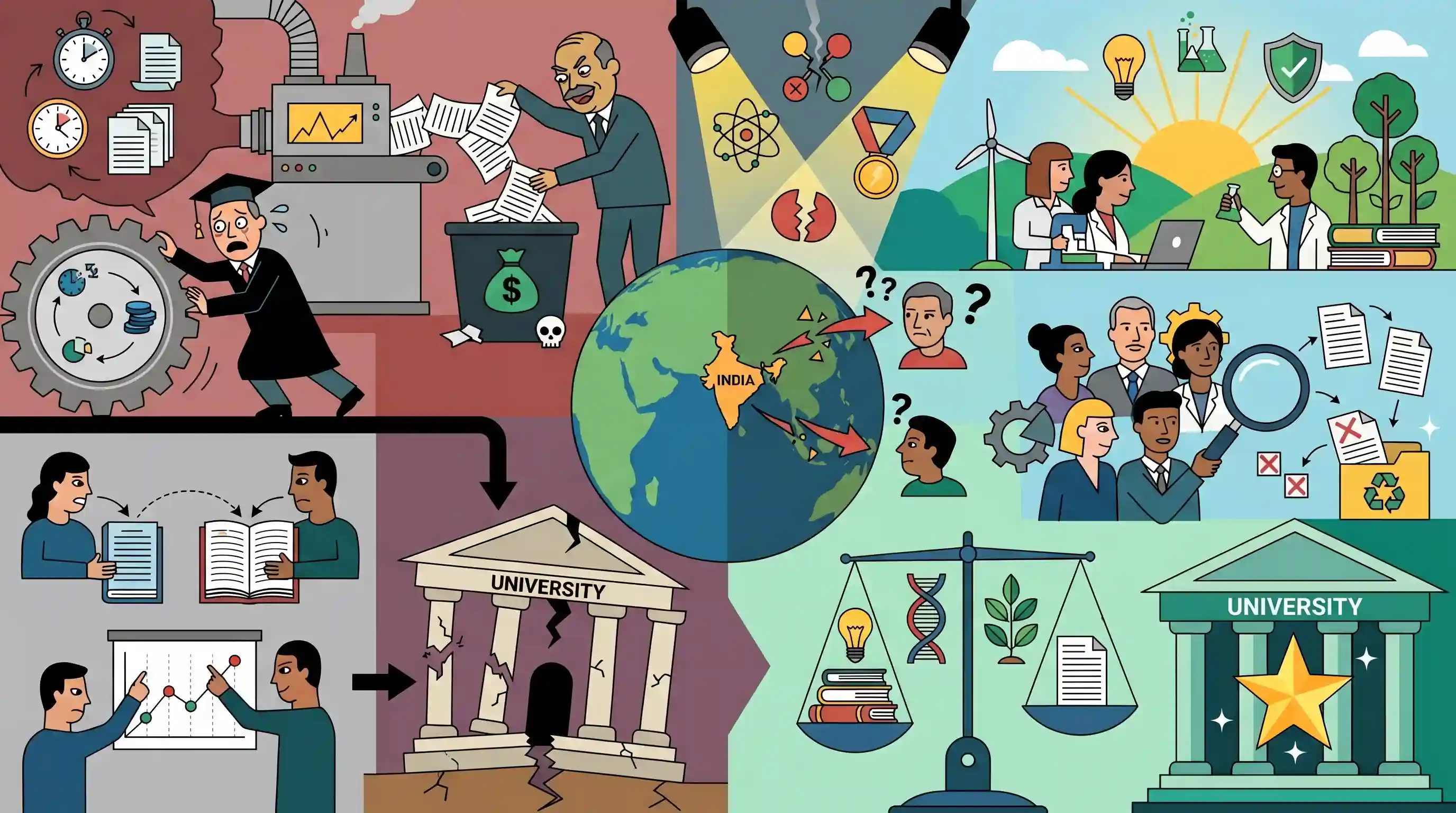
The article highlights the growing crisis of research fraud in India, driven by the systemic 'publish or perish' culture in academia. Intense pressures to meet quantitative metrics for recruitment and promotions have led to a surge in unethical practices, including data fabrication, plagiarism, and the use of predatory journals. This epidemic of academic dishonesty severely compromises the quality and international credibility of Indian scientific output and higher education. To combat this, the piece underscores the urgent need to overhaul evaluation criteria, decouple career advancement from sheer publication volume, strengthen institutional ethical oversight (such as the UGC-CARE list), and foster a genuine culture of scientific integrity as envisioned by the NEP 2020.
Key Points
- The 'publish or perish' culture in Indian academia forces researchers to prioritize the quantity of publications over quality to secure jobs and promotions.
- Quantitative evaluation metrics, such as UGC's Academic Performance Indicators (API), have inadvertently incentivized unethical practices like plagiarism and data manipulation.
- There is a massive proliferation of predatory journals and 'paper mills' that exploit academic desperation by publishing unverified research for a fee.
- Academic fraud severely damages the international credibility and competitiveness of India's higher education and R&D ecosystem.
- Systemic reforms are required, including rigorous institutional oversight, replacing volume-based metrics with quality assessments, and fulfilling the research-centric vision of the National Education Policy (NEP) 2020 through the National Research Foundation (NRF).
Important Terms
National Education Policy (NEP) 2020

A 2020 policy framework aimed at transforming India's education system. It emphasizes research-intensive universities, multidisciplinary learning, and the creation of an apex body (NRF) to foster a high-quality research culture.
UPSC context
GS Paper II (Education/Governance); provides the structural basis for modern academic reforms and ethical research standards in India.
University Grants Commission (UGC)
A statutory body under the Ministry of Education responsible for maintaining standards in higher education. It issues regulations to promote academic integrity and prevent plagiarism and research misconduct.
UPSC context
GS Paper II (Statutory/Regulatory Bodies); its role is crucial in regulating university ethics and determining career advancement criteria.
Anusandhan National Research Foundation (ANRF)
An apex statutory body established in 2023 to provide strategic direction for scientific research. It aims to bridge gaps between industry and academia, funding high-impact R&D across diverse disciplines.
UPSC context
GS Paper III (Science & Technology); focuses on building a globally competitive R&D ecosystem and improving research funding efficiency.
UGC-CARE
An initiative to curate a list of quality journals to prevent predatory publishing. Recently, the UGC moved toward decentralizing this process, tasking institutions with evaluating journal quality themselves.
UPSC context
GS Paper II/III (Education/S&T); essential for discussing measures to uphold scientific credibility and combat the "predatory journal" menace.
Predatory Journals
Deceptive academic publishers that prioritize profit over quality. They charge authors high fees for rapid publication without performing rigorous peer review, often exploiting "publish or perish" pressures.
UPSC context
GS Paper III (Science & Technology/Ethics); a major challenge to the integrity of India's research output and global academic standing.
'Publish or Perish' Culture
A systemic pressure in academia where career success and recruitment are tied to the quantity of publications. This culture often incentivizes unethical practices, including data fabrication and plagiarism.
UPSC context
GS Paper IV (Ethics) and Paper II (Education); explains the institutional root causes behind the epidemic of academic dishonesty.
Prelims Trap
The Anusandhan National Research Foundation (ANRF) functions as a regulatory wing under the University Grants Commission (UGC).
ANRF is an independent statutory body established by the ANRF Act 2023, headed by the Prime Minister. It is not under the UGC.
Static Concepts Connected
What are the core mandate and structural features of the Anusandhan National Research Foundation (ANRF)?
- Statutory body: Established via the ANRF Act 2023, it replaces the Science and Engineering Research Board (SERB) to broad-base R&D funding across universities.
- Apex leadership: The Prime Minister acts as the ex-officio President, ensuring high-level political backing for strategic national research priorities.
- Funding model: It aims to mobilize ₹50,000 crore over 5 years, with nearly 70% of the funds expected from private sector and philanthropic contributions.
What is the UGC-CARE list and why was it established?
- Quality benchmark: It is the Consortium for Academic and Research Ethics, a reference list of quality journals maintained by the UGC.
- Combating fraud: Created to curb the proliferation of predatory journals and ensure that academic credits (API) are awarded only for research published in credible, peer-reviewed platforms.
Cross-Topic Patterns
GS4: Institutional metrics vs moral integrity
The 'publish or perish' crisis is a classic GS4 example of how flawed institutional incentives (like API scores) systematically drive unethical individual behavior, such as data fabrication and using paper mills.
Innovation Index vs Quality Deficit
While India climbs the Global Innovation Index (GII), the high rate of paper retractions reveals a severe gap between sheer quantitative research output and actual qualitative impact in global science.

Expect a GS3/GS2 question linking ANRF's mandate to resolving the R&D funding deficit and the 'publish or perish' quality crisis.
Linked PYQs · 3
Linked PYQs · 3
- 2024MainsGS4
Dr. Srinivasan is a senior scientist working for a reputed biotechnology company known for its cutting-edge research in pharmaceuticals. Dr. Srinivasan is heading a research team working on a new drug aimed at treating a rapidly spreading variant of a new viral infectious disease. The disease has been rapidly spreading across the world and the cases reported in the country are increasing. There is huge pressure on Dr. Srinivasan's team to expedite the trials for the drug as there is significant market for it, and the company wants to get the first-mover advantage in the market. During a team meeting, some senior team members suggest some shortcut for expediting the clinical trials for the drug and for getting the requisite approvals. These include manipulating data to exclude some negative outcomes and selectively reporting positive results, foregoing the process of informed consent and using compounds already patented by a rival company, rather than developing one's own component. Dr. Srinivasan is not comfortable taking such shortcuts, at the same time he realises meeting the targets is impossible without using these means. (a) What would you do in such a situation ? (b) Examine your options and consequences in the light of the ethical questions involved. (c) How can data ethics and drug ethics save humanity at large in such a scenario?
- 2015MainsGS2
The quality of higher education in India requires major improvements to make it internationally competitive. Do you think that the entry of foreign educational institutions would help improve the quality of higher and technical education in the country? Discuss.
- 2020MainsGS2
National Education Policy 2020 is in conformity with the Sustainable Development Goal-4 (2030). It intends to restructure and reorient education system in India. Critically examine the statement.
