Allahabad High Court Ruling on Public Safety Over Tenancy Rights
Source:Indian Express ↗
Why It Matters
The ruling clarifies the boundaries of tenant rights when they conflict with broader public safety imperatives. It empowers municipal and urban local bodies to act decisively against hazardous infrastructure without being indefinitely stalled by eviction disputes, which is crucial for urban disaster management in India's aging cities.
Summary
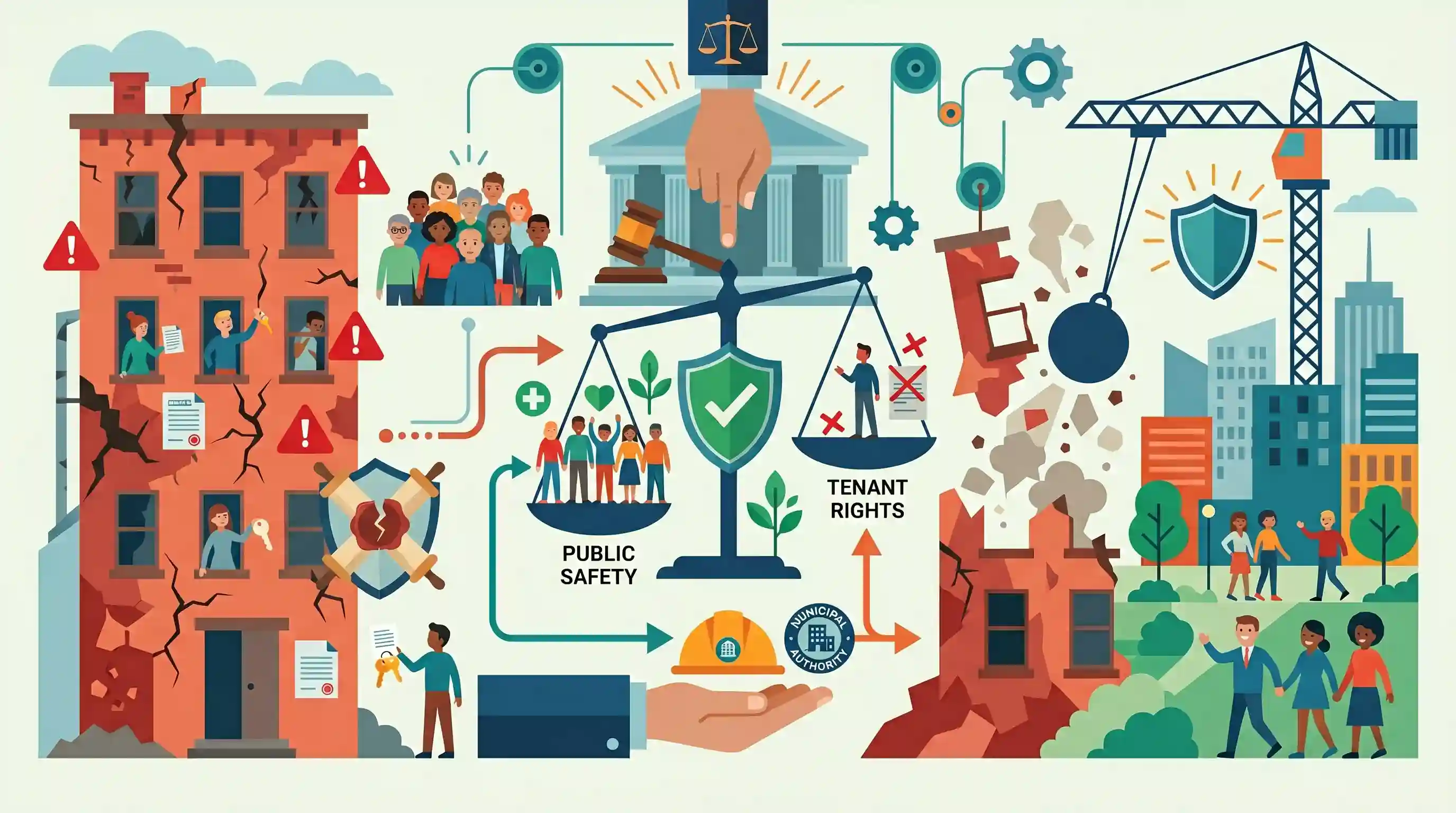
The Allahabad High Court has ordered the demolition of a dangerous building in Varanasi, establishing that public safety outweighs tenant rights. The court clarified that tenancy laws designed to prevent arbitrary eviction cannot be misused by occupants to remain in life-threatening structures. This ruling empowers municipal authorities to proactively demolish structurally compromised buildings to prevent urban disasters and protect public life, highlighting the balance between individual residential rights and collective public interest.
Key Points
- The Allahabad High Court ordered the demolition of a severely dilapidated and dangerous building in Varanasi.
- The court ruled that public safety takes absolute precedence over tenant rights, prioritising the prevention of potential casualties.
- Tenants cannot leverage standard legal protections against eviction to continue residing in structures that pose severe structural and public hazards.
- The ruling underscores the duty of civic authorities to enforce safety regulations in densely populated urban areas, even if it displaces current occupants.
Important Terms
Allahabad High Court

The High Court of Uttar Pradesh, based in Prayagraj. It is one of India's oldest and largest courts, exercising extensive jurisdiction over constitutional and legal matters in the country's most populous state.
UPSC context
GS Paper 2 (Judiciary); tests High Court jurisdiction, judicial hierarchy, and influential rulings that shape state-level governance and constitutional interpretation.
Article 21 of the Constitution
A fundamental right in the Constitution ensuring "protection of life and personal liberty." Courts interpret this broadly to include the right to a safe environment, prioritizing public safety over individual property rights.
UPSC context
GS Paper 2 (Fundamental Rights); tests the scope of judicial activism and the hierarchy of competing rights (Right to Life vs. property/tenancy).
Urban Local Bodies (ULBs)
Constitutionalized local government units (e.g., Municipal Corporations) responsible for urban planning and safety. They hold statutory powers to demolish hazardous structures to prevent disasters and protect public health.
UPSC context
GS Paper 2 (Governance); examines the 74th Amendment and the executive duties of municipalities in urban risk management and safety administration.
Writ Jurisdiction
The power granted to High Courts (Article 226) and the Supreme Court (Article 32) to issue judicial orders, such as Mandamus, for enforcing fundamental rights or ensuring administrative compliance with legal duties.
UPSC context
GS Paper 2 (Indian Polity); essential for understanding judicial review and the judiciary’s role in holding government authorities accountable for public safety.
U.P. Regulation of Urban Premises Tenancy Act, 2021
A state law regulating relations between landlords and tenants. The court recently clarified that its protections cannot be misused to obstruct the demolition of buildings officially declared dangerous.
UPSC context
GS Paper 2 (Governance/State Laws); tests knowledge of legislative balancing between private property rights and collective public welfare.
Prelims Trap
"Urban Local Bodies must obtain judicial clearance before demolishing structurally dangerous private buildings."
Under state municipal acts, ULBs possess independent statutory authority to issue demolition notices for life-threatening structures to ensure public safety, without needing prior judicial approval.
Static Concepts Connected
What are the reasonable restrictions on the Right to Reside and Settle (Art 19(1)(e))?
- General Public Interest: The state can impose restrictions in the interest of the general public, encompassing aspects like public safety, health, and urban order.
- Scheduled Tribes Protection: Restrictions can be placed to protect the distinct culture, language, customs, and land rights of Scheduled Tribes from outsider influx.
What statutory powers do Urban Local Bodies (ULBs) have for urban disaster mitigation?
- Hazard Removal: Under municipal acts, ULBs have independent authority to issue notices for the demolition or repair of dilapidated, life-threatening structures.
- Building Code Enforcement: ULBs are mandated to enforce building bye-laws and structural safety norms to prevent casualties during urban flooding or seismic events.
Cross-Topic Patterns
Article 21 vs Urban Disaster Mitigation
The interplay between the Right to Shelter (Article 21) and proactive urban disaster mitigation is a recurring theme, notably seen in debates over slum evictions and structural safety audits.
Judiciary empowering 74th Amendment bodies
Courts frequently reinforce the statutory powers of municipalities over state rent control laws, implicitly strengthening the functional mandate of ULBs under the 74th Amendment.

Expect a Prelims question testing the exceptions to Art 19(1)(e) against the statutory disaster-mitigation powers of urban local bodies.
Linked PYQs · 3
Linked PYQs · 3
- 2023MainsGS2
“The Constitution of India is a living instrument with capabilities of enormous dynamism. It is a constitution made for a progressive society.” Illustrate with special reference to the expanding horizons of the right to life and personal liberty.
- 2022MainsGS2
“Right of movement and residence throughout the territory of India are freely available to the Indian citizens, but these rights are not absolute.” Comment.
- 2023MainsGS2
“The states in India seem reluctant to empower urban local bodies both functionally as well as financially.” Comment.
