Karnataka High Court on Public Office and Defeated Politicians
Source:The Hindu ↗
Why It Matters
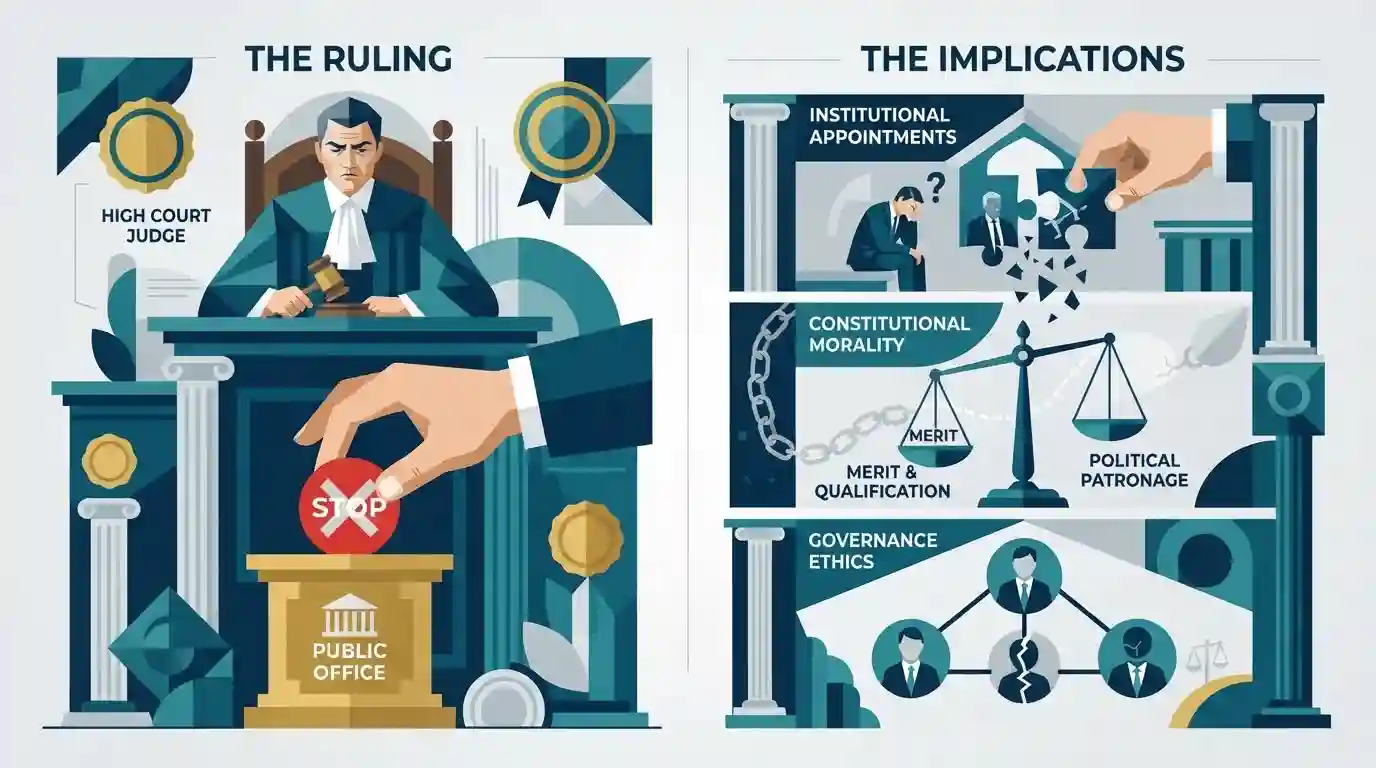
This ruling touches upon constitutional morality, ethics in public governance, and the legal limits or judicial oversight regarding political appointments of defeated candidates to public offices.
Summary
The Karnataka High Court made strong observations stating that public office should not be treated as a consolation prize for politicians who have been defeated in elections, raising critical questions about institutional appointments, constitutional morality, and governance ethics.
Key Points
- Karnataka High Court observed that public office is not a consolation prize for defeated politicians.
- The ruling highlights issues concerning the appointment or nomination of individuals who lost elections to key public offices.
- Emphasizes constitutional morality, accountability, and the sanctity of public institutions.
Prelims Trap
Public office is barred for all defeated politicians across all categories.
Aspirants might assume that the Karnataka HC barred defeated politicians from ever holding any public office permanently, whereas the ruling specifically addresses executive nomination abuse and political rehabilitation without transparent guidelines.
Static Concepts Connected
What are the constitutional provisions and conventions regarding the appointment of non-legislators to ministerial or public offices in India?
- Ministerial Appointments: Article 164(4) permits a non-legislator to be appointed as a minister, but they must get elected within six months.
- Constitutional Morality: Constitutional Morality requires that public power be exercised in accordance with democratic norms, public trust, and institutional integrity rather than pure political patronage.
- Judicial Review: Executive discretion in statutory or non-statutory board appointments is subject to judicial review if it violates equality (Article 14) or public trust doctrines.
Cross-Topic Patterns
Executive Appointments & GS-4 Ethics
Executive discretion in political appointments intersects with administrative ethics and civil services neutrality, a core theme in Ethics (GS-4).
Judicial Review vs. Executive Nominations
Judicial review of executive nominations connects high court powers under Article 226 with the basic structure doctrine.

Constitutional morality and executive patronage questions frequently appear in GS-2 polity mains or analytical prelims statements.
Linked PYQs · 2
Linked PYQs · 2
- 2025MainsGS2
"Constitutional morality is the fulcrum which acts as an essential check upon the high functionaries and citizens alike...." In view of the above observation of the Supreme Court, explain the concept of constitutional morality and its application to ensure balance between judicial independence and judicial accountability in India.
- 2021MainsGS2
‘Constitutional Morality’ is rooted in the Constitution itself and is founded on its essential facets. Explain the doctrine of ‘Constitutional Morality’ with the help of relevant judicial decisions.
