Anti Cheating Bill Proposes Fast Track Courts and Severe Penalties
Source:The Hindu ↗
આ શા માટે મહત્વનું છે
The integrity of public examinations in India is a major governance, socio-economic, and administrative concern, as evidenced by recent paper leaks (e.g., NEET). This legislative amendment directly impacts the institutional sanctity of exams, judicial speed (Fast Track Courts), and governance reforms—topics that are heavily tested in the UPSC Mains GS2 paper.
સારાંશ
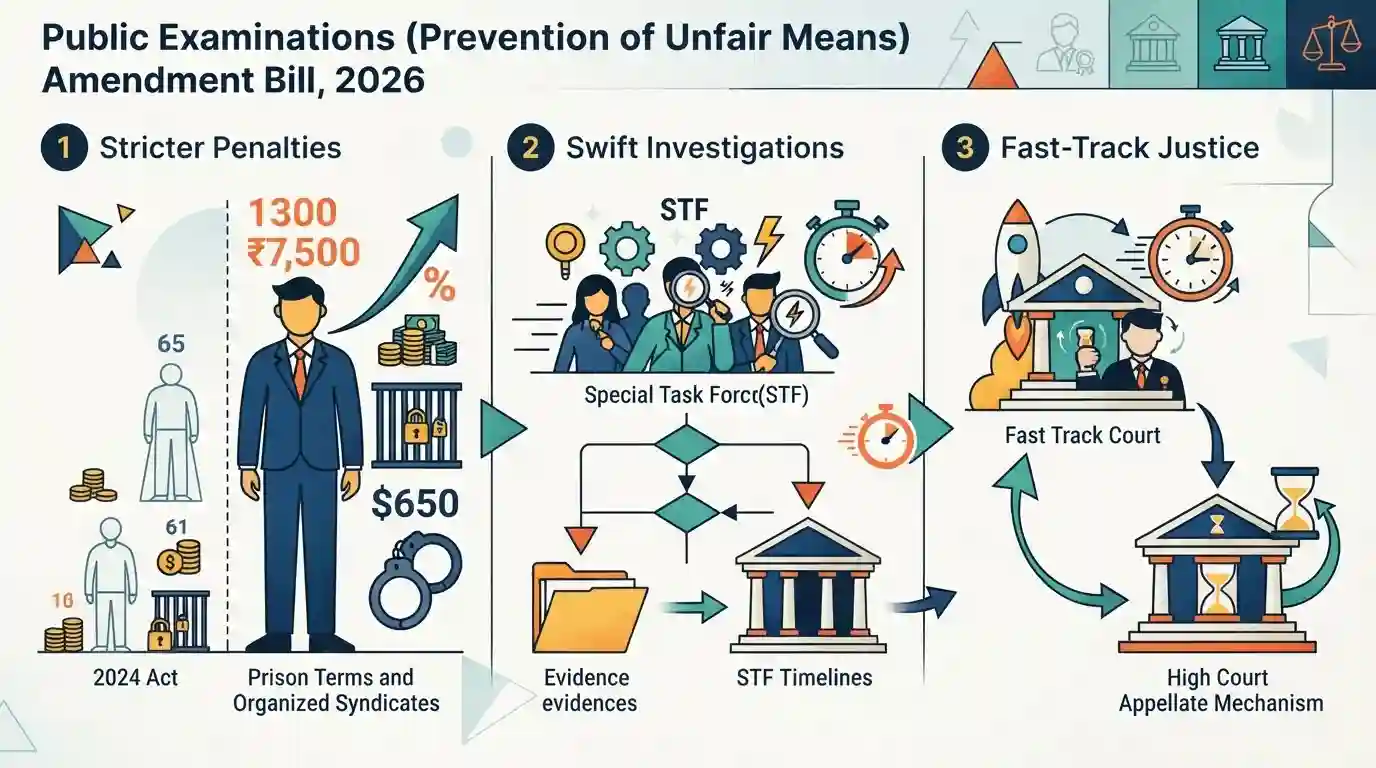
The Union Government has introduced the Public Examinations (Prevention of Unfair Means) Amendment Bill, 2026, in the Lok Sabha. The proposed legislation overhauls the two-year-old anti-cheating framework (the 2024 Act) by drastically raising prison terms and monetary penalties for individuals and organised syndicates. It also introduces swift investigative timelines via Special Task Forces and quick trial processes through Fast Track Courts and a time-bound High Court appellate mechanism.
મુખ્ય મુદ્દા
- The Public Examinations (Prevention of Unfair Means) Amendment Bill, 2026, was introduced in the Lok Sabha to amend the 2024 Act and deter organised exam-cheating networks.
- The Bill significantly enhances penalties: individual jail terms rise from 5 to 10 years (with fines up to ₹50 lakh), colluding officials/directors face up to 5 years (up from 3 years), and organised offences carry up to 7 years in prison (up from 5) and fines up to ₹10 crore (up from ₹1 crore).
- It empowers the Union Government to establish a Special Task Force (STF) to investigate offences within a strict two-month deadline.
- Special Fast Track Courts will be established in States/UTs to conduct daily hearings and conclude trials within three months of the charge sheet being filed.
- A robust appellate mechanism is proposed, where a bench of two High Court judges will hear appeals and must dispose of them within three months of admission.
મહત્વપૂર્ણ શબ્દો
Public Examinations (Prevention of Unfair Means) Amendment Bill, 2026

A 2026 bill seeking to amend the 2024 anti-cheating law by introducing stricter penalties for paper leaks, creating Special Task Forces, and mandating fast-track courts to ensure timely trials within three months of a chargesheet.
UPSC context
Crucial for GS Paper 2 (Governance), reflecting legislative responses to secure merit-based recruitment and restore public trust in national examinations.
Department of Personnel and Training (DoPT)
The central nodal agency under the Ministry of Personnel, Public Grievances and Pensions that formulates policies and regulates recruitment, training, and service conditions of central government employees, including the IAS and CSS.
UPSC context
Vital for GS Paper 2 (Governance and Administration). It controls the recruitment machinery (including UPSC) and enforces accountability frameworks.
Public Examinations (Prevention of Unfair Means) Act, 2024
Enacted to curb leaks and malpractices in specified national exams. It criminalises organized cheating and holds service providers accountable, making offences cognizable, non-bailable, and non-compoundable.
UPSC context
A landmark law for GS Paper 2 (Statutory Bodies/Governance) directly aimed at securing transparency in public employment and education.
Lok Sabha
The Lower House of the Indian Parliament, composed of directly elected representatives. It is the primary legislative body holding exclusive powers over Money Bills and executive accountability.
UPSC context
A foundational topic in GS Paper 2 (Indian Polity), testing knowledge on legislative processes, separation of powers, and parliamentary democracy.
Union Government
The central authority in India's federal structure, comprising the Executive (President, PM, Council of Ministers), Legislature (Parliament), and Judiciary (Supreme Court). It exercises national governance and holds overarching powers.
UPSC context
Core to GS Paper 2 (Polity and Governance). Understanding its structure and federal dynamics is essential for analyzing executive and legislative actions.
High Court
The highest judicial authority in a state, possessing original, appellate, and writ jurisdictions. It exercises superintendence over subordinate courts and tribunals, enforcing fundamental and legal rights.
UPSC context
Key to GS Paper 2 (Judiciary). The 2026 Bill mandates a time-bound appellate mechanism within the High Court, linking judiciary speed to governance.
પ્રિલિમ્સ ટ્રેપ
"The Special Task Force to investigate exam fraud is established by the respective State Governments."
The 2026 Amendment Bill specifically empowers the Union Government—not the State governments—to establish the Special Task Force (STF) to investigate these offenses.
સંલગ્ન સ્થિર ખ્યાલો
How are Fast Track Courts (FTCs) generally constituted in India?
- Establishment: They are typically set up by State Governments in consultation with the respective High Courts.
- Statutory Mandate: While many run on executive schemes, specific legislations (like POCSO or this 2026 Bill) provide explicit statutory mandates for their creation.
- Origin & Funding: Originally recommended by the 11th Finance Commission to clear long-pending sessions cases, they are now often domain-specific.
What is the significance of a Division Bench in a High Court?
- Definition: A bench comprising at least two judges of the High Court.
- Appellate Role: It hears appeals from single-judge benches or specialized lower courts (like Fast Track Courts) to ensure rigorous judicial scrutiny for high-stakes matters.
આંતર-વિષય પેટર્ન
Exam Syndicates & Organised Crime
Treating exam mafias as organized syndicates connects GS2 educational governance with GS3 internal security, drawing parallels to money laundering and cybercrime networks.
Statutory Deadlines vs Judicial Pendency
Mandating 3-month trial and appellate conclusions mirrors the IBC and POCSO frameworks, reflecting a legislative trend to bypass general judicial pendency.

Expect a GS2 Mains question evaluating whether statutory timelines and harsher penalties can cure systemic governance failures like exam leaks.
સંલગ્ન PYQ · 1
સંલગ્ન PYQ · 1
- 2024MainsGS2
What are the aims and objects of recently passed and enforced, The Public Examination (Prevention of Unfair Means) Act, 2024? Whether University/State Education Board examinations, too, are covered under the Act ?
