Public Examination Amendment Bill and Anti-Leak Measures
Source:Indian Express ↗
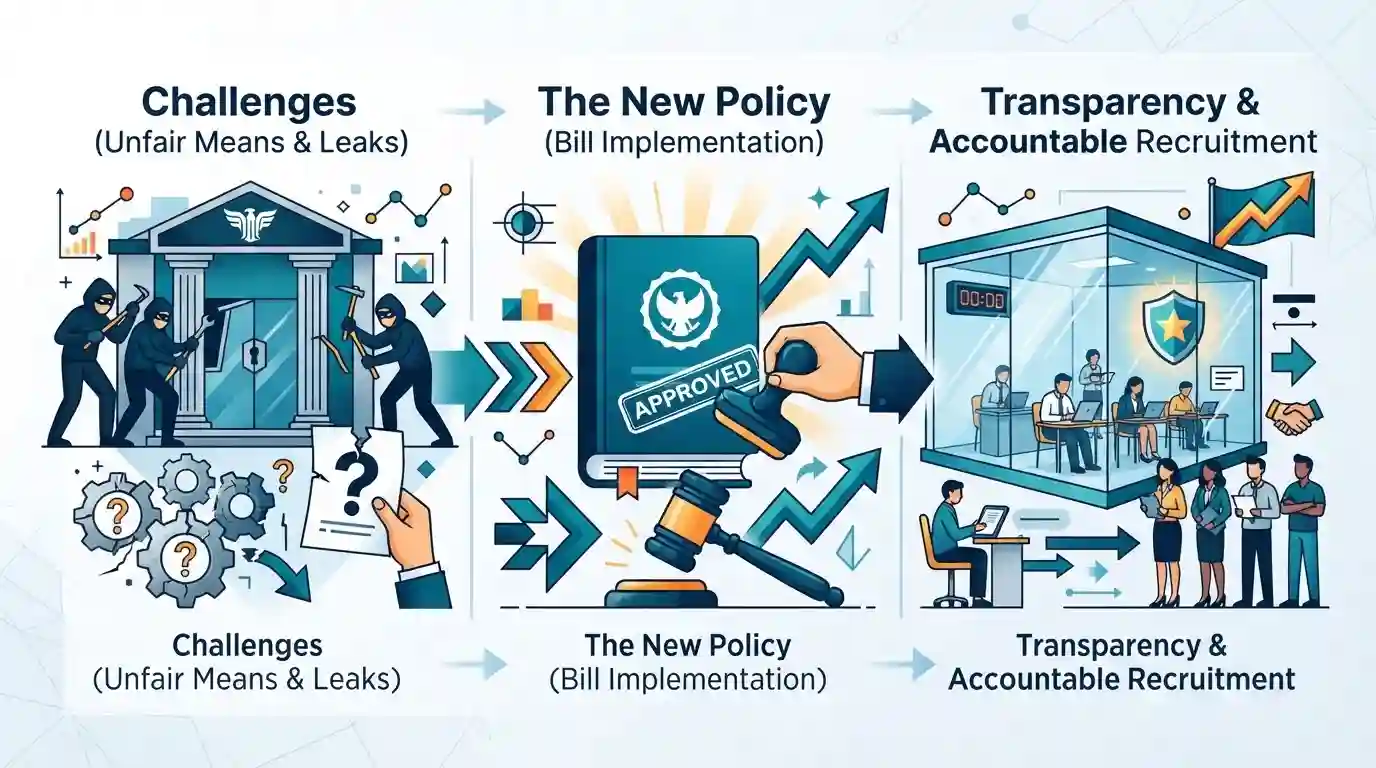
Why It Matters
This topic is directly relevant to GS Paper II under Governance, transparency, and accountability, addressing structural reforms in public examinations and prevention of unfair means.
Summary
The article discusses the key changes introduced by the Public Examination Amendment Bill, which aims to tighten measures against unfair means, paper leaks, and organized malpractices in public examinations to ensure transparency and accountability in recruitment.
Key Points
- The Public Examination Amendment Bill introduces changes to strengthen legal provisions against paper leaks and unfair means in public examinations.
- It aims to streamline examination processes, protect the integrity of public recruitment systems, and ensure transparency.
- The legislation builds upon previous anti-cheating laws to impose stricter penalties on organized cartels and malpractice networks.
- It is crucial for maintaining public trust in recruitment examinations and ensuring fair opportunities for aspirants.
Important Terms
Public Examination Prevention of Unfair Means Act 2024

Legislation enacted to curb paper leaks, cheating, and organized malpractices in central recruitment and entrance examinations through stringent penalties and cognizable offenses.
UPSC context
GS Paper II (Governance, Transparency, Policy & Legislation) and GS Paper IV (Ethics), testing legal frameworks against corruption and institutional malpractices.
Public Examination Amendment Bill
The legislative measure introduced to strengthen enforcement mechanisms, deter paper leaks, and bring uniformity in punishing unfair practices across public examinations.
UPSC context
GS Paper II (Governance and Institutional Reforms), testing reforms in recruitment policies and transparency in public administration.
Prelims Trap
The Public Examinations Act, 2024 applies exclusively to Union Public Service Commission (UPSC) civil services examinations.
Aspirants assume the Act applies only to civil services (UPSC), but it legally covers all central recruitment and entrance bodies including NTA, SSC, and RRBs.
Static Concepts Connected
What are the classifications of criminal offences under Indian penal jurisprudence? (Cognizable vs Non-Cognizable, Bailable vs Non-Bailable)
- Cognizable Offence: Police officer can arrest without a warrant; typically serious offences with imprisonment of 3 years or more.
- Non-Bailable Offence: Accused cannot claim bail as a matter of right; granted only by a court of law under exceptional discretion.
- Non-Compoundable: Offences that cannot be resolved through a compromise between the victim and accused without court permission.
Cross-Topic Patterns
Public Examinations Act & Federal Governance Limits
Anti-paper leak legislation intersects with federal principles under Article 246, as recruitment falls under both Union (Entry 70 List I) and Concurrent lists (Entry 41/25).
Organized Crime Syndicates in Statutory Recruitment Laws
Organized exam cartels and economic offences connect enforcement challenges under the PMLA and the Bharatiya Nyaya Sanhita (BNS).

Public Examinations Act 2024 penal provisions (cognizable, non-bailable, ₹1 cr fine) are prime targets for matching/statement questions.
Linked PYQs · 1
Linked PYQs · 1
- 2024MainsGS2
What are the aims and objects of recently passed and enforced, The Public Examination (Prevention of Unfair Means) Act, 2024? Whether University/State Education Board examinations, too, are covered under the Act ?
