Public Examination Amendment Act and Penalties for Paper Leaks
Source:Indian Express ↗
কেন এটি গুরুত্বপূর্ণ
This topic directly addresses governance issues regarding recruitment integrity, transparency, and the prevention of unfair means in public examinations, which affect millions of aspirants and the credibility of state institutions.
সারসংক্ষেপ
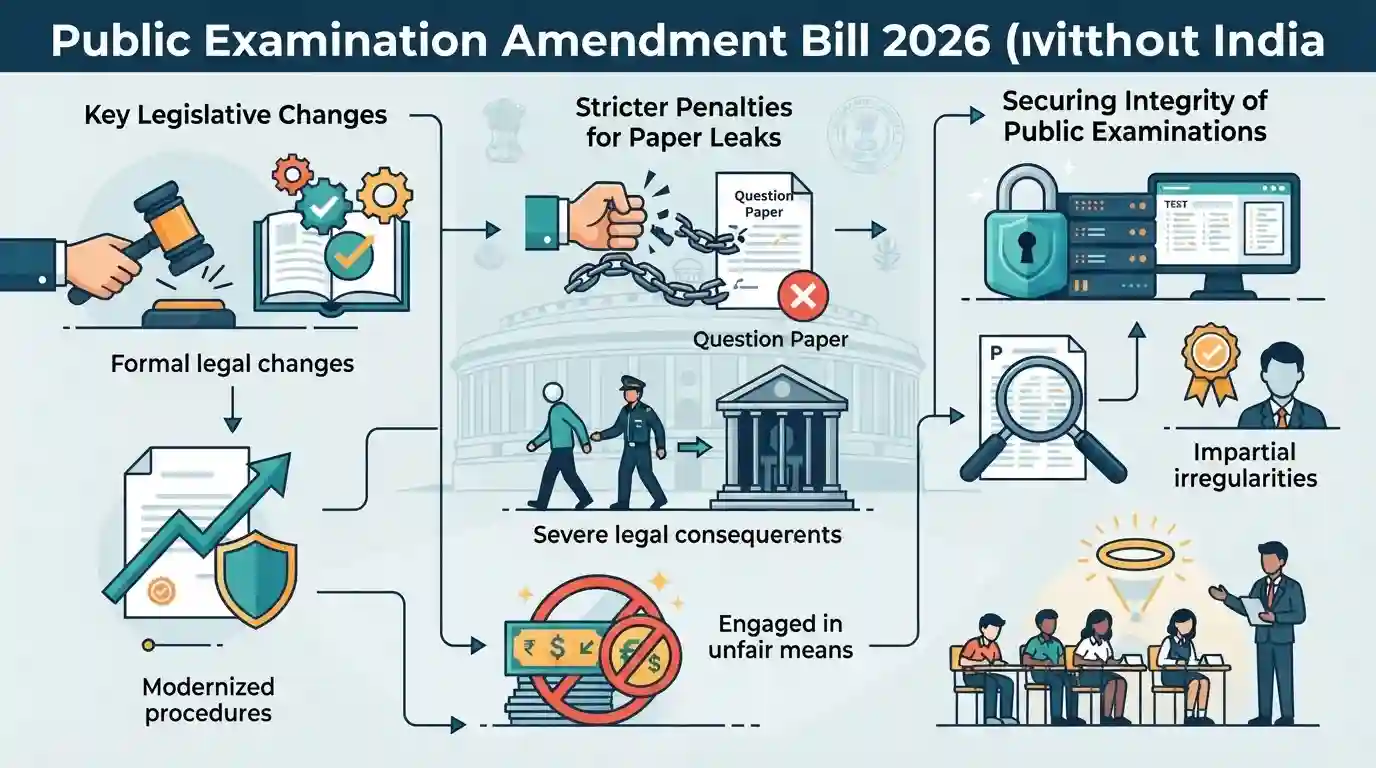
An analysis of the Public Examination Amendment Bill 2026, highlighting key legislative changes, stricter penalties for paper leaks and unfair means, and measures to secure the integrity of public examinations in India.
মূল বিষয়
- The Public Examination Amendment Bill introduces key updates to strengthen the legal framework against paper leaks and unfair means in public examinations.
- It targets organized cheating syndicates, service providers, and institutional flaws with stringent penalties, fines, and non-bailable offenses.
- Aims to restore integrity, transparency, and credibility in recruitment and entrance examinations conducted by public authorities.
- Builds upon previous legislation like the 2024 Act by closing loopholes and enhancing enforcement mechanisms.
গুরুত্বপূর্ণ শব্দ
Public Examination Amendment Bill 2026

A legislative measure introduced to strengthen the 2024 anti-cheating law by imposing stricter penalties, higher fines, debarment extensions, and Special Fast Track Courts to tackle public exam paper leaks and organized fraud.
UPSC context
GS Paper II (Governance): Tests institutional mechanisms, transparency, and policy reforms to prevent corruption and safeguard recruitment integrity.
Public Examinations (Prevention of Unfair Means) Act 2024
The principal central legislation enacted to curb paper leaks, question paper tampering, and organized cheating in public examinations conducted by authorized federal recruiting agencies.
UPSC context
GS Paper II (Governance): Tests statutory frameworks and administrative measures for transparent public service recruitment.
Parliament
The supreme legislative body of India consisting of the President, Lok Sabha, and Rajya Sabha, responsible for enacting laws, holding the executive accountable, and debating national policies.
UPSC context
GS Paper II (Polity): Tests the law-making process, parliamentary oversight, and federal legislative powers.
সংযুক্ত স্থির ধারণা
What is the difference between cognizable and non-cognizable offenses under Indian criminal law?
- Cognizable Crime: Police can arrest an accused without a warrant and start investigation without magistrate permission.
- Non-Cognizable Crime: Police cannot arrest without a warrant and require a magistrate's explicit order to initiate investigation.
- Exam Legislation Link: Public exam offenses are made cognizable and non-bailable to ensure immediate deterrence.
আন্তঃবিষয় প্যাটার্ন
Anti-Paper Leak Laws vs. Federalism
Anti-paper leak laws intersect with federalism debates, as states argue central recruitment acts infringe upon state public service commission autonomy and legislative competence.

Paper leak laws + cognizable/non-bailable offense classification likely to feature in a statement-based Prelims question.
সংযুক্ত PYQ · 1
সংযুক্ত PYQ · 1
- 2024MainsGS2
What are the aims and objects of recently passed and enforced, The Public Examination (Prevention of Unfair Means) Act, 2024? Whether University/State Education Board examinations, too, are covered under the Act ?
