Public Examinations Amendment Act Penalties and Fast Track Courts
Source:Indian Express ↗
ఇది ఎందుకు ముఖ్యం
The Bill directly responds to student distress and large-scale irregularities in national-level examinations (like NEET-UG), aiming to restore faith in public recruiting and testing systems. It serves as an important case study for governance accountability mechanisms and the practical limitations of fast-track courts within India's overburdened judicial system.
సారాంశం
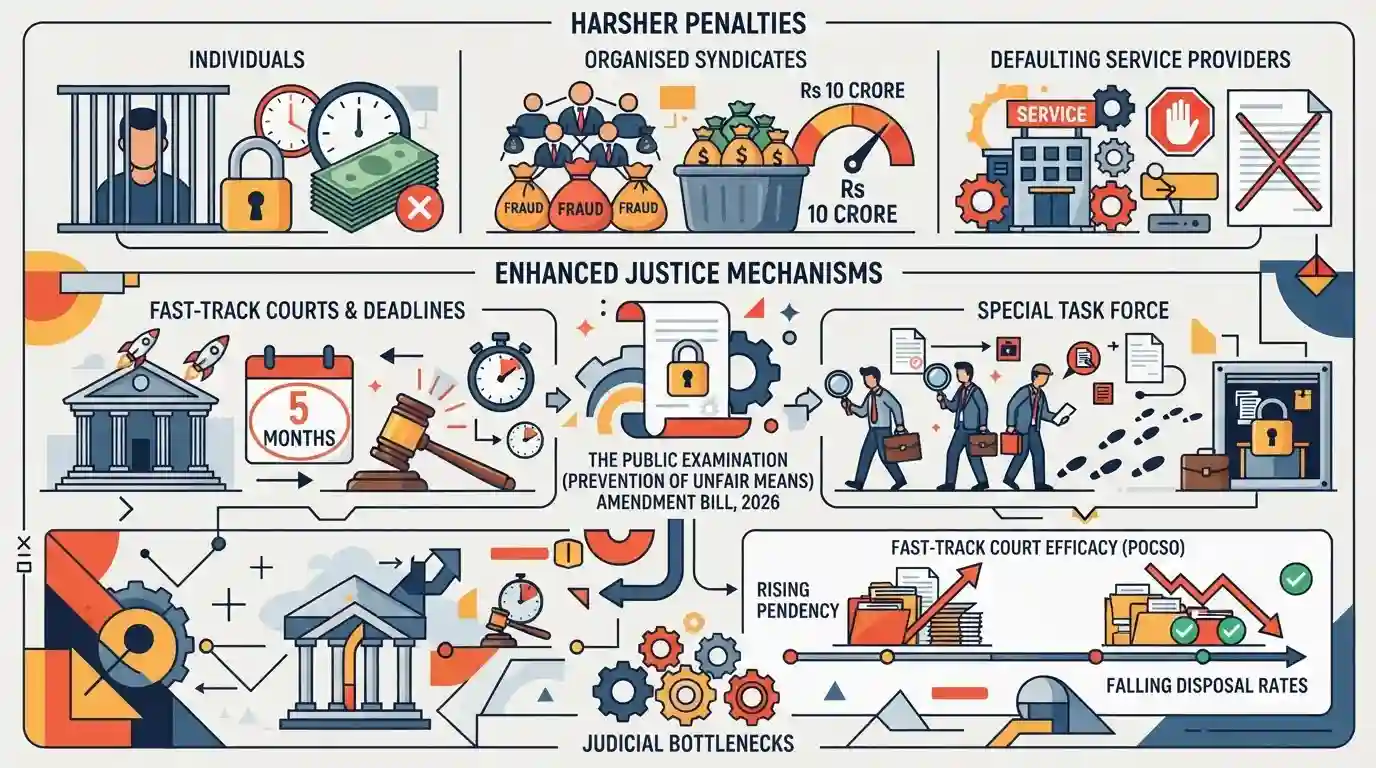
The Public Examination (Prevention of Unfair Means) Amendment Bill, 2026 seeks to amend the original 2024 legislation to impose significantly harsher penalties for paper leaks and examination fraud. The Bill increases maximum imprisonment terms for individuals, imposes up to Rs 10 crore fines for organised syndicates, and raises penalties and ban durations for defaulting service providers. It also introduces statutory backing for fast-track courts, setting a strict five-month deadline for investigation and trial, and creates a Special Task Force for specialized probes. However, concerns remain regarding the efficacy of fast-track courts, as existing ones (such as those under the POCSO Act) have seen rising pendency and falling disposal rates, indicating that systemic judicial bottlenecks must be addressed for the new courts to be effective.
ముఖ్య అంశాలు
- The 2026 Amendment Bill significantly strengthens penal provisions of the 2024 Act, raising maximum jail terms for individuals from 5 years to 10 years and fines from Rs 10 lakh to Rs 50 lakh.
- Penalties for organised crime syndicates have increased to a minimum of 7 years in prison and up to Rs 10 crore in fines.
- Service providers face fines up to Rs 5 crore and an 8-year ban, with their directors and senior management facing a minimum of 5 years in prison and Rs 5 crore fine.
- The Bill introduces statutory backing for fast-track courts with a strict five-month deadline for completing investigations and trials, and empowers the Centre to create a Special Task Force (STF) for such offences.
- Experts caution that creating new fast-track courts may not guarantee swift justice, pointing to the structural bottlenecks seen in POCSO fast-track courts, which face a rising pendency of 2.45 lakh cases as of 2025.
ప్రిలిమ్స్ ఉచ్చు
The Public Examination (Prevention of Unfair Means) Act automatically applies to all State Public Service Commission exams.
The Act strictly applies to central agencies like UPSC, SSC, RRB, IBPS, and NTA. It does not automatically apply to State Public Service Commissions (SPSCs) or state boards unless specifically notified.
అనుసంధానమైన స్థిర భావనలు
What is the constitutional and administrative framework of Fast-Track Courts (FTCs)?
- Origin: First recommended by the 11th Finance Commission in 2000 to dispose of long-pending cases.
- Jurisdiction: Established by State Governments in consultation with their respective High Courts under their administrative jurisdiction.
- Funding: Often supported by Central schemes, such as the Fast Track Special Courts (FTSCs) scheme under the National Mission for Safety of Women.
How are public examinations and education distributed under the Seventh Schedule?
- Union List: Entry 70 covers Union Public Services and the Union Public Service Commission.
- State List: Entry 41 covers State Public Services and State Public Service Commissions.
- Concurrent List: Entry 25 covers Education, including technical, vocational, and university education, giving concurrent jurisdiction to both Centre and States.
అంతర-అంశ నమూనాలు
Statutory Timelines vs Judicial Pendency
Mandating statutory trial timelines without resolving structural shortages in judges and judicial infrastructure risks replicating the high pendency rates seen in POCSO fast-track courts.
Private Vendors and State Capacity
Outsourcing public exams to private vendors tests the limits of state capacity, shifting regulatory focus toward corporate criminal liability and strict debarment frameworks.

GS2 Mains 2026 may analyze the efficacy of statutory fast-track timelines versus systemic judicial bottlenecks and infrastructure deficits.
అనుసంధాన PYQలు · 1
అనుసంధాన PYQలు · 1
- 2024MainsGS2
What are the aims and objects of recently passed and enforced, The Public Examination (Prevention of Unfair Means) Act, 2024? Whether University/State Education Board examinations, too, are covered under the Act ?
