Dehradun Master Plan Public Consultation Process Initiated
Source:timesofindia ↗
Why It Matters
Urban planning, sustainable development, and administrative authorities (like MDDA) are high-yield areas for UKPSC GS Paper-1. Questions on regional infrastructure, environmental challenges in hilly capitals, and historical municipal events (such as the 2006 Asian Mayors' Conference held in Dehradun) frequently appear in the prelims exam.
Summary
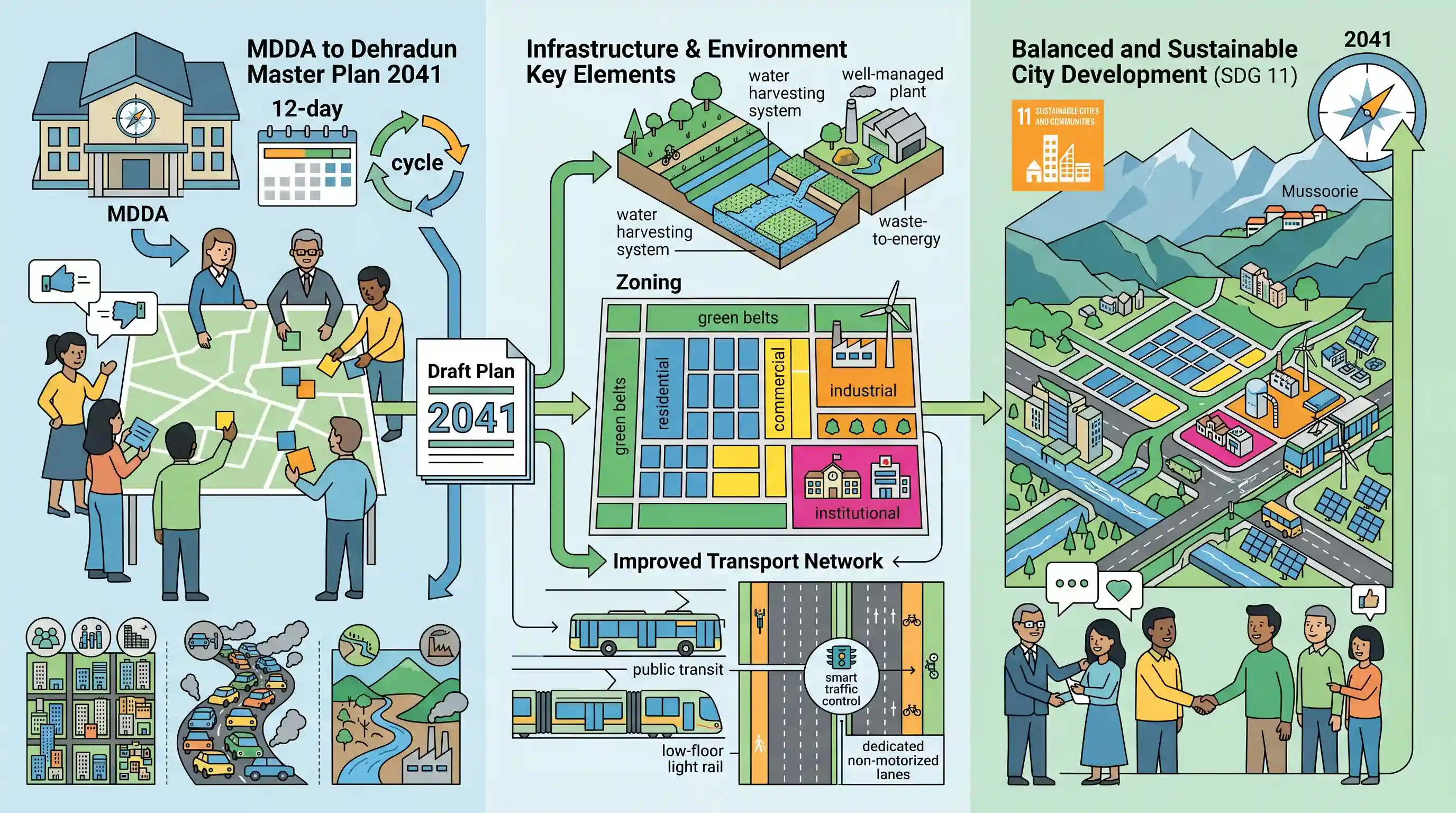
The Mussoorie Dehradun Development Authority (MDDA) has launched a 12-day public consultation to shape the 'Dehradun Master Plan 2041'. The master plan serves as a comprehensive blueprint for Dehradun's long-term urban growth, targeting challenges like rapid population expansion, unplanned construction, heavy traffic, and environmental issues. The draft proposes designated zones for residential, commercial, industrial, and institutional uses, along with green belts and improved transport networks, incorporating public feedback to ensure balanced and sustainable city development.
Key Points
- The Mussoorie Dehradun Development Authority (MDDA) has initiated a 12-day public consultation process to finalize the draft 'Dehradun Master Plan 2041'.
- The master plan serves as a long-term development blueprint, addressing challenges such as population growth, unplanned construction, traffic congestion, environmental issues, and infrastructural demands.
- The draft includes structural proposals for residential expansion, commercial and industrial zones, institutional zones, green belts, improved road networks, and public transport systems.
- Citizens' suggestions and objections from various sectors are being registered and subjected to technical and legal scrutiny before integration into the final plan.
Important Terms
Dehradun Master Plan 2041

A comprehensive GIS-based urban development blueprint designed by the Mussoorie Dehradun Development Authority to guide sustainable growth, environmental preservation, and infrastructure development in the Doon Valley until 2041.
UPSC context
GS Paper I (Urbanization issues) and GS Paper III (Disaster-resilient infrastructure, Environmental planning).
Mussoorie Dehradun Development Authority
A statutory body established in 1984 under the U.P. Urban Planning and Development Act 1973 to oversee and regulate planned urban growth and infrastructure in Dehradun, Mussoorie, and surrounding areas.
UPSC context
GS Paper II (Statutory, regulatory bodies) and GS Paper I (Local governance and urban management).
GIS-based Master Plan
An urban development layout developed using Geographic Information System mapping, integrating geospatial data for zoning, land-use planning, and infrastructure tracking to ensure scientific city development.
UPSC context
GS Paper I (Urban Planning) and GS Paper III (Use of technology in governance and AMRUT).
Urban Agglomeration
A continuous built-up urban spread comprising at least one statutory town and its adjoining outgrowths, having a minimum total population of 20,000 according to Census guidelines.
UPSC context
GS Paper I (Urbanization and census concepts) and GS Paper II (Urban governance).
Prelims Trap
Urban Development Authorities like the MDDA are constitutional bodies directly created under the 74th Amendment Act.
While 74th CAA constitutionalized urban local bodies, state-level parastatal Development Authorities (like MDDA) remain statutory bodies created under state laws, often overriding elected municipal councils.
Static Concepts Connected
What is the governance conflict between Municipalities and Parastatal Development Authorities?
- Constitutional vs Statutory: Municipal Corporations are constitutional entities mandated by the 74th Amendment, whereas Development Authorities are statutory bodies created by specific State Acts.
- Functional Overlap: Development Authorities handle lucrative land-use master plans, which often bypass or strip elected Municipal Councils of their constitutional planning functions.
- Democratic Deficit: Municipalities are democratically elected, while Development Authorities are parastatals governed by unelected state-appointed bureaucrats.
How does the AMRUT mission utilize GIS-based Master Planning?
- Scale Mandate: AMRUT mandates the formulation of GIS-based Master Plans on a highly detailed 1:4000 scale for comprehensive urban planning.
- Reform Linkage: Preparing these plans is a mandatory reform linked to state funding eligibility to incentivize structured urban land utilization.
Cross-Topic Patterns
Himalayan Urbanization & Disaster Risk
Rapid master-planned expansion in ecologically fragile zones like Dehradun/Mussoorie links directly to GS-3 disaster management, highlighting the clash between real estate pressure and seismic vulnerability.
Parastatals vs 74th Amendment
The dominance of statutory parastatals (like MDDA) over elected local bodies in drafting master plans showcases the incomplete devolution of planning functions mandated by the 74th Amendment.

UPSC may test the statutory limits of state-level urban development authorities versus constitutional municipal bodies under the 74th CAA.
Linked PYQs · 2
Linked PYQs · 2
- 2025UKPSC_PRELIMSGS1
Where was the first Asian Mayors' Conference held in Uttarakhand in 2006?
- 2024UKPSC_PRELIMSGS1
Headquarters of which of the following is located in Dehradun, the Capital of Uttarakhand ?
