Supreme Court Mandates Minimal Intrusion in Child Custody Evals
Source:The Hindu ↗
Why It Matters
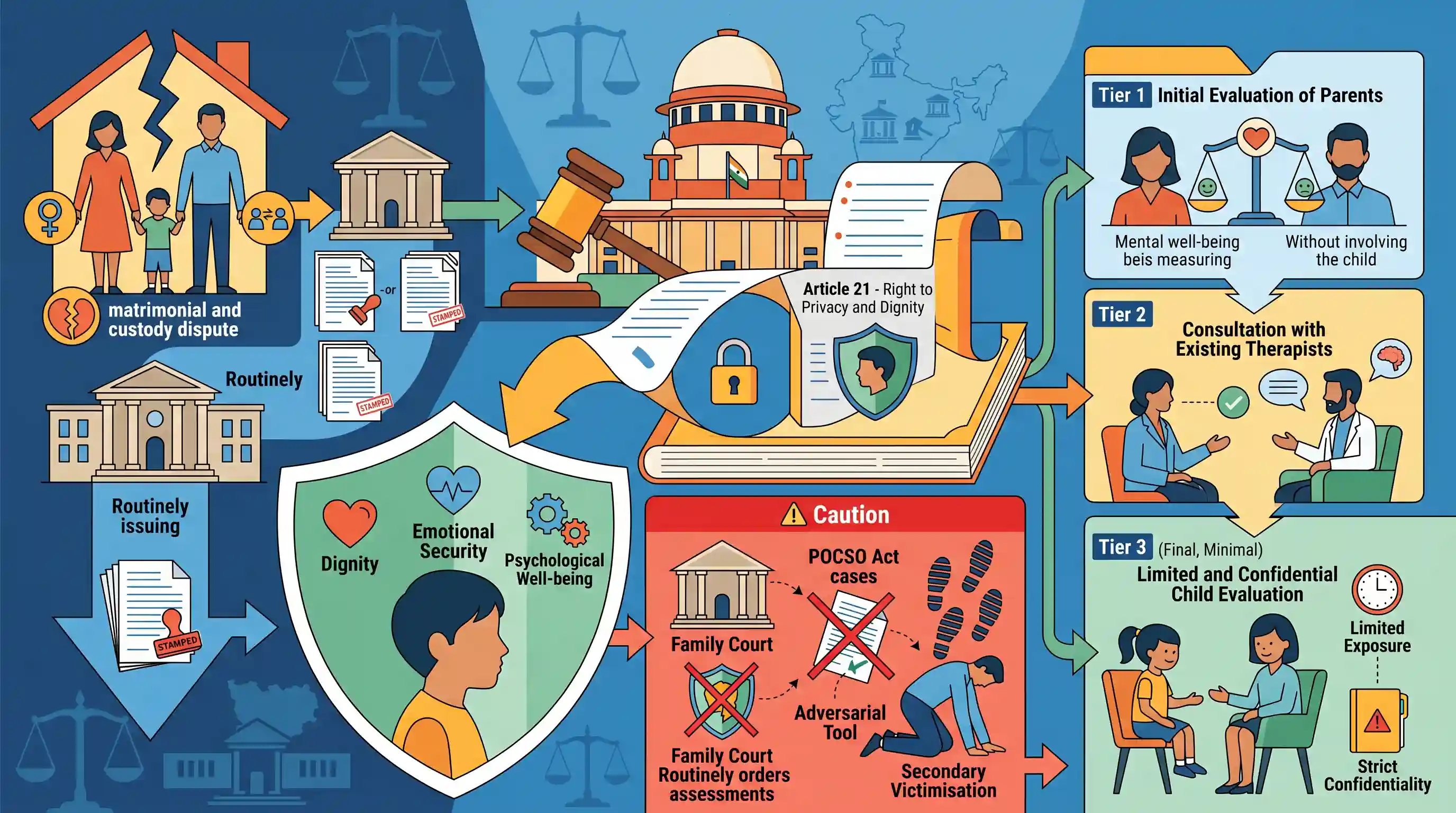
This ruling establishes crucial judicial guidelines and procedural safeguards prioritizing child welfare, dignity, and privacy in legal disputes. It limits the adversarial approach of Family Courts and reinforces the protections envisaged under the POCSO Act and Article 21 for minors.
Summary
The Supreme Court has mandated that psychological evaluations of children in custody and matrimonial disputes must involve minimal intrusion to safeguard their dignity, emotional security, and psychological well-being. The Court cautioned Family Courts against routinely ordering such assessments, especially in cases involving allegations under the POCSO Act, warning that the process should not result in secondary victimisation or be used as an adversarial tool. A careful, tiered procedure was advised, including initial evaluations of parents and consultation with existing therapists, to ensure that the child's exposure to the legal system is strictly limited and confidential.
Key Points
- The Supreme Court ruled that psychological evaluations of children in custody disputes must be conducted with minimal intrusion and exposure to protect their emotional and psychological well-being.
- Family Courts have been cautioned against routinely ordering such evaluations without establishing absolute necessity.
- In cases involving the POCSO Act, the child's welfare, dignity, and emotional security are of paramount consideration.
- The Court warned against using psychological evaluations as an adversarial tool and emphasized protecting children from secondary victimisation or emotional trauma.
- A step-by-step approach was suggested: first evaluating parents, consulting the child's current psychologist, and only involving an independent psychologist if strictly necessary, while ensuring confidentiality.
Important Terms
Protection of Children from Sexual Offences (POCSO) Act, 2012

A 2012 law providing a child-friendly judicial framework for sexual offence trials. It defines a child as anyone under 18 and mandates gender-neutral protection and special courts.
UPSC context
GS Paper 2: Social Justice; Statutory bodies and laws for the protection of vulnerable sections.
Family Courts
Specialized courts established under the Family Courts Act, 1984, to promote conciliation and speedy settlement of disputes relating to marriage and family affairs, including child custody.
UPSC context
GS Paper 2: Judiciary; Mechanisms for alternative dispute resolution and specialized judicial institutions.
Best Interests of the Child
A paramount legal principle (UNCRC/JJ Act) where a child's well-being and development are the primary considerations in judicial decisions, overriding parental rights or strict technicalities.
UPSC context
GS Paper 2: Social Justice; Rights of children and the role of the judiciary as a protector.
Secondary Victimisation
The trauma or emotional harm caused to a victim by the justice-delivery system's own processes, such as repeated questioning or intrusive evaluations, rather than the original offence.
UPSC context
GS Paper 2: Social Justice; Issues related to the efficiency and sensitivity of the criminal justice system.
Parens Patriae
A legal doctrine where the State (or Court) acts as the 'parent of the nation,' exercising protective jurisdiction over those unable to care for themselves, such as minors.
UPSC context
GS Paper 2: Judiciary; Inherent powers and the protective role of the Higher Judiciary in India.
Right to Dignity (Article 21)
A core component of the Right to Life under Article 21, ensuring that individuals, especially children, are not subjected to humiliating or psychologically invasive procedures during legal processes.
UPSC context
GS Paper 2: Fundamental Rights; Expansive judicial interpretations of the Right to Life and Liberty.
Prelims Trap
Family Courts are strictly barred from ordering psychological evaluations of children in custody disputes.
The SC did not ban evaluations; it merely mandated a "tiered procedure" and "absolute necessity" to avoid routine orders and secondary victimisation of children.
Static Concepts Connected
What are the key features of the Family Courts Act, 1984?
- Conciliation focus: Emphasizes conciliation and speedy, non-adversarial settlement of disputes relating to marriage, alimony, and child custody.
- Legal representation: Parties have no absolute right to be represented by a legal practitioner; courts can appoint legal/medical experts as amicus curiae.
- Evidentiary rules: Courts are not strictly bound by the rigid rules of the Indian Evidence Act, allowing flexibility in admitting evidence.
How does the Right to Privacy protect minors in the Indian legal system?
- Constitutional mandate: Protected as an intrinsic part of Article 21, guaranteeing dignity and emotional security against unwarranted judicial or state intrusion.
- Statutory protection: Specific laws like POCSO mandate in-camera trials, ban identity disclosure, and demand child-friendly environments to prevent trauma.
Cross-Topic Patterns
Justice System vs. Secondary Victimisation
Connects to the broader debate on victim-centric jurisprudence, seen in both POCSO and the new criminal laws (BNSS) aiming to protect vulnerable witnesses from further trauma during trials.
Article 21 Privacy & Family Law
Reflects the ongoing expansion of the Puttaswamy verdict (Right to Privacy) into personal laws, intersecting with debates on child welfare and custody within the Uniform Civil Code discourse.

Expect a Prelims statement linking 'minimum intrusion' in child custody to the Right to Privacy (Art 21) based on the Puttaswamy ruling.
Linked PYQs · 2
Linked PYQs · 2
- 2024MainsGS2
Right to privacy is intrinsic to life and personal liberty and is inherently protected under Article 21 of the constitution. Explain. In this reference discuss the law relating to D.N.A. testing of child in the womb to establish its paternity.
- 2025MainsGS2
The National Commission for Protection of Child Rights has to address the challenges faced by children in the digital era. Examine the existing policies and suggest measures the Commission can initiate to tackle the issue.
