ISRO PSLV C61 Launch Failure and Earth Observation Satellite
Source:The Hindu ↗
Why It Matters
UPSC consistently tests the technological features of ISRO's launch vehicles (like the solid and liquid stages of PSLV) and the specific applications of satellites (like the all-weather capability of SAR in Earth observation). The rare failure of ISRO's workhorse rocket provides a context for analyzing India's space capabilities and challenges.
Summary
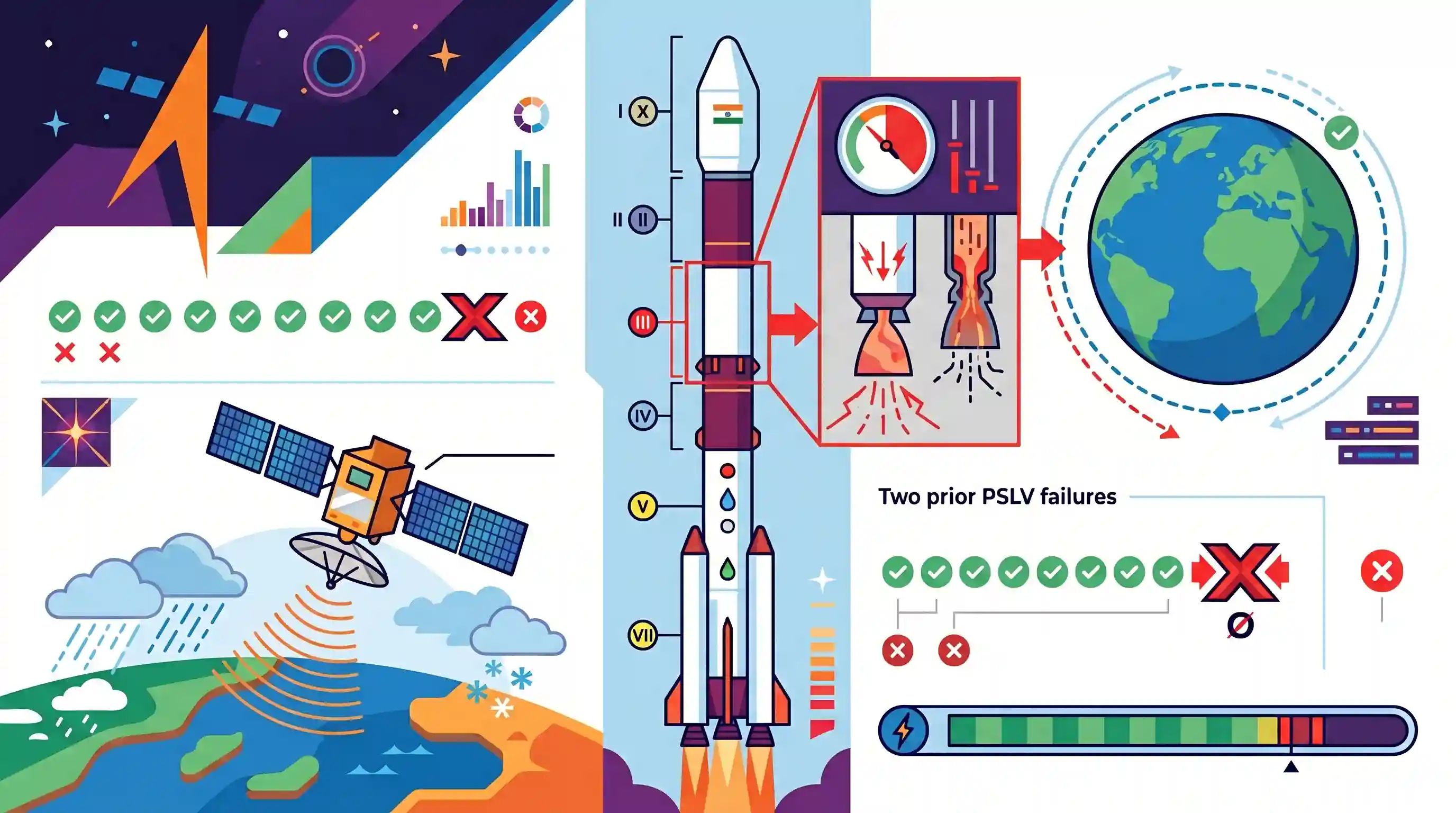
The Indian Space Research Organisation (ISRO) reported the failure of its 101st mission, the PSLV-C61, which was carrying the EOS-09 Earth Observation Satellite. The mission was unaccomplished due to a drop in chamber pressure in the third stage, a solid rocket motor, preventing the satellite from reaching its intended Sun Synchronous Polar Orbit. EOS-09 featured a Synthetic Aperture Radar (SAR) payload for all-weather remote sensing. Historically, the PSLV has been highly dependable, suffering only two previous failures since its inception in 1993. This incident marks a rare setback for India's space program, following a recent anomaly with the NVS-02 mission.
Key Points
- ISRO's PSLV-C61 mission, carrying the Earth Observation Satellite EOS-09, failed due to a technical anomaly in the launch vehicle's third stage.
- The PSLV is a four-stage vehicle; the third stage is a solid rocket motor that experienced an unexpected drop in chamber pressure.
- EOS-09 was equipped with a Synthetic Aperture Radar (SAR) payload, designed to provide all-weather, continuous remote sensing data for various operational applications.
- This is only the third failure in the history of the PSLV, which is widely considered ISRO's most reliable workhorse.
- The setback follows the recent failure of orbit-raising operations for the NVS-02 satellite.
Important Terms
Polar Satellite Launch Vehicle (PSLV)

A four-stage launch vehicle with alternating solid and liquid stages, often called ISRO's 'workhorse' for its reliability in placing satellites into Low Earth and Sun-Synchronous orbits.
UPSC context
GS Paper III (Science & Tech); tests knowledge of India's indigenous launch capabilities and history.
Earth Observation Satellite (EOS)
Satellites equipped with remote sensing technology to monitor Earth's physical, chemical, and biological systems. Used for agriculture, disaster management, and environmental monitoring.
UPSC context
GS Paper III (Science & Tech); relevant for applications of space technology in governance and resource management.
Sun-Synchronous Polar Orbit (SSPO)
A near-polar orbit where the satellite passes over any location at the same local mean solar time, ensuring consistent illumination for high-quality remote sensing imagery.
UPSC context
GS Paper III (Science & Tech); fundamental orbital concept for remote sensing and communication missions.
Synthetic Aperture Radar (SAR)
An active remote sensing technology that uses microwave pulses to generate high-resolution images, capable of penetrating clouds and darkness for all-weather, day-and-night observation.
UPSC context
GS Paper III (Science & Tech); tests understanding of advanced imaging technologies for disaster response and surveillance.
Satish Dhawan Space Centre (SDSC)
The primary spaceport of India located in Sriharikota, Andhra Pradesh, providing launch pads and infrastructure for missions like PSLV and GSLV.
UPSC context
GS Paper III (Science & Tech); essential institutional knowledge regarding India's space infrastructure.
Indian Space Research Organisation (ISRO)
India's premier space agency responsible for the design, development, and execution of the country's space program and planetary exploration.
UPSC context
GS Paper III (Science & Tech); foundational agency for all space-related current affairs.
Prelims Trap
SAR relies on reflected solar radiation to provide continuous day-and-night, all-weather Earth imaging.
SAR is an active sensor that emits its own microwave pulses. Passive optical sensors rely on solar radiation, which is why they cannot image at night.
Static Concepts Connected
What is the stage and propulsion configuration of the PSLV?
- Solid Stages: The first and third stages use solid propellants. The C61 mission failed due to a pressure drop in this third solid stage.
- Liquid Stages: The second and fourth stages use liquid propellants, with the second stage famously utilizing the indigenous liquid-fueled Vikas engine.
How does Synthetic Aperture Radar (SAR) enable continuous Earth observation?
- Active Sensor: SAR is an active sensor. It emits its own microwave pulses rather than relying on sunlight, enabling high-resolution night-time imaging.
- Cloud Penetration: Microwave wavelengths are longer than visible light, allowing them to penetrate clouds, smoke, and heavy rain, unlike passive optical sensors.
- Virtual Antenna: It uses the forward motion of the satellite to simulate a much larger physical antenna, drastically improving image resolution.
Cross-Topic Patterns
SAR for Border & Disaster Mgmt
SAR’s all-weather, day-night capability is crucial for tracking troop movements across cloudy borders and assessing flood inundation beneath monsoon cloud cover.
Space Privatisation & NSIL
As ISRO transitions PSLV manufacturing to the private sector via NSIL, isolated anomalies underscore the critical need for stringent quality control protocols and IN-SPACe oversight.

Multi-statement Qs combining PSLV stage propellants (solid vs liquid) and SAR's active remote sensing mechanisms are highly likely in 2026.
Linked PYQs · 3
Linked PYQs · 3
- 2018PrelimsGS1
With reference to India's satellite launch vehicles, consider the following statements: 1. PSLVs launch the satellites useful for Earth resources monitoring whereas GSLVs are designed mainly to launch communication satellites. 2. Satellites launched by PSLV appear to remain permanently fixed in the same position in the sky, as viewed from a particular location on Earth. 3. GSLV Mk III is a four-staged launch vehicle with the first and third stages using solid rocket motors; and the second and fourth stages using liquid rocket engines. Which of the statements given above is/are correct?
- 2019PrelimsGS1
For the measurement/estimation of which of the following are satellite images/remote sensing data used? 1. Chlorophyll content in the vegetation of a specific location 2. Greenhouse gas emissions from rice paddies of a specific location 3. Land surface temperatures of a specific location Select the correct answer using the code given below.
- 2023MainsGS3
What is the main task of India's third moon mission which could not be achieved in its earlier mission? List the countries that have achieved this task. Introduce the subsystems in the spacecraft launched and explain the role of the Virtual Launch Control Centre' at the Vikram Sarabhai Space Centre which contributed to the successful launch from Sriharikota.
