RBI Microfinance Regulations and Household Debt Challenges
Source:The Hindu ↗
Why It Matters
It addresses a core GS3 economic issue: balancing financial inclusion and credit access for the poor with consumer protection, systemic financial stability, and the prevention of debt distress caused by regulatory loopholes.
Summary
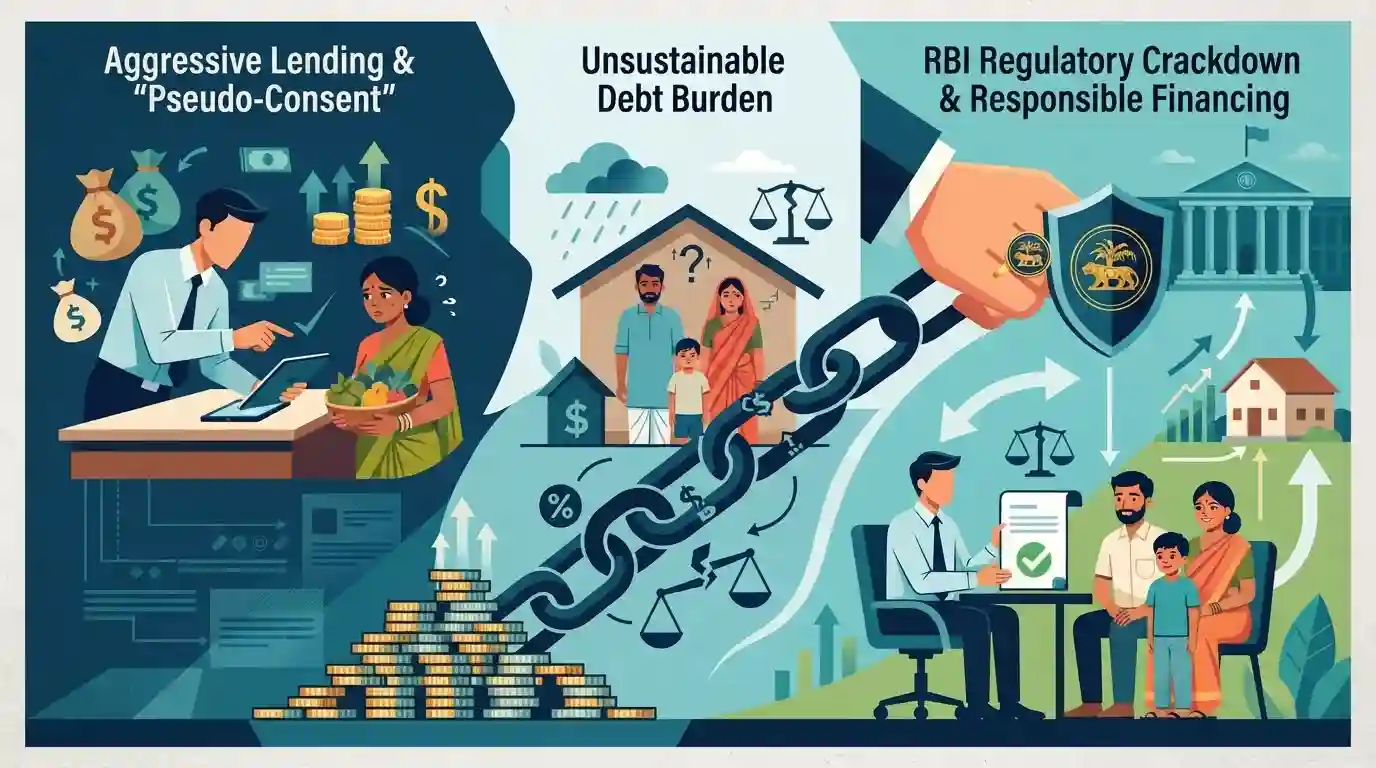
The article examines the Reserve Bank of India's recent regulatory crackdowns and interventions in the microfinance sector. It highlights how 'pseudo-consent' and aggressive lending practices lead to real, unsustainable debt burdens for low-income and vulnerable households, prompting the central bank to enforce stricter responsible financing rules and guard against over-leveraging.
Key Points
- The Reserve Bank of India (RBI) has flagged serious issues in the microfinance sector, specifically concerning pseudo-consent, over-leveraging of low-income borrowers, and systemic debt traps.
- Lenders have increasingly used digital and subtle coercion tactics, bypassing explicit financial literacy and proper underwriting, resulting in vulnerable borrowers accumulating unsustainable multi-lender debts.
- The RBI's new measures emphasize responsible lending norms, tightening guardrails for microfinance institutions (MFIs) and non-banking financial companies (NBFCs) to protect financially vulnerable sections.
- The situation underscores the tension between aggressive financial inclusion targets and consumer protection mandates within India's financial sector architecture.
Important Terms
Reserve Bank of India

India's central banking institution that controls monetary policy, regulates banks, issues currency, and ensures financial stability and consumer protection across the banking and microfinance sectors.
UPSC context
UPSC GS Paper III (Indian Economy, Banking Regulation, Monetary Policy). Tests understanding of central banking mandates, financial inclusion, and sector regulation.
Prelims Trap
Microfinance loans require physical collateral once the household annual income crosses ₹1.5 lakh.
Aspirants often confuse microfinance income thresholds with priority sector lending limits or assume collateral is required for MFI loans above a certain amount.
Static Concepts Connected
What are the key regulatory parameters governing microfinance institutions (MFIs) in India?
- Income Threshold:: Collateral-free credit extended to households having annual household income up to ₹3 lakh.
- FOIR Cap:: Total monthly loan repayment obligation of a household capped at 50% of monthly income to prevent debt traps.
- Lender Limit:: Borrowers can take loans from a maximum of three micro-lenders simultaneously to prevent over-leveraging.
Cross-Topic Patterns
Financial Inclusion vs. Consumer Protection Dilemma
The friction between aggressive financial inclusion targets and prudential consumer protection mirrors past debates on priority sector lending and digital lending app crackdowns.

RBI microfinance guardrails (FOIR, income limits) vs over-leveraging will likely be tested in a multi-statement Prelims question.
Linked PYQs · 2
Linked PYQs · 2
- 2022MainsGS3
Is inclusive growth possible under market economy ? State the significance of financial inclusion in achieving economic growth in India.
- 2026PrelimsGS1
Which one of the following correctly represents the three key sub-indices of the Financial Inclusion Index (FI-Index) of the Reserve Bank of India (RBI) ?
