Punjab integrates AI and robotics into school curriculum
Source:Indian Express ↗
Why It Matters
Highlights regional efforts in India to modernize the education system in line with 21st-century technological demands, addressing both the skill gap and the ethical implications of emerging technologies like AI.
Summary
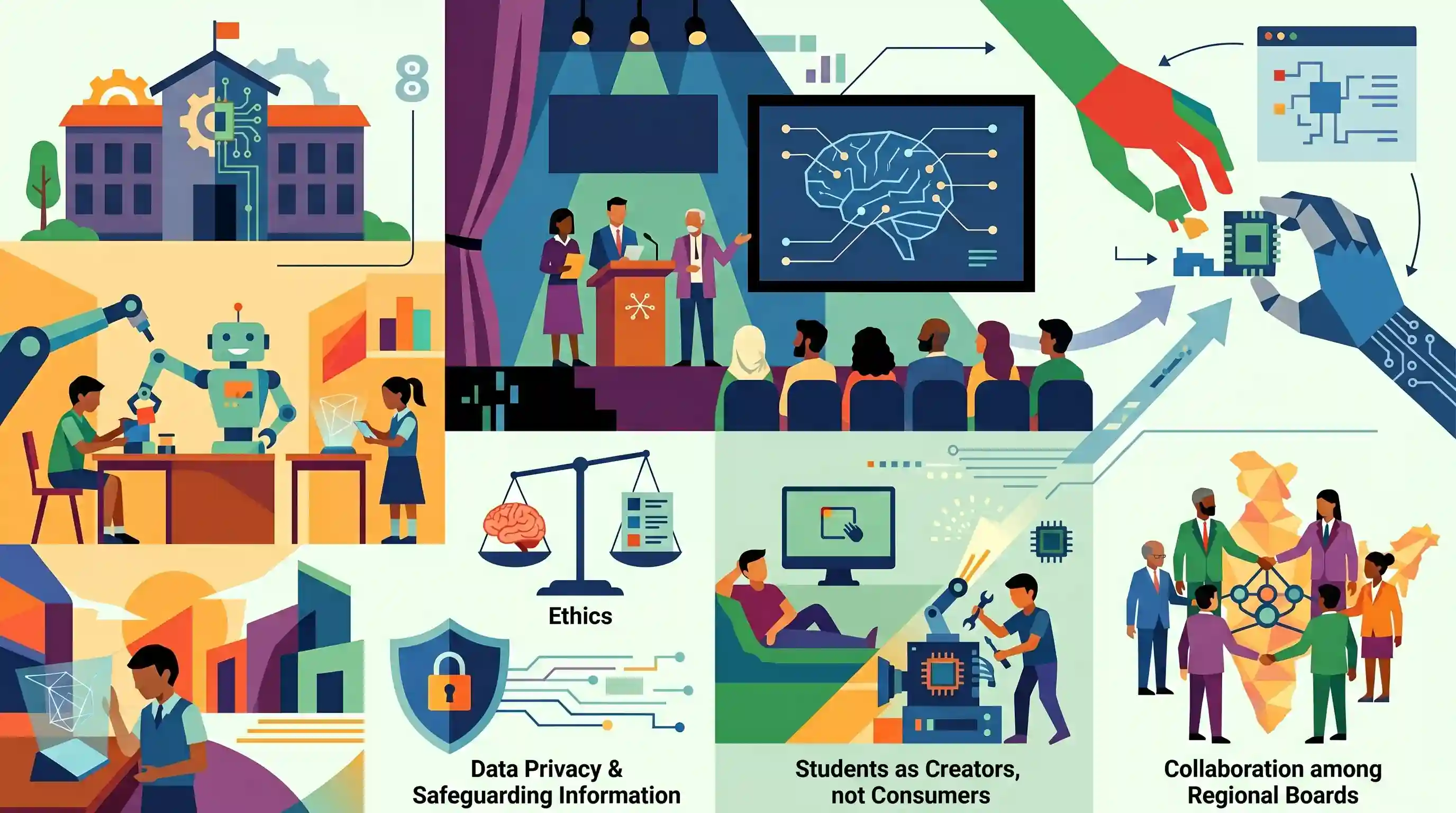
The Punjab School Education Board (PSEB) has announced the integration of Artificial Intelligence (AI) and robotics into its school curriculum starting from Class 8. This decision was highlighted during a two-day national AI conference featuring workshops by Google and Intel, aimed at promoting responsible AI adoption in education. PSEB emphasized the necessity of ethical AI use, data privacy, and safeguarding sensitive information, urging students to become creators rather than mere consumers of technology. The event also facilitated collaboration among multiple regional education boards to explore AI's role in enhancing learning outcomes, accessibility, and school management.
Key Points
- The Punjab School Education Board (PSEB) is introducing AI and robotics in the school curriculum from Class 8 for the current academic session.
- The announcement followed a two-day national AI conference organized by PSEB, featuring workshops by Google and Intel.
- The initiative focuses on responsible AI adoption, emphasizing data privacy, ethical use, and safeguarding sensitive information.
- PSEB aims to transform students from mere consumers of AI into creators and innovators.
- The conference facilitated knowledge sharing among multiple regional education boards regarding AI integration in academics and school management.
Important Terms
Punjab School Education Board (PSEB)

The state-level statutory body responsible for curriculum development, regulating school education, and conducting public examinations in Punjab.
UPSC context
GS Paper II (Education/Governance); relevant for studying state-level implementation of national educational reforms and regional policy shifts.
Central Board of Secondary Education (CBSE)
A national-level board of education in India controlled by the Union Government, setting benchmarks for skill-based subjects like AI and collaborating with regional boards.
UPSC context
GS Paper II (Issues Related to Education); tests knowledge of central educational authorities and their role in standardizing technology-led learning.
National Education Policy (NEP) 2020
A landmark policy aimed at transforming India’s education system by 2040, emphasizing vocational training, digital literacy, and the early integration of emerging technologies.
UPSC context
GS Paper II (Education Policy); a core topic for questions on governance, social justice, and human resource development.
Industry 4.0
The fourth industrial revolution characterized by the fusion of digital, physical, and biological technologies, prominently featuring artificial intelligence, robotics, and automation.
UPSC context
GS Paper III (Science & Technology/Economy); critical for understanding future workforce demands and the necessity of technological upskilling.
AI Ethics
A framework of moral principles ensuring AI development prioritizes data privacy, transparency, and safety while preventing algorithmic bias and misuse.
UPSC context
GS Paper III (S&T) and GS Paper IV (Ethics); relevant for discussions on the societal impact of technology and governance of innovation.
Industry-Academia Collaboration
The strategic partnership between educational institutions and tech giants to provide curriculum expertise, hands-on training, and industry-aligned skill certification.
UPSC context
GS Paper III (Skill Development/Economy); tests the role of Public-Private Partnerships (PPP) in enhancing employability and national innovation.
Prelims Trap
NEP 2020 mandates the integration of Artificial Intelligence and coding starting from the foundational stage (Classes 1-5).
NEP 2020 recommends introducing contemporary subjects like AI, coding, and computational thinking starting in the 'Middle Stage' (Classes 6-8), not the foundational stage.
Static Concepts Connected
What is the 5+3+3+4 pedagogical structure introduced by NEP 2020?
- Foundational (5 years): Ages 3-8, covering Anganwadi/preschool to Class 2. Focuses strictly on flexible, play-based, and activity-based learning.
- Preparatory (3 years): Ages 8-11, Classes 3-5. Introduces basic reading, writing, speaking, and discovery-based learning.
- Middle (3 years): Ages 11-14, Classes 6-8. Introduces abstract concepts, coding, AI, vocational training, and experiential learning.
- Secondary (4 years): Ages 14-18, Classes 9-12. Offers multidisciplinary study, critical thinking, and significant student choice of subjects.
What are the core pillars of Responsible and Ethical AI?
- Fairness and Mitigation: Algorithms must avoid perpetuating societal biases by ensuring diverse, representative training datasets.
- Explainability and Transparency: AI systems must be explainable, avoiding 'black box' models so users understand automated decisions.
- Data Privacy: Ensuring stringent data protection and informed consent, especially for minors, aligning with the DPDP Act 2023.
Cross-Topic Patterns
Big Tech in public education PPPs
State boards partnering with Google and Intel highlight a growing PPP model to bridge skill gaps, though it raises governance concerns over the corporatization of public education and data harvesting.
Demographic dividend via AI creators
Transitioning students from passive digital consumers to active AI innovators aligns with the Skill India Mission to cultivate a future-ready, deep-tech workforce capable of capturing the demographic dividend.

Expect a mixed question evaluating NEP 2020's mandate for Middle Stage coding alongside the ethical data privacy risks of Big Tech in schools.
Linked PYQs · 4
Linked PYQs · 4
- 2025MainsGS2
The National Commission for Protection of Child Rights has to address the challenges faced by children in the digital era. Examine the existing policies and suggest measures the Commission can initiate to tackle the issue.
- 2021MainsGS2
Has digital illiteracy, particularly in rural areas, coupled with lack of Information and Communication Technology (ICT) accessibility hindered socio-economic development? Examine with justification.
- 2023MainsGS3
Introduce the concept of Artificial Intelligence (AI). How does Al help clinical diagnosis? Do you perceive any threat to privacy of the individual in the use of Al in healthcare?
- 2024MainsGS4
The application of Artificial Intelligence as a dependable source of input for administrative rational decision-making is a debatable issue. Critically examine the statement from the ethical point of view.
