Public Sector Banks Minimum Balance Penalties and Financial Inclusion
Source:Indian Express ↗
Why It Matters
It exposes the structural friction between the commercial viability of Public Sector Banks and their developmental obligations. High penalties on minimum balances penalize the poor, emphasizing the critical role of state-backed zero-balance initiatives like PMJDY in ensuring genuine financial inclusion and inclusive growth.
Summary
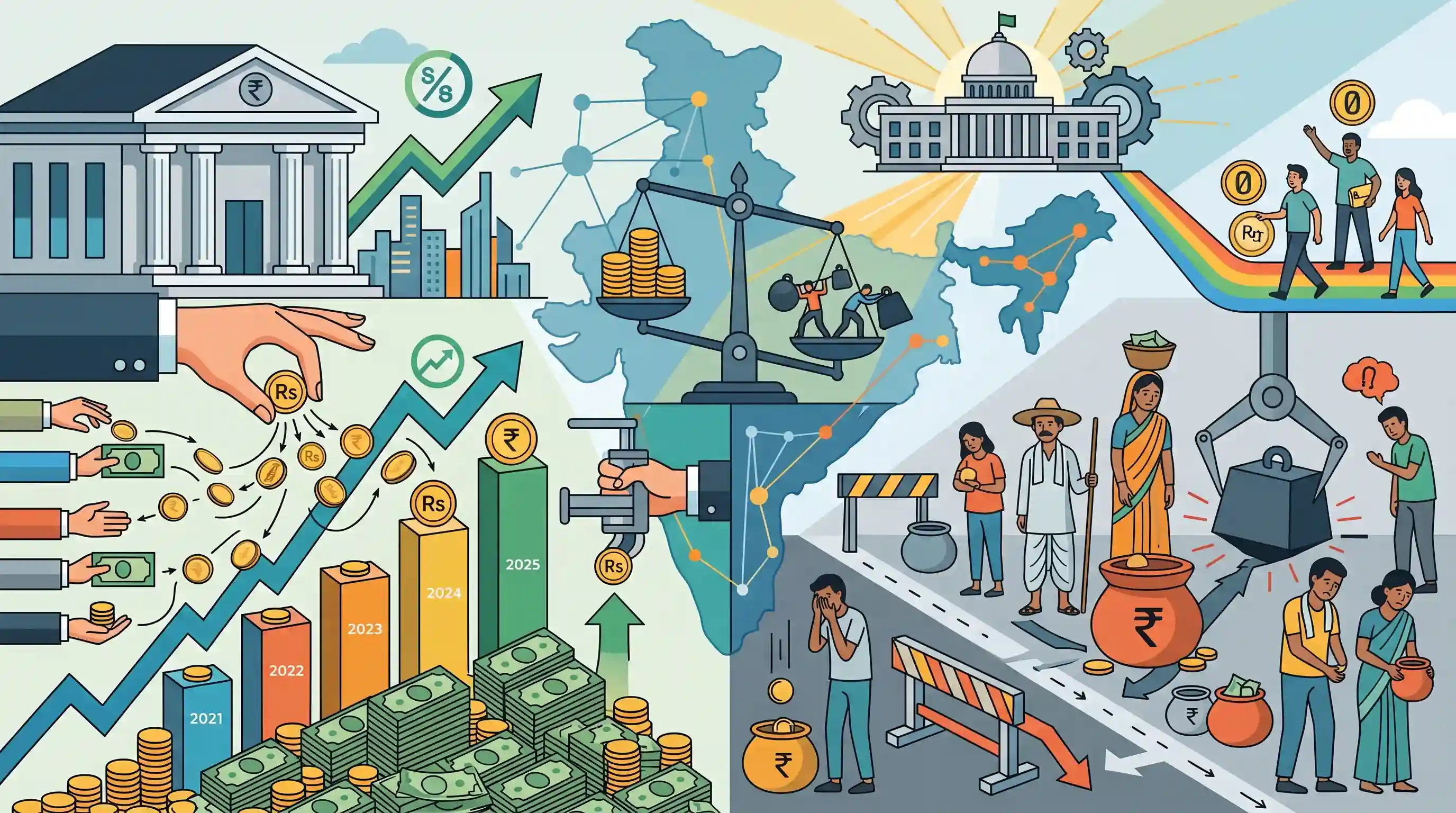
Public Sector Banks (PSBs) in India have collected approximately Rs 9,000 crore over the last five years in penalty charges for the non-maintenance of minimum balances in regular savings accounts. This significant revenue stream highlights the ongoing tension between the commercial profitability of PSBs and the national mandate for financial inclusion. Although schemes like the Pradhan Mantri Jan Dhan Yojana (PMJDY) mandate zero-balance Basic Savings Bank Deposit Accounts (BSBDA) for the unbanked, many low-income depositors with regular accounts still bear the brunt of these penalties, potentially disincentivizing formal banking among marginalized communities.
Key Points
- Public Sector Banks (PSBs) have collected nearly Rs 9,000 crore over a five-year period by levying penalties on customers for the non-maintenance of minimum balances in savings accounts.
- Such penalty mechanisms disproportionately impact low-income and vulnerable groups, creating a conflict with the broader macroeconomic goal of comprehensive financial inclusion.
- While the Pradhan Mantri Jan Dhan Yojana (PMJDY) offers Basic Savings Bank Deposit Accounts (BSBDA) with zero minimum balance requirements, regular savings account holders continue to face these charges.
- The substantial revenue generated from these penalties highlights the tension between the commercial profitability objectives of public banks and their social welfare mandates.
Important Terms
Pradhan Mantri Jan Dhan Yojana (PMJDY)

A national mission launched in 2014 to ensure universal banking access. It provides zero-balance accounts, RuPay debit cards, and insurance/overdraft facilities to unbanked sections of society.
UPSC context
GS Paper 3 (Economy); crucial for testing government schemes aimed at inclusive growth and poverty alleviation.
Basic Savings Bank Deposit Accounts (BSBDA)
Zero-balance savings accounts mandated by the RBI to provide basic banking services—like ATM facilities and four monthly withdrawals—free of cost to all individuals regardless of income.
UPSC context
GS Paper 3 (Banking); tests regulatory measures for deepening financial reach among marginalized populations.
Public Sector Banks (PSBs)
Commercial banks in which the Government of India holds more than 50% equity. They prioritize social welfare and financial inclusion alongside commercial operations.
UPSC context
GS Paper 3 (Economic Development); tests knowledge of Indian banking structure and its role in state policy.
Financial Inclusion
The process of ensuring affordable and timely access to essential financial products and services—like credit, savings, and insurance—for vulnerable and low-income groups.
UPSC context
GS Paper 3 (Inclusive Growth); a central theme in questions regarding economic inequality and developmental economics.
Reserve Bank of India (RBI)
India’s central bank and apex regulatory body for the banking system. It manages monetary policy and oversees financial stability while allowing banks autonomy over service charges.
UPSC context
GS Paper 3 (Economy); fundamental for questions on monetary policy, banking regulation, and institutional frameworks.
Prelims Trap
Banks can deduct minimum balance penalties even if it pushes the savings account into a negative balance.
RBI regulations explicitly prohibit banks from creating a negative balance in a savings account solely due to minimum balance penal charges.
Static Concepts Connected
What are the core features of a Basic Savings Bank Deposit Account (BSBDA)?
- Zero balance: No requirement for an initial deposit or maintenance of a minimum balance.
- Withdrawal limits: Account holders are restricted to a maximum of four withdrawals per month, though deposits are unlimited.
- Exclusive holding: A customer cannot simultaneously hold a BSBDA and a regular savings account in the same bank.
What are the RBI guidelines on minimum balance penalties?
- No negative balance: Penal charges for non-maintenance of a minimum balance cannot push the account balance below zero.
- Proportionality: Charges must be directly proportional to the extent of the shortfall, not a flat punitive fee.
- Service downgrade: Instead of penalizing, RBI advises banks to restrict the account's services to BSBDA-level until the balance is restored.
Cross-Topic Patterns
Social Banking vs. Profitability
The Rs 9,000 crore penalty revives the GS3 debate on PSBs bearing the dual burden of commercial profitability targets and state-driven financial inclusion mandates like the JAM trinity.
DBT Leakage via Penalties
When regular accounts of low-income citizens are drained by minimum-balance penalties, it indirectly erodes the net value of Direct Benefit Transfers (DBT), undermining India's welfare delivery infrastructure.

Expect a 2026 Prelims statement testing if minimum balance penalties can cause negative balances or if PMJDY mandates BSBDA conversion.
Linked PYQs · 3
Linked PYQs · 3
- 2022MainsGS3
Is inclusive growth possible under market economy ? State the significance of financial inclusion in achieving economic growth in India.
- 2024PrelimsGS1
With reference to the Pradhan Mantri Jan Dhan Yojana (PMJDY), which of the following statements is/are correct? 1. The scheme aims to open bank accounts for unbanked households. 2. There is a minimum balance requirement for accounts opened under this scheme. 3. Beneficiaries get a Rupay Debit Card with an inbuilt accident insurance cover. Select the correct answer using the code given below.
- 2015PrelimsGS1
'Pradhan Mantri Jan-Dhan Yojana' has been launched for
