Open Access to Artificial Intelligence Infrastructure Policy in India
Source:The Hindu ↗
Why It Matters
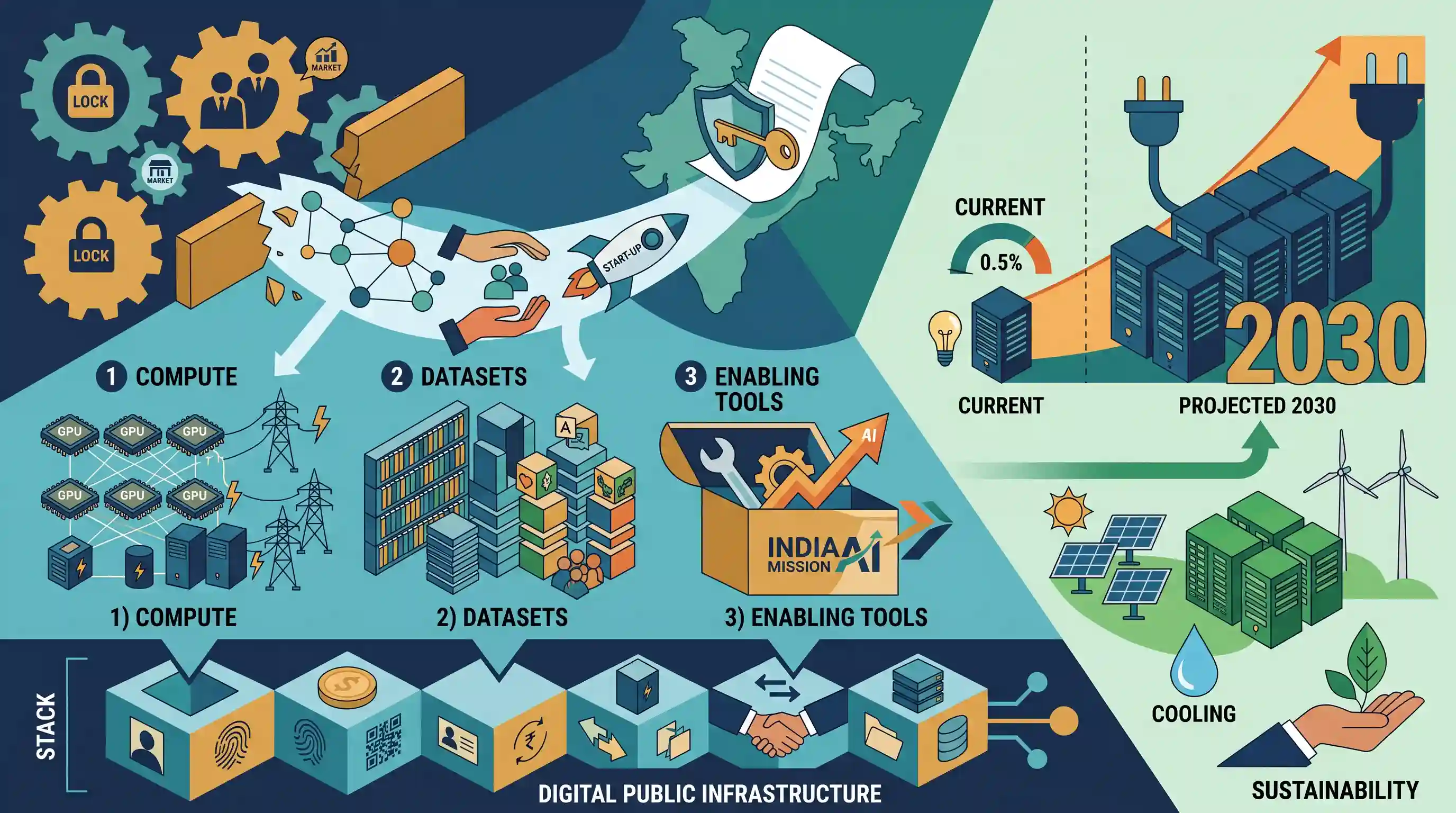
Democratization of AI infrastructure ensures inclusive digital growth and reduces monopolistic tendencies by tech giants. Understanding the substantial energy footprint of data centers is critical for balancing sustainable technological advancement with India's climate goals.
Summary
The Office of the Principal Scientific Adviser (PSA) released a white paper emphasizing the need for open access to Artificial Intelligence (AI) infrastructure in India. To prevent market concentration, it calls for democratizing compute capacity, high-quality datasets, and enabling tools through initiatives like the IndiaAI Mission. The document underscores the importance of integrating Digital Public Infrastructure (DPI) into AI models and addresses the critical environmental sustainability of expanding AI data centers, which currently consume 0.5% of India's electricity but are projected to demand significantly more by 2030.
Key Points
- The PSA's white paper advocates for open access to AI infrastructure to prevent monopolization by large tech firms and urban centers.
- Democratization of AI is being driven by the IndiaAI Mission, which aims to provide subsidized computing power and GPUs to local researchers and startups.
- The paper suggests integrating Digital Public Infrastructure (DPI) like Aadhaar and UPI to build secure, scalable, and inclusive AI models.
- Sustainability is a major concern, as AI data centers currently consume 0.5% of India's electricity—a figure expected to rise to 3% by 2030, necessitating energy-efficient operations.
- It recommends an ecosystem-wide effort to deploy AI solutions across critical sectors such as agriculture, healthcare, and education to bridge the digital divide.
Important Terms
IndiaAI Mission

A ₹10,372 crore national initiative to build India's AI ecosystem through high-performance computing (10,000+ GPUs), indigenous model development, and dataset platforms.
UPSC context
GS Paper 3: Science & Technology. Tests knowledge of national missions and indigenization of critical technology.
Digital Public Infrastructure (DPI)
Open, interoperable digital blocks (like Aadhaar, UPI) that provide foundational services at population scale to enable innovation and inclusive governance.
UPSC context
GS Paper 2 & 3: Governance/Economy. Key for topics on digital transformation and global tech leadership.
Office of the Principal Scientific Adviser (PSA)
The top scientific advisory body to the Prime Minister and Cabinet, established in 1999 to evolve strategic S&T policies and cross-sectoral synergy.
UPSC context
GS Paper 2: Statutory/Executive Bodies. Important for understanding the institutional framework of India's scientific governance.
AI Compute Capacity
The combined hardware (GPUs), software, and data center resources necessary for processing large-scale AI workloads and training foundational models.
UPSC context
GS Paper 3: Infrastructure/S&T. Relevant for discussing the physical and energy requirements of the digital economy.
AI Impact Summit
A 2026 global summit in New Delhi that resulted in a declaration by 92 countries for responsible, inclusive, and democratized AI governance.
UPSC context
GS Paper 2: International Relations. Relevant for India's role as a leader of the Global South in tech policy.
Prelims Trap
The Office of the Principal Scientific Adviser (PSA) is a statutory body functioning under the Ministry of Science and Technology.
The Office of the PSA is an advisory body established by a Cabinet resolution in 1999. It is non-statutory and functions under the Cabinet Secretariat.
Static Concepts Connected
What are the three foundational layers of India's Digital Public Infrastructure (India Stack)?
- Identity Layer: Provides a unique, verifiable digital identity to citizens (e.g., Aadhaar, eKYC, eSign), forming the base of all subsequent DPI applications.
- Payments Layer: Enables interoperable, fast, and cashless financial transactions across different banks and wallets (e.g., UPI, Aadhaar Enabled Payment System).
- Data Empowerment: Allows secure, consent-based user data sharing through frameworks like the Data Empowerment and Protection Architecture (DEPA) and Account Aggregators.
What is the mandate and administrative status of the Office of the PSA?
- Origin & Status: Established in 1999 via a Cabinet resolution; it is an extra-constitutional, non-statutory advisory body functioning under the Cabinet Secretariat.
- Core Mandate: Provides pragmatic, objective advice to the Prime Minister and Cabinet on science, technology, and innovation policies and interventions.
- PM-STIAC: The PSA chairs the Prime Minister's Science, Technology, and Innovation Advisory Council (PM-STIAC) to drive national science missions.
Cross-Topic Patterns
AI's heavy carbon footprint
Data centers require uninterrupted baseload power, currently dominated by coal. Rapid AI expansion strains the grid and directly challenges India's low-carbon transition and COP26 Panchamrit targets.
Evolution of India Stack
Integrating AI with existing DPI transforms platforms from mere transactional tools into predictive, vernacular-enabled e-governance systems for agriculture, welfare delivery, and rural healthcare.

Expect a 2026 Prelims question blending IndiaAI Mission's GPU targets with the exact ecological footprint (energy/water) of AI data centers.
Linked PYQs · 5
Linked PYQs · 5
- 2023MainsGS3
What is the status of digitalization in the Indian economy? Examine the problems faced in this regard and suggest improvements.
- 2018MainsGS3
“Access to affordable, reliable, sustainable and modern energy is the sine qua non to achieve Sustainable Development Goals (SDGs).” Comment on the progress made in India in this regard.
- 2025MainsGS2
e-governance projects have a built-in bias towards technology and back-end integration than user-centric designs. Examine.
- 2020PrelimsGS1
With the present state of development, Artificial Intelligence can effectively do which of the following? 1. Bring down electricity consumption in industrial units 2. Create meaningful short stories and songs 3. Disease diagnosis 4. Text-to-Speech Conversion 5. Wireless transmission of electrical energy Select the correct answer using the code given below:
- 2018PrelimsGS1
Which of the following is/are the aim/aims of "Digital India" Plan of the Government of India? 1. Formation of India's own Internet companies like China did. 2. Establish a policy framework to encourage overseas multinational corporations that collect Big Data to build their large data centres within our national geographical boundaries. 3. Connect many of our villages to the Internet and bring Wi-Fi to many of our schools, public places and major tourist centres. Select the correct answer using the code given below:
