Reserve Bank of India repo rate cut and monetary policy neutral stance
Source:The Hindu ↗
Why It Matters
The RBI's interest rate adjustments illustrate the practical application of monetary policy in managing the trade-off between growth and inflation, a core GS3 topic. Furthermore, the discussion on the impact of US tariffs highlights the vulnerabilities of India's export and MSME sectors to global protectionist trends, which is critical for answering questions on international trade, external sector dynamics, and economic resilience.
Summary
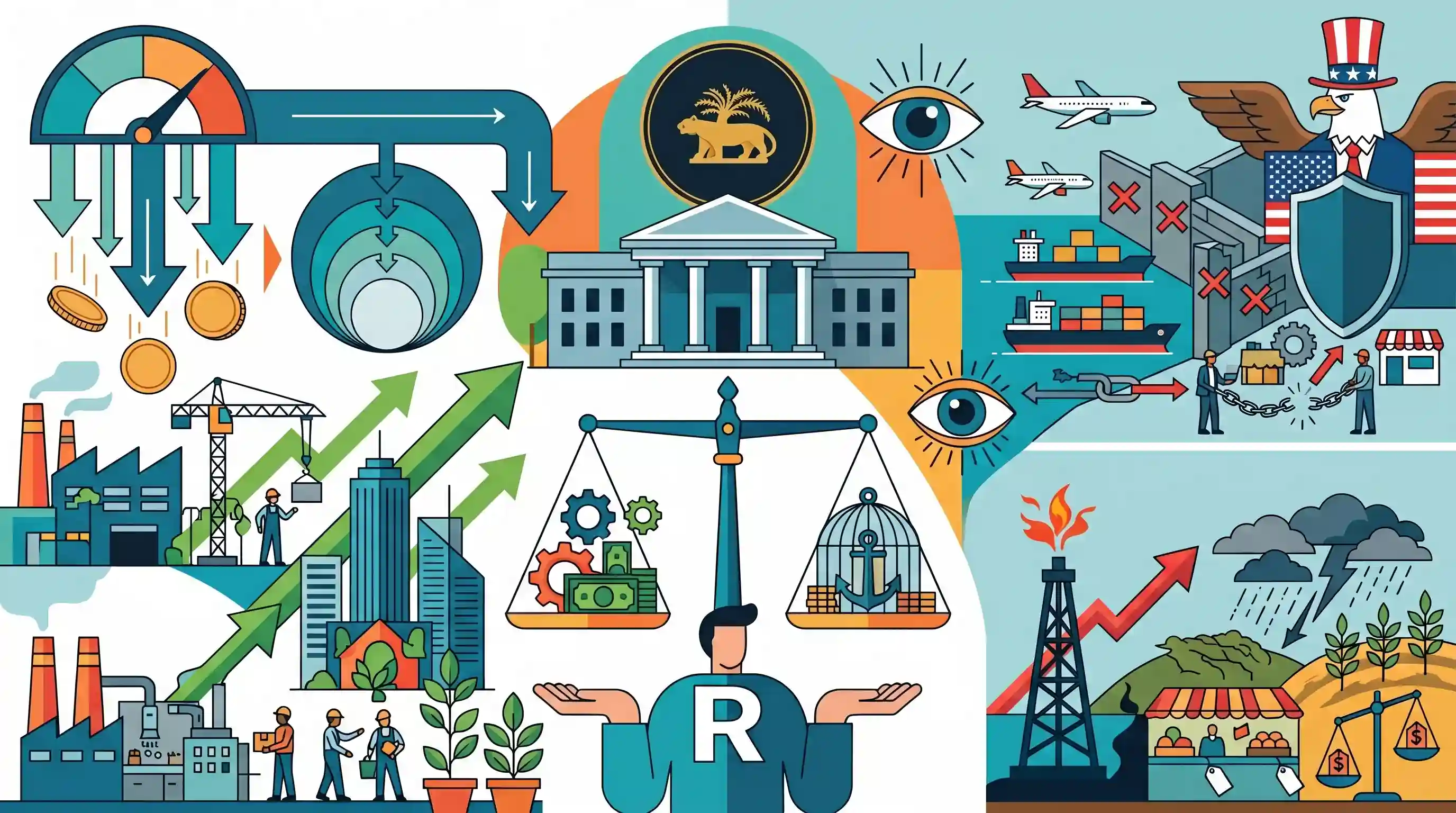
The editorial examines the Reserve Bank of India's (RBI) strategic decision to cut interest rates by 25 basis points, bringing the benchmark rate down to 5.25%. With cumulative cuts totaling 125 basis points in 2025, the central bank aims to catalyze economic growth, particularly as private investments lag due to excess capacity across industrial sectors. The RBI maintains a 'neutral' policy stance, balancing the need to stimulate the economy with the mandate to anchor inflation. While headline inflation has cooled, the article underscores substantial ongoing risks. Externally, the threat of 50% tariffs by the United States on Indian goods could severely disrupt MSMEs and force a recalibration of global supply chains. Domestically, volatile crude oil prices and unpredictable food inflation demand continuous vigilance, ensuring the RBI remains cautious against premature celebrations of price stability.
Key Points
- The RBI cut the repo rate by 25 basis points to 5.25%, resulting in a cumulative reduction of 125 basis points in 2025 to stimulate economic growth.
- The monetary policy stance remains 'neutral' to balance growth support with inflation management, as the RBI targets a 2% inflation rate for early 2026.
- Despite a robust GDP growth acceleration to 8.2%, private capital expenditure remains sluggish due to persistent excess industrial capacity.
- External shocks, such as the imposition of 50% tariffs on Indian exports by the US, pose severe risks to MSMEs and necessitate supply chain adjustments.
- Domestic risks to macroeconomic stability persist due to unpredictable food inflation and volatile global crude oil prices, requiring vigilant monetary oversight.
Important Terms
Monetary Policy Committee (MPC)

A statutory six-member committee (3 RBI, 3 Government appointees) chaired by the RBI Governor. It determines the policy repo rate required to achieve the inflation target while supporting economic growth.
UPSC context
GS Paper 3: Indian Economy. Tests knowledge of institutional frameworks for price stability and decision-making processes.
Repo Rate
The benchmark interest rate at which the RBI lends money to commercial banks against the collateral of government securities. It is the primary tool used to control liquidity and inflation.
UPSC context
GS Paper 3: Economy. Essential for understanding monetary policy transmission and central bank liquidity management tools.
Inflation Targeting
A monetary policy framework where the central bank aims to keep inflation within a specific range. In India, the target is 4% with a tolerance band of +/- 2% (2% to 6%).
UPSC context
GS Paper 3: Economic Development. Tests understanding of macroeconomic stability goals and the legal mandate of the RBI.
Neutral Stance
A policy stance where the central bank remains flexible, with no predetermined bias toward either increasing or decreasing interest rates. Decisions are guided purely by evolving macroeconomic data.
UPSC context
GS Paper 3: Monetary Policy. Important for analyzing the RBI’s strategic response to shifting economic conditions.
Headline Inflation
The total inflation in an economy, measured by the Consumer Price Index (CPI). Unlike core inflation, it includes volatile components like food and fuel prices.
UPSC context
GS Paper 3: Indian Economy. Key for distinguishing between supply-side shocks and underlying demand-driven price pressures.
MSME Sector
Enterprises categorized by investment and turnover limits. They are critical for employment and exports, but vulnerable to global supply chain disruptions and trade protectionism.
UPSC context
GS Paper 3: Industry and Employment. Tests knowledge of the ‘backbone’ of the Indian economy and external trade risks.
Prelims Trap
The RBI is specifically targeting an inflation rate of 2% for early 2026.
Under the amended RBI Act, the statutory flexible inflation target is exactly 4% (with a ±2% tolerance band). 2% is the lower limit, not the central target.
Static Concepts Connected
What does a 'Neutral' monetary policy stance signify?
- Data Dependence: The MPC has the flexibility to either increase, decrease, or maintain rates based on macroeconomic data, rather than committing to a specific direction.
- Balanced Priority: Indicates that managing inflation and supporting growth are given balanced priority, unlike an 'accommodative' stance where growth stimulation is the primary focus.
How does 'excess industrial capacity' limit the impact of interest rate cuts?
- Capacity Utilization: The ratio of actual output to potential output. Low utilization means existing factories are underused and idle.
- Investment Stagnation: Firms delay fresh capital expenditure (CapEx) until existing infrastructure is fully utilized, rendering cheaper borrowing costs (rate cuts) less effective at spurring new investments.
Cross-Topic Patterns
Tariffs + MSME Export Vulnerability
Rising US protectionism disproportionately impacts Indian MSMEs, connecting global trade friction directly to India's domestic employment and export promotion strategies.
Food Shocks vs Headline Inflation
Structural bottlenecks in agriculture make food inflation volatile, forcing RBI to maintain tighter monetary control even when core inflation and industrial demand soften.

Expect a 2026 Prelims question testing the difference between RBI's neutral stance and accommodative stance amidst global tariff threats.
Linked PYQs · 5
Linked PYQs · 5
- 2022PrelimsGS1
In India, which one of the following is responsible for maintaining price stability by controlling inflation?
- 2017PrelimsGS1
Which of the following statements is/are correct regarding the Monetary Policy Committee (MPC)? 1. It decides the RBI's benchmark interest rates. 2. It is a 12-member body including the Governor of RBI and is reconstituted every year. 3. It functions under the chairmanship of the Union Finance Minister. Select the correct answer using the code given below:
- 2024MainsGS3
What are the causes of persistent high food inflation in India? Comment on the effectiveness of the monetary policy of the RBI to control this type of inflation.
- 2025MainsGS3
What are the challenges before the Indian economy when the world is moving away from free trade and multilateralism to protectionism and bilateralism? How can these challenges be met?
- 2023MainsGS3
Faster economic growth requires increased share of the manufacturing sector in GDP, particularly of MSMEs. Comment on the present policies of the Government in this regard.
