Andhra Pradesh Revitalizes Development Programme for Sustainable Goals
Source:The Hindu ↗
Why It Matters
Provides concrete, state-level examples of how Centrally Sponsored Schemes (MGNREGS, PDS, PM JANMAN) are adapted and reformed to fix leakages, improve targeting, and achieve convergence for holistic socio-economic development.
Summary
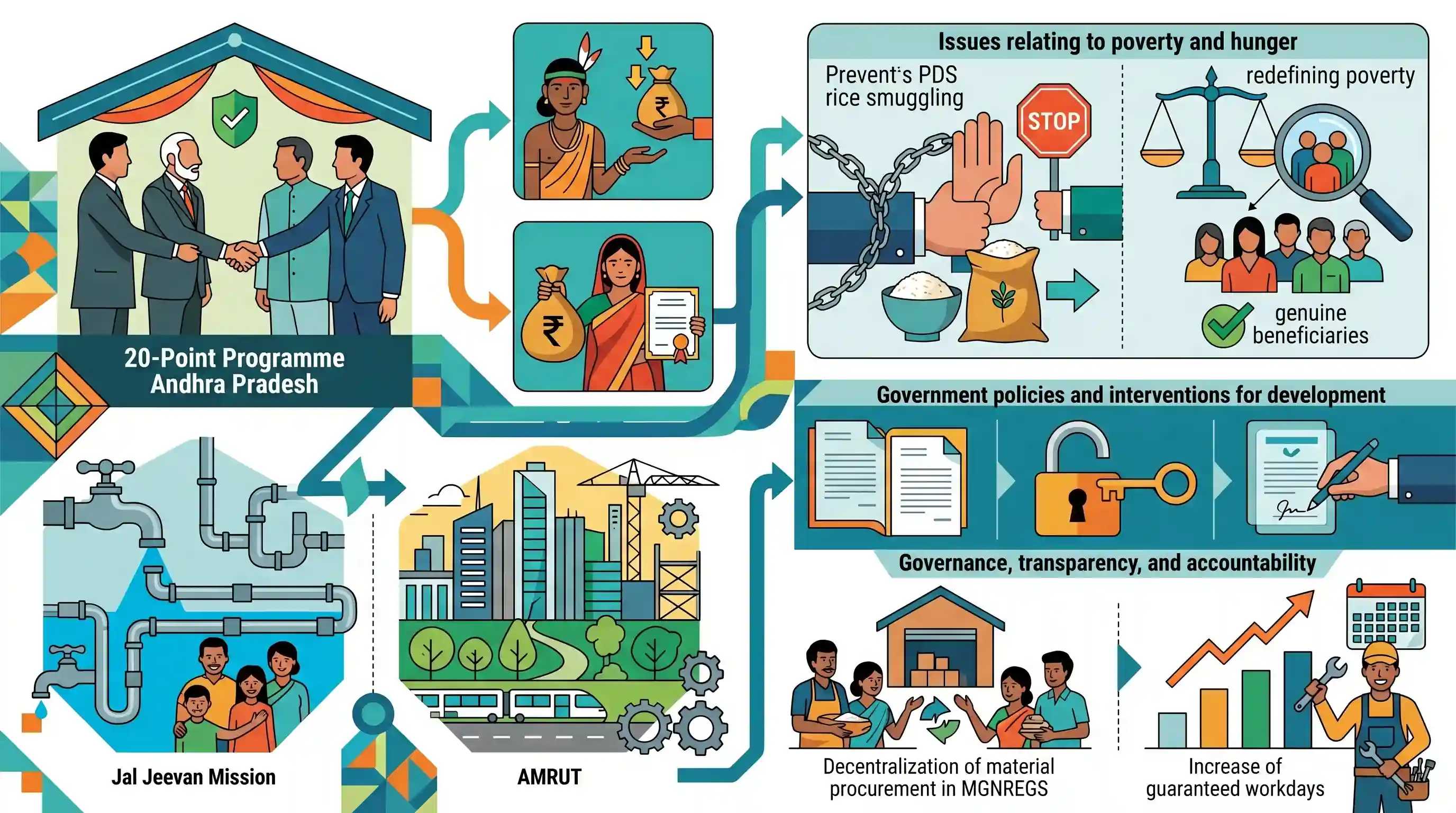
The Andhra Pradesh government is revitalizing its 20-Point Programme to align with national objectives like Viksit Bharat and NITI Aayog's SDGs. Chaired by Lanka Dinakar, the program focuses on providing safe drinking water via Jal Jeevan Mission, improving urban infrastructure under AMRUT, and empowering vulnerable sections through PM JANMAN and the 'Lakhpati Didi' initiative. Key administrative reforms include tackling PDS rice smuggling, redefining poverty to target genuine beneficiaries, ending centralized material procurement in MGNREGS to curb corruption, and increasing guaranteed rural workdays from 100 to 150.
Key Points
- The Andhra Pradesh 20-Point Programme is being aligned with NITI Aayog's Sustainable Development Goals (SDGs) and Swarnandhra Vision @ 2047.
- PDS reforms are being undertaken to redefine poverty criteria for accurate beneficiary targeting and to combat the smuggling of ration rice.
- Under MGNREGS, maximum workdays will be increased from 100 to 150, and centralized procurement of materials will be ended to curb corruption.
- Convergence of central schemes like PM JANMAN and 'Lakhpati Didi' is prioritized to uplift tribal populations and economically empower women.
Important Terms
20-Point Programme

Originally launched in 1975 and restructured in 2006, this umbrella framework monitors schemes related to poverty alleviation, employment, housing, and education to improve rural quality of life.
UPSC context
GS II: Governance/Welfare. Tests knowledge of poverty alleviation frameworks and administrative accountability in implementing multi-sectoral development goals.
Jal Jeevan Mission
A flagship initiative targeting 'Har Ghar Jal', aiming to provide 55 litres of potable tap water per capita daily to every rural household by 2028.
UPSC context
GS II: Welfare Schemes. Key for infrastructure, public health, and achieving SDG 6 (Clean Water and Sanitation).
MGNREGS
A demand-driven legal guarantee for rural wage employment, recently undergoing reforms (VB-GRAM G 2025) to increase workdays and enhance the quality of durable asset creation.
UPSC context
GS III: Inclusive Growth. Tests understanding of social safety nets, rural livelihoods, and structural shifts in rights-based legislation.
PM JANMAN
Launched in 2023, this mission provides 11 critical interventions (housing, water, etc.) to 75 Particularly Vulnerable Tribal Groups (PVTGs) across 18 states and one UT.
UPSC context
GS II: Vulnerable Sections. Focuses on social justice and targeted interventions for the most marginalized tribal communities.
Lakhpati Didi
A DAY-NRLM initiative aiming to empower 3 crore Self-Help Group (SHG) women to achieve a sustainable annual household income of at least ₹1 lakh.
UPSC context
GS III: Inclusive Growth. Tests strategies for women-led development and rural economic transformation through micro-enterprises.
Swarnandhra Vision @ 2047
A strategic roadmap for Andhra Pradesh to reach a $2.4 trillion economy by 2047, focusing on ten principles including zero poverty and deep-tech.
UPSC context
GS II: Governance. Tests regional planning, competitive federalism, and the localization of national development objectives.
Viksit Bharat
The national vision to transform India into a developed $30 trillion economy by 2047, built on pillars of youth, women, farmers, and the poor.
UPSC context
GS III: Economy. Tests long-term policy visioning, sectoral reforms, and India’s global economic standing.
NITI Aayog
India’s premier policy think tank and nodal agency for monitoring SDGs, fostering cooperative federalism through policy guidance and performance indices.
UPSC context
GS II: Governance. Tests the role of central agencies in policy coordination and state-level developmental monitoring.
Prelims Trap
MGNREGS strictly limits guaranteed rural employment to a maximum of 100 days per household annually.
The Centre provisions 150 days in notified drought/calamity areas. Furthermore, state governments can legally fund additional days beyond the 100-day central mandate from their own exchequer.
Static Concepts Connected
What is the 20-Point Programme (TPP-2006) and who monitors it?
- Origin & Evolution: Initially launched in 1975, it was restructured in 1982, 1986, and 2006 to align with contemporary macro-economic development goals.
- Central Monitoring: It is monitored centrally by the Ministry of Statistics and Programme Implementation (MoSPI), tracking state-level performance, rather than NITI Aayog.
- Core Objective: It serves as a macro-level framework for poverty eradication, rural development, health, and housing for weaker sections.
How are Particularly Vulnerable Tribal Groups (PVTGs) classified for PM JANMAN?
- Dhebar Commission: The Dhebar Commission created the 'Primitive Tribal Groups' category in 1973, which was later renamed to PVTGs in 2006.
- Classification Criteria: Includes pre-agricultural level of technology, stagnant or declining population, extremely low literacy, and subsistence-level economy.
- Scheme Coverage: PM JANMAN is a saturation approach targeting 75 identified PVTGs across 18 states and 1 UT with 11 critical interventions (housing, water, roads).
Cross-Topic Patterns
State funding of CSS extensions
AP increasing MGNREGS days to 150 highlights fiscal federalism, where states leverage their own exchequers to bear the wage cost for additional employment days beyond the Centre's 100-day mandate.
Legacy schemes + SDG Index mapping
States are increasingly mapping legacy poverty-alleviation frameworks like the 1975 TPP to NITI Aayog's modern SDG India Index to streamline administrative monitoring and improve rankings for central grants.

Expect a multi-statement question on MGNREGS funding patterns, specifically targeting state-funded extra workdays and drought provisions.
Linked PYQs · 5
Linked PYQs · 5
- 2022MainsGS3
What are the major challenges of Public Distribution System (PDS) in India ? How can it be made effective and transparent ?
- 2020MainsGS2
Micro-Finance as an anti-poverty vaccine, is aimed at asset creation and income security of the rural poor in India". Evaluate the role of the Self Help Groups in achieving the twin objectives along with empowering women in rural India.
- 2019MainsGS3
What are the reformative steps taken by the Government to make food grain distribution system more effective?
- 2017MainsGS2
To ensure effective implementation of policies addressing water, sanitation and hygiene needs the identification of the beneficiary segments is to be synchronized with the anticipated outcomes." Examine the statement in the context of the WASH scheme.
- 2023MainsGS2
“Development and welfare schemes for the vulnerable, by its nature, are discriminatory in approach.” Do you agree? Give reasons for your answer.
