New Delhi urges Beijing to ensure safety of Indian travelers
Source:The Hindu ↗
Why It Matters
The event underscores the persistent geopolitical friction between India and China over territorial disputes. China's refusal to recognize Indian passports for residents of Arunachal Pradesh challenges India's sovereignty and necessitates robust diplomatic responses to protect its citizens. This is crucial for UPSC aspirants studying international relations, border disputes, and India's neighborhood policies.
Summary
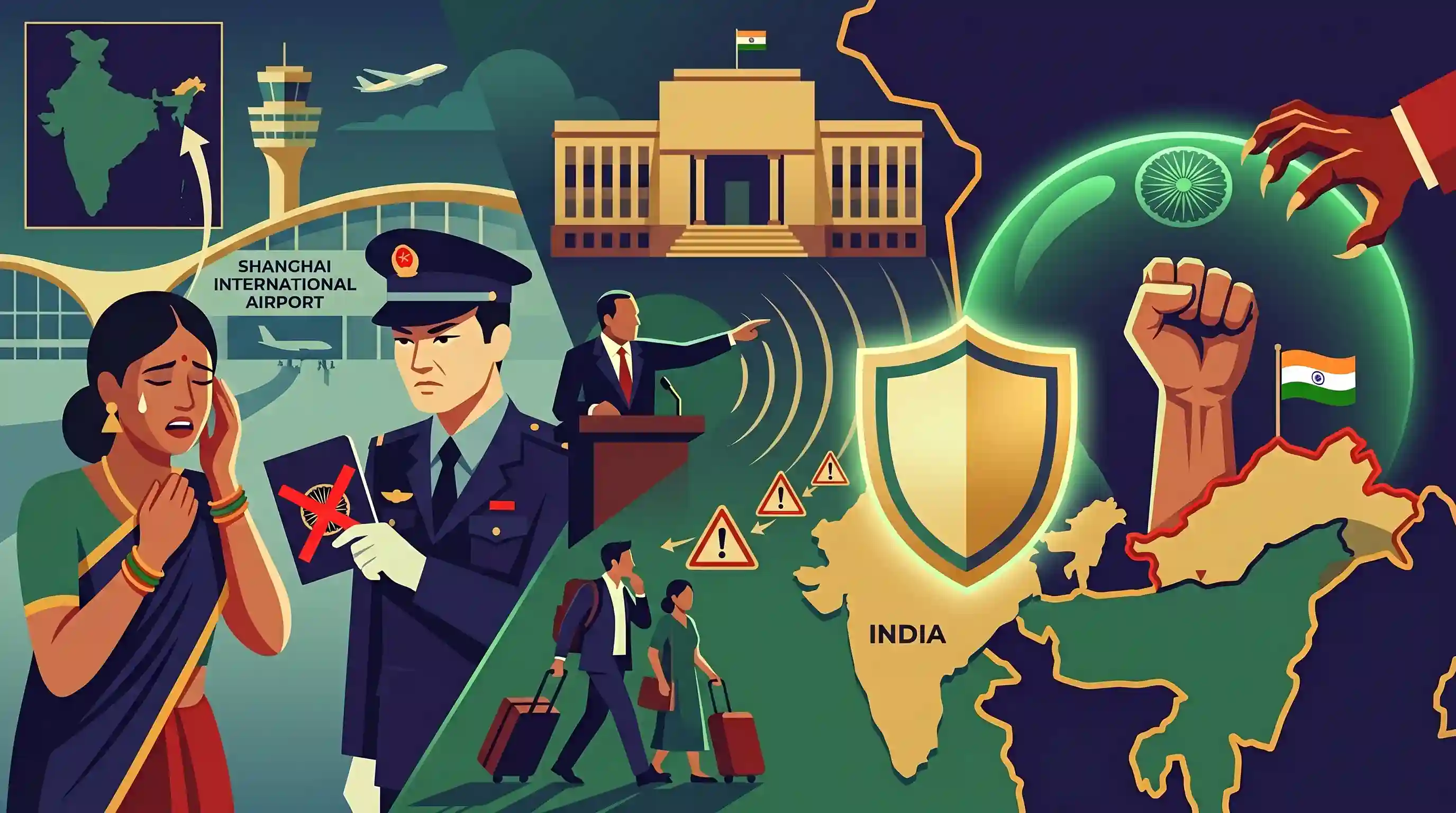
The Ministry of External Affairs (MEA) has advised Indian nationals to exercise caution when transiting through China and urged Beijing to ensure Indian citizens are not selectively targeted or harassed. This diplomatic friction follows the 18-hour detention of Pema Thongdok, an Indian citizen from Arunachal Pradesh, at Shanghai International Airport. Chinese authorities claimed her Indian passport was invalid, reflecting China's ongoing assertion that Arunachal Pradesh is its territory. In response, India firmly reiterated its sovereignty, maintaining that Arunachal Pradesh, including the Tawang region, is an integral and inalienable part of the country.
Key Points
- The MEA advised Indian nationals to exercise "due discretion" while travelling or transiting through China.
- India urged Beijing to provide assurances that Indian citizens will not be selectively targeted, arbitrarily detained, or harassed.
- The advisory follows the 18-hour detention of an Indian citizen from Arunachal Pradesh at Shanghai International Airport.
- Chinese authorities justified the detention by claiming the traveler's Indian passport was invalid, asserting that Arunachal Pradesh is Chinese territory.
- India strongly reiterated its sovereignty, declaring that Arunachal Pradesh, including Tawang, is an integral and inalienable part of India.
Important Terms
Ministry of External Affairs (MEA)

The Indian government ministry responsible for conducting foreign policy, managing diplomatic missions, and representing India in international forums like the UN.
UPSC context
GS Paper-II (International Relations); fundamental for understanding India’s diplomatic machinery and foreign policy execution.
Sovereignty
The supreme and independent power of a state to exercise absolute authority over its territory, people, and internal affairs without external interference.
UPSC context
GS Paper-II (Polity/IR); central to discussions on border disputes and constitutional principles of the Indian state.
Demarche
A formal diplomatic representation, request, or protest issued by one government to another, typically to convey a firm stance on a specific incident or policy.
UPSC context
GS Paper-II (International Relations); tests knowledge of diplomatic tools used to manage bilateral friction and territorial disputes.
Territorial Integrity
The principle in international law that a nation-state's borders are sacrosanct and should not be altered by the use of force or external territorial claims.
UPSC context
GS Paper-III (Internal Security); critical for analyzing border management and India’s response to regional security challenges.
Chicago Convention
The 1944 international treaty that established the core principles of civil aviation, including aircraft sovereignty, transit rights, and non-discrimination in international air travel.
UPSC context
GS Paper-II (IR/International Law); relevant for understanding the legal framework governing international transit and diplomatic protests.
Selective Targeting
The discriminatory practice of singling out individuals or groups for harassment or arbitrary detention based on specific characteristics, such as their region of origin.
UPSC context
GS Paper-II (IR); pertains to the protection of Indian diaspora rights and non-discriminatory international relations.
Prelims Trap
"The McMahon Line was formally accepted by both British India and the Republic of China at the 1914 Simla Convention."
China explicitly refused to sign the 1914 Simla Convention, arguing Tibet lacked sovereign authority to sign international treaties. The McMahon line was agreed upon only by British India and Tibet.
Static Concepts Connected
What is the legal basis of the McMahon Line and why does China reject it?
- Simla Convention: The boundary in the Eastern Sector defined during the 1914 Simla Convention between British India and Tibet.
- Chinese Rejection: China argues that Tibet was never an independent state with treaty-making powers, thus rendering agreements signed by Tibetan representatives invalid.
- Zangnan Claim: China refers to Arunachal Pradesh as "Zangnan" or "South Tibet," claiming about 90,000 sq km of Indian territory.
What are stapled visas and cartographic warfare in India-China relations?
- Stapled Visas: Issuing unstamped visas on a separate piece of paper to residents of Arunachal and J&K to tacitly deny Indian sovereignty without outright refusing entry.
- Cartographic Warfare: Publishing standardized Mandarin and Tibetan names for locations in Arunachal Pradesh to build a fabricated legal and historical pretext for territorial claims.
Cross-Topic Patterns
ILP and border security governance
Arunachal Pradesh is protected by the Inner Line Permit (Bengal Eastern Frontier Regulation, 1873), blending internal demographic protection with external border security dynamics.
Tawang's Tibetan Buddhist succession links
Tawang's importance isn't purely geographic; as the birthplace of the 6th Dalai Lama, it is central to China's geopolitical strategy to control Tibetan Buddhist succession and legitimacy.

Expect a Prelims question mapping Himalayan Buddhist monasteries (like Tawang) or border passes directly against disputed border sectors.
Linked PYQs · 2
Linked PYQs · 2
- 2012MainsGS2
Do you think that China's emergence as one of the largest trading partners of India has adversely affected the settlement of the outstanding border problem?
- 2024MainsGS3
India has a long and troubled border with China and Pakistan fraught with contentious issues. Examine the conflicting issues and security challenges along the border. Also give out the development being undertaken in these areas under the Border Area Development Programme (BADP) and Border Infrastructure and Management (BIM) Scheme.
