Tribal Protests and Rehabilitation Demands for River Link
Source:The Hindu ↗
Why It Matters
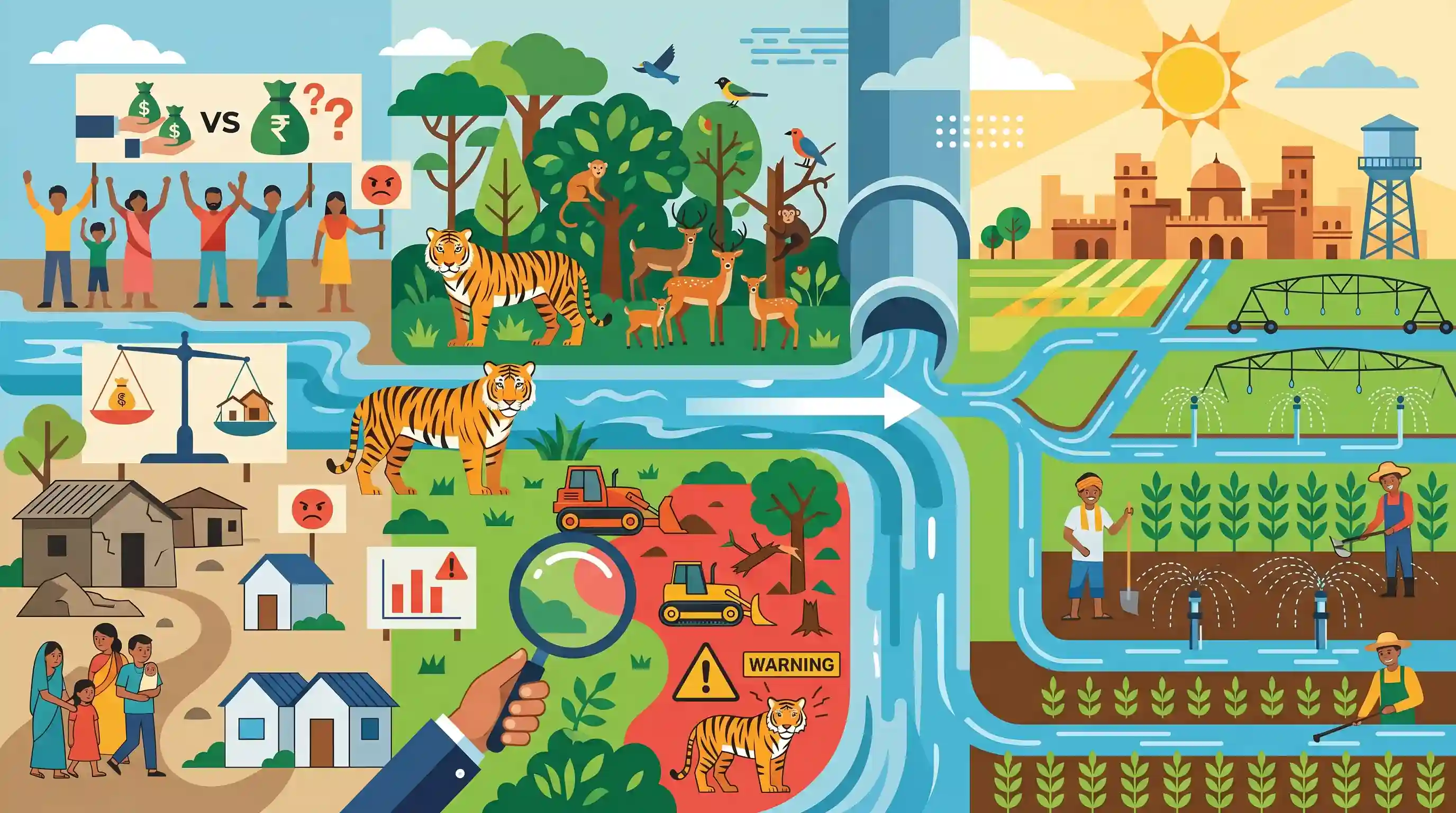
The Ken-Betwa Link Project is a pioneering water infrastructure initiative in India. It serves as a benchmark for analyzing the delicate balance between developmental needs (such as drought mitigation in Bundelkhand), ecological conservation (Panna Tiger Reserve), and the socio-economic rights of indigenous tribal populations.
Summary
Tribal residents in Chhatarpur and Panna districts, Madhya Pradesh, have resumed protests demanding higher rehabilitation and compensation packages (₹25 lakh instead of ₹12.5 lakh) on the banks of the Barana River. These protests target displacement concerns from the landmark Ken-Betwa Link Project (KBLP)—India's first major inter-basin river transfer project designed to irrigate the Bundelkhand region—as well as the Majhgaon and Runjh irrigation projects. The KBLP faces persistent criticism over its displacement of tribals and its significant environmental footprint within the Panna National Park and Tiger Reserve.
Key Points
- The Ken-Betwa Link Project (KBLP) was formally flagged off by Prime Minister Narendra Modi on December 25, 2024, as the first of 30 interlinking projects under the National Perspective Plan (NPP).
- The project aims to transfer surplus water from the Ken river basin to the water-deficit Betwa river basin, providing critical irrigation and drinking water to the Bundelkhand region of Madhya Pradesh and Uttar Pradesh.
- Tribal residents and villagers in Chhatarpur and Panna districts have resumed protests (including a 'Chita Andolan' in April and symbolic hanging noose demonstrations) on the banks of the Barana River near Kupi village.
- Protestors are demanding an increase in rehabilitation packages to ₹25 lakh (from the current ₹12.5 lakh), affecting people under KBLP as well as the local Majhgaon and Runjh irrigation projects.
- The Madhya Pradesh State Cabinet recently allocated an additional ₹300 crore to increase the rehabilitation package for Majhgaon and Runjh projects from ₹5 lakh to ₹12.5 lakh.
- Environmentalists have raised serious concerns over the ecological impact of KBLP, as a large portion of the project lies within the eco-sensitive Panna National Park and Tiger Reserve.
Important Terms
Ken-Betwa Link Project

India's first major inter-basin river transfer project, transferring surplus water from the Ken River in Madhya Pradesh to the Betwa River in Uttar Pradesh to irrigate the drought-prone Bundelkhand region.
UPSC context
GS III: Water Resources. Tests understanding of river-interlinking, federal challenges, and environmental-developmental trade-offs.
National Perspective Plan
Formulated in 1980 by the central government to address water imbalances by proposing the interlinking of 30 major rivers (14 Himalayan and 16 Peninsular) through canals and reservoirs.
UPSC context
GS III: Water Resource Management. Tests knowledge of national water-grid planning, regional imbalances, and infrastructural bottlenecks.
Panna Tiger Reserve
A critical tiger habitat and UNESCO Biosphere Reserve in Madhya Pradesh, heavily affected by land submergence from the Ken-Betwa project's Daudhan Dam.
UPSC context
GS III: Biodiversity & Environment. Tests knowledge of protected area networks and developmental impacts on critical tiger habitats.
Majhgaon irrigation project
A medium irrigation project in Panna, Madhya Pradesh, involving a composite dam on Bada Nala (a Ken River tributary) to supply local agricultural command areas.
UPSC context
GS III: Environmental Impact Assessment. Tests understanding of local displacement, public hearings, and compensation structures.
Runjh irrigation project
A medium irrigation project in Panna, Madhya Pradesh, constructing an earthen dam on the Runjh River to irrigate drought-prone lands, facing resettlement package protests.
UPSC context
GS III: Welfare & Tribal Resettlement. Tests knowledge of administrative compensation policies, tribal displacement, and local conflicts.
Prelims Trap
The National Water Development Agency is a statutory body, and the Ken and Betwa are left-bank tributaries of the Yamuna.
NWDA is a registered society (under the Societies Registration Act, 1860), not a statutory body. Also, the Ken and Betwa are right-bank (not left-bank) tributaries of the Yamuna.
Static Concepts Connected
What is the National Perspective Plan (NPP) for water resources development?
- Dual components: Formulated in 1980, it features the Himalayan Rivers Development Component (14 links) and the Peninsular Rivers Development Component (16 links).
- Executing agency: The National Water Development Agency (NWDA), established in 1982 as a registered society, conducts studies and plans implementation.
What is the ecological profile and significance of the Panna Tiger Reserve?
- River lifeline: Located in Madhya Pradesh's Vindhyan range, the Ken River flows south-to-north directly through this reserve, serving as its primary water source.
- Compensatory corridors: To offset KBLP submergence, adjacent habitats like Ranipur (UP) and Veerangana Durgavati (MP) tiger reserves were notified to secure wildlife corridors.
- Global recognition: Designated as a UNESCO Biosphere Reserve in 2020, it primarily features dry deciduous forest ecosystems.
Cross-Topic Patterns
Infrastructure vs. Wildlife Protection
KBLP highlights how national infrastructure goals bypass core conservation zones, forcing the notification of compensatory tiger reserves to meet legal mandates under the Wildlife Protection Act.
Climate Adaptation vs. Tribal Rights
Highlights the climate justice dilemma where mega-projects designed for regional drought resilience (Bundelkhand) lead to displacement and protest over rehabilitation rights of vulnerable tribal communities.

Spatial geography of KBLP, its Yamuna tributaries, and connected reserves (Ranipur, Veerangana Durgavati) likely to be tested in 2026.
Linked PYQs · 3
Linked PYQs · 3
- 2020MPPSC_PRELIMSGS1
Betwa river originate from
- 2023MPPSC_PRELIMSGS1
Which of the following rivers of Madhya Pradesh flows in three states?
- 2024MPPSC_PRELIMSGS1
In which of the following irrigation projects do four states have partnership?
