Land acquisition issues in transmission line projects
Source:Indian Express ↗
Why It Matters
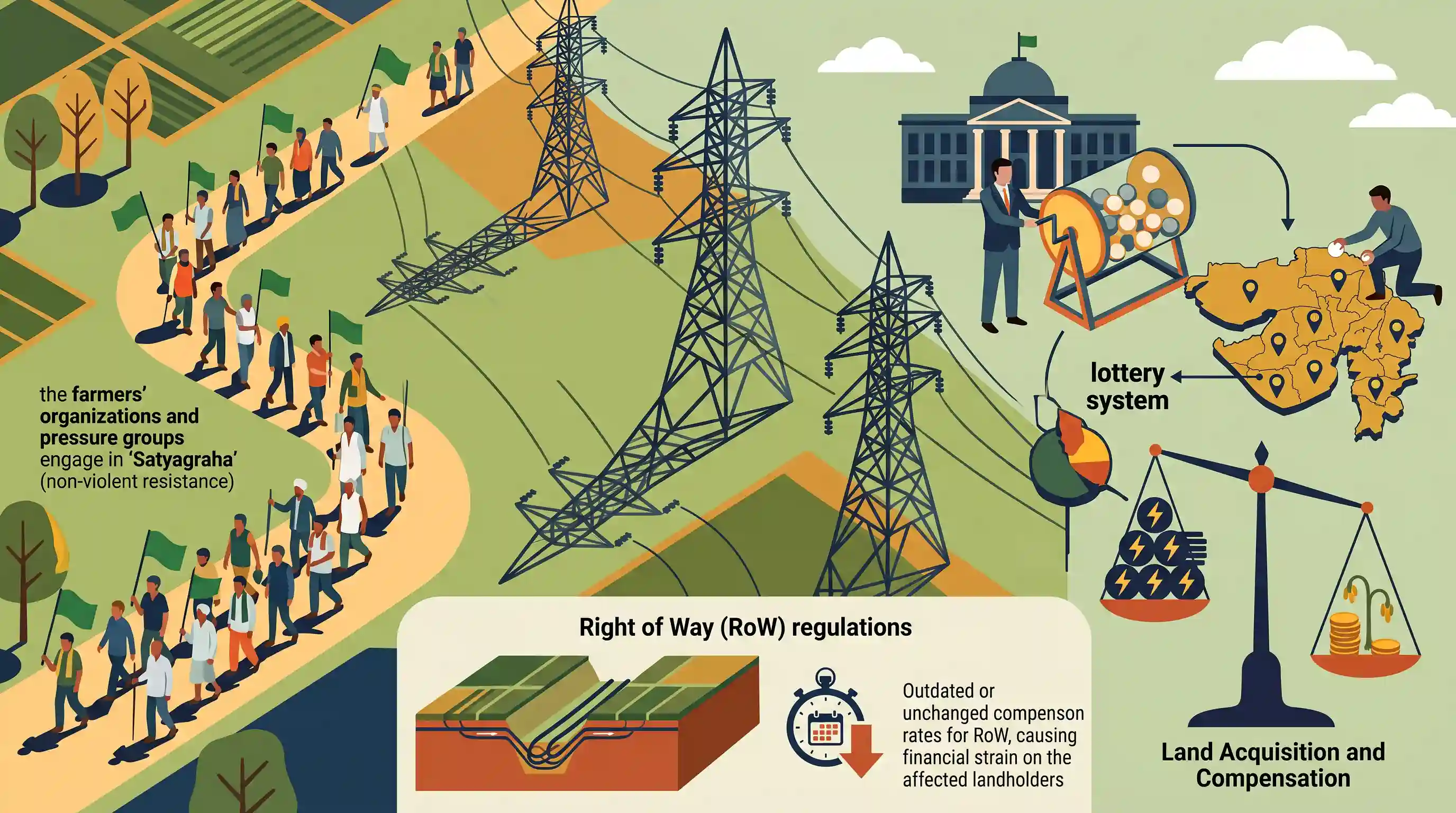
This article highlights the friction between critical energy infrastructure expansion (green energy transmission from Khavda) and local agricultural land rights. It exposes the complexities of administrative valuation mechanisms (using a lottery method and IBBI-empanelled valuers) and demonstrates how decentralized agrarian pressure groups organize democratic protests (satyagraha, padyatra) to negotiate with regional administrations over compensatory policies and Right of Way (RoW) guidelines.
Summary
Farmers in Morbi, Gujarat, are staging a 'Satyagraha' and a 3.5 km 'padyatra' to protest a new Government Resolution (GR) issued on July 4, 2026, regarding land and crop compensation for a 756 kV power transmission line being installed by Adani Energy Solutions Ltd's SPV. The farmers strongly object to a novel 'lottery system' introduced by the state government to determine land valuation using IBBI-empanelled valuers, calling it arbitrary and unfavorable. They also demand revision of the 'Right of Way' (RoW) compensation rates for laying power cables, which remain unchanged, leading to significant financial losses for affected landholders.
Key Points
- Farmers in Morbi, Gujarat, are protesting the installation of a 756 kV transmission line by Halvad Transmission Limited (an SPV of Adani Energy Solutions Ltd) running 246 km from Khavda (Kutch) to Halvad (Morbi).
- The farmers are protesting against a new Government Resolution (GR) issued on July 4, 2026, which supersedes previous resolutions governing crop and land compensation during transmission network projects.
- The GR introduces a controversial lottery system to determine reference land market rates. Out of three sealed valuation reports submitted by Insolvency and Bankruptcy Board of India (IBBI) empanelled valuers (one each representing landowners, the transmission service provider, and the District Collector), two are randomly opened by lottery to decide compensation.
- If the difference in valuations between the two opened reports is less than 20% of the lower value, their average is taken; if greater than 20%, compensation is fixed at 10% more than the lower valuation. Only if unacceptable is the third report opened, and the average of the two lowest valuations is used.
- Protesters argue that this lottery system is arbitrary, non-transparent, and structurally biased against farmers. Furthermore, they object that 'Right of Way' (RoW) compensation for laying cables remains low (at 30%, 45%, and 60% based on different criteria), causing heavy losses compared to compensation given for transmission towers.
- The farmers launched 'Part 3' of their protest (Satyagraha) with a 3.5 km padyatra to the Morbi Collector's office on July 14, 2026, while building coordination committees across 12 districts of Gujarat to formalize demand frameworks.
Important Terms
Right of Way

The legal right of utility providers to access and use private or public land to construct and maintain infrastructure (like power lines), where ownership remains with the landholder but usage is restricted.
UPSC context
GS-3: Infrastructure / GS-2: Public Policy. Tests legal frameworks balancing development needs with property rights of citizens.
Right to Fair Compensation and Transparency in Land Acquisition, Rehabilitation and Resettlement Act, 2013
A landmark Indian legislation regulating government land acquisition, mandating social impact assessments, landowner consent (70-80%), rehabilitation and resettlement of affected families, and fair compensation up to four times market value.
UPSC context
GS-3: Land Reforms. Tests legal mechanisms of land acquisition, balancing economic development with agrarian rights and welfare.
Insolvency and Bankruptcy Board of India
The statutory regulatory body established under the IBC, 2016, responsible for regulating insolvency proceedings and, crucially, registering and empanelling professional asset and land valuers nationwide.
UPSC context
GS-3: Indian Economy. Tests institutional regulatory frameworks, ease of doing business, and national valuation standards.
Market Rate Committee
A district-level body chaired by the District Collector, comprising farmers, independent valuers, and utility representatives, established to determine the realistic market value of land for infrastructure compensation.
UPSC context
GS-2: Local Governance & Administration. Tests administrative decentralization, dispute resolution, and local price determination.
Government Resolution on land and crop compensation 2026
An administrative notification issued by Gujarat's Energy and Petroleum Department in July 2026, replacing Jantri-based compensation with twice the actual market value for electricity transmission projects.
UPSC context
GS-2: Government Policies. Tests executive state actions, policy responses to public agitations, and state-level infrastructure guidelines.
Prelims Trap
Installing power transmission lines involves permanent land acquisition and transfer of title under the LARR Act, 2013.
Under the Indian Telegraph Act, laying transmission lines only secures easement rights (user rights/wayleaves). Land ownership remains with the farmer; hence, the LARR Act 2013 does not trigger complete acquisition.
Static Concepts Connected
How is 'Right of Way' (RoW) legally governed for Indian power transmission lines?
- Governing Laws: Section 10 of the Indian Telegraph Act, 1885, read with Section 164 of the Electricity Act, 2003, permits utilities to erect towers and lines.
- Ownership Status: Ownership remains with the landholder; the utility only acquires wayleave/user rights, restricting permanent construction along the designated corridor.
- Compensation Model: Calculated separately for tower base land (often 100-200% of market value) and the corridor width (30-60% of land value depending on the zone).
What is the statutory role of the IBBI in asset and land valuation?
- Statutory Mandate: Under Section 247 of the Companies Act, 2013, the IBBI is the designated statutory authority to register and regulate Registered Valuers in India.
- Cross-Sectoral Use: IBBI-registered valuers are increasingly utilized by non-insolvency sectors, including power and highway ministries, to standardise land and asset valuations.
Cross-Topic Patterns
Green transition vs. Agrarian rights
The expansion of massive clean energy grids (e.g., Khavda) creates a classic GS-3 policy paradox: India's ambitious climate targets directly clash with localized agrarian property rights.
Federalism in infrastructure pricing
While the Union Ministry of Power issues standard RoW guidelines, state-level implementation and discretionary local compensation resolutions cause sharp regional disparities in land value calculations.

Legal distinctions between permanent land acquisition (LARR 2013) and easement rights (Telegraph Act 1885) likely to feature in 2026.
Linked PYQs · 2
Linked PYQs · 2
- 2014MainsGS3
The Right to Fair Compensation and Transparency in Land Acquisition, Rehabilitation and Resettlement Act, 2013 has come into effect from 1st January, 2014. What are the key issues which would get addressed with the Act in place? What implications would it have on industrialization and agriculture in India?
- 2019MainsGS2
What are the methods used by the farmers' organisations to influence the policy-makers in India and how effective are these methods?
