Maharashtra Farmers Loan Repayment Incentive And Agrarian Demands
Source:thehindu ↗
Why It Matters
Highlights the political economy of farm loan waivers in Maharashtra, the active role of peasant organizations like AIKS in shaping agricultural policy, and ongoing structural issues such as land rights and crop insurance efficacy that are crucial for MPSC General Studies.
Summary
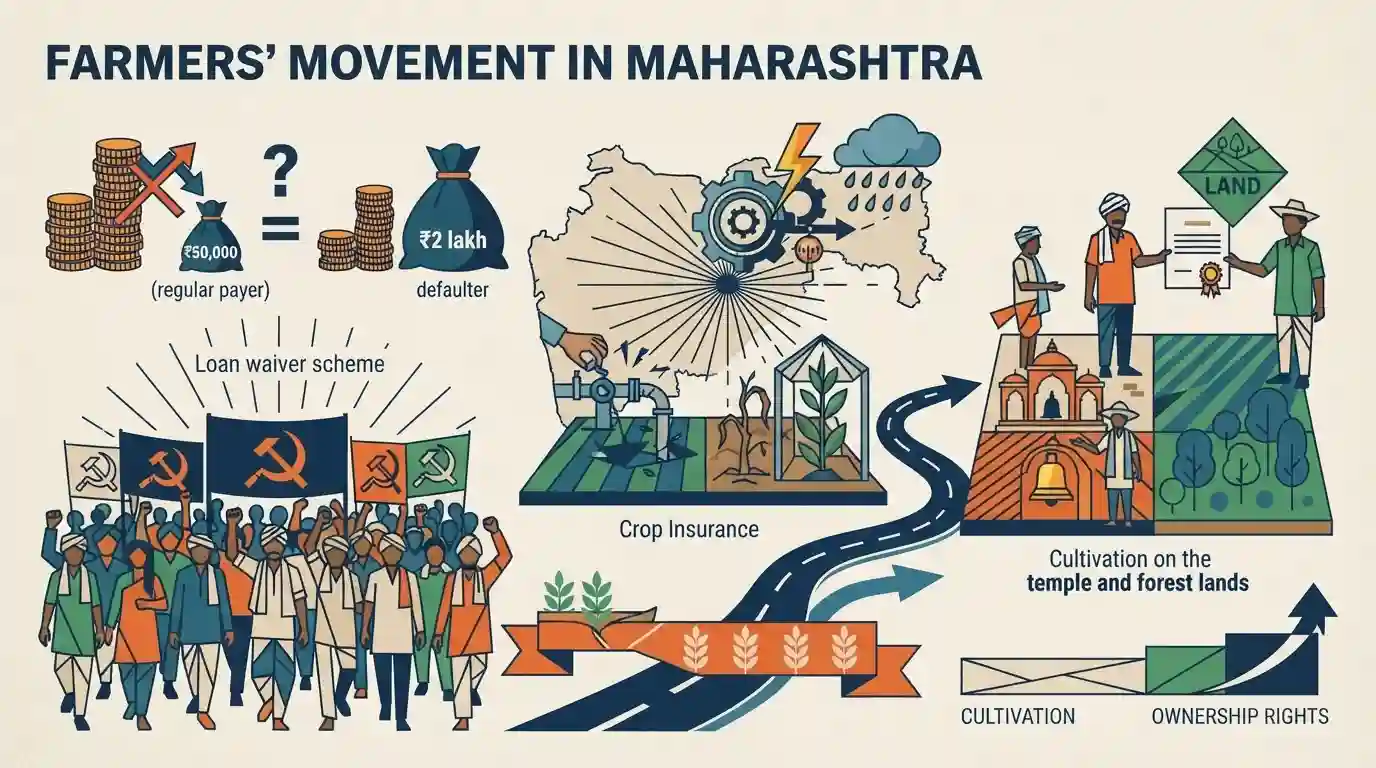
Farmers in Maharashtra, organized by the All India Kisan Sabha, have launched widespread protests demanding equitable benefits under the state's farm loan waiver scheme. They argue that the Punyashlok Ahilyadevi Holkar Shetkari Karzmukti scheme unfairly limits the incentive for regular loan payers to ₹50,000, while waiving up to ₹2 lakh for defaulters. Alongside credit-related demands, the farmers are pressing for structural agricultural support, including the restoration of crop insurance triggers and formal land ownership rights for those cultivating temple and forest lands, highlighting persistent agrarian challenges and credit disparities in the state.
Key Points
- Farmers across 23 districts in Maharashtra participated in a 'Jail Bharo' agitation led by the All India Kisan Sabha (AIKS).
- Protesters are demanding a ₹2 lakh incentive for regular loan repayment, objecting to the ₹50,000 limit set under the Punyashlok Ahilyadevi Holkar Shetkari Karzmukti scheme.
- The state government's loan waiver scheme targets 56 lakh farmers, aiming to waive a total of ₹36,585 crore in agricultural loans.
- Additional farmer demands include the restoration of crop-insurance triggers and formal land ownership rights for farmers cultivating forest, Devasthan (temple), Gairan, and Varkas lands.
- AIKS leaders have warned of an indefinite 'Mahamukkam' protest at the residence of State Agriculture Minister Dattatreya Bharne if their grievances are ignored.
Important Terms
Punyashlok Ahilyadevi Holkar Shetkari Karzmukti Yojana

A farm loan waiver scheme launched by Maharashtra in 2026, offering up to ₹2 lakh debt waiver for eligible distressed farmers and ₹50,000 incentives for regular crop loan repayers.
UPSC context
GS Paper III (Agriculture/Govt Schemes); tests understanding of state-level agrarian support, rural credit, and fiscal implications of farm waivers.
All India Kisan Sabha (AIKS)
A historic peasant organization founded in 1936 by Swami Sahajanand Saraswati to protect farmers' interests, abolish the zamindari system, and advocate for agrarian reforms.
UPSC context
GS Paper I (Modern Indian History); tests knowledge of peasant mobilization, agrarian struggles, and key historical leaders.
AgriStack
A digital public infrastructure initiative by the Indian government creating a unified database for farmers, integrating land records, crop data, and registries to streamline services.
UPSC context
GS Paper III (E-technology in Agriculture); tests understanding of digital public infrastructure, governance, and tech integration in rural sectors.
Land Reforms
Structural changes in land ownership, tenure, and cultivation rights intended to redistribute agricultural land, eliminate intermediary exploitation, and secure farmers' rights.
UPSC context
GS Paper III (Land Reforms); tests knowledge of institutional transformations, tenure security, and ongoing socio-economic challenges in rural India.
Prelims Trap
Gairan lands are privately owned fallow lands subject to redistribution under state agricultural land ceiling laws.
Gairan lands are government-owned common property grazing resources protected under the Land Revenue Code, not private lands subject to agricultural ceiling limits.
Static Concepts Connected
What are Common Property Resources (CPRs) and their legal status in rural India?
- Definition: CPRs are community-accessible resources such as village pastures (Gairan), forests, and water bodies that are crucial for smallholder livelihoods.
- Legal protection: They are governed by state Land Revenue Codes; the Supreme Court strictly prohibits regularizing encroachments on village commons (Jagpal Singh case, 2011).
What is the 'moral hazard' associated with agricultural loan waivers?
- Definition: The tendency of borrowers to default intentionally on loans because they anticipate future state-sponsored debt write-offs.
- Credit culture disruption: It penalizes honest, regular repayers and encourages systematic defaults, causing banks to tighten rural lending criteria.
- Fiscal strain: Large-scale debt relief diverts scarce public funds from long-term capital investments like irrigation to short-term revenue expenditure.
Cross-Topic Patterns
Credit discipline vs Fiscal Federalism
State-funded agricultural loan waivers strain subnational budgets, often breaching state FRBM targets and crowding out long-term public investments in irrigation and rural infrastructure.
Agrarian land classification and reforms
Complex historic land categories like Devasthan Inam and Gairan complicate modern digitisation, land-titling, and tenancy reforms, hindering collateral-based formal credit access.

Analyzing the systemic impact of state-level farm loan waivers on rural credit culture and fiscal space will be a core GS-3 focus in 2026.
Linked PYQs · 4
Linked PYQs · 4
- 2020MPSC_PRELIMSGS1
What happened in Maharashtra due to fragmentation of agricultural land ? (a) Farmer is not able to produce food grains, sufficient for his family. (b) There are obstacle to supply water to agricultural land. (c) The use of modern agricultural tools is uneconomical. (d) To pay individual attention on agriculture is uneconomical. Answer Options :
- 2020MPSC_PRELIMSGS1
Pradhan Mantri Jan Dhan Yojana (PMJDY) envisages : (a) Financial inclusion (b) Financial literacy (c) Insurance cover (d) Crop insurance Answer Options :
- 2022MPSC_PRELIMSGS1
Before the formation of 'All India States Peoples' Congress' at the national level, which of the following organizations was active in Kolhapur to raise the concerns of the people ?
- 2026MPSC_PRELIMSGS1
Select the correct statements from the following about PM Dhan-Dhaanya Krishi Yojana. (a) The Union Cabinet approved the PM Dhan-Dhaanya Krishi Yojana on 16th July, 2025. (b) The scheme identifies 100 districts based on low productivity, low cropping intensity and less credit disbursement. (c) The scheme will be governed through a four-tier implementation structure.
