Protests and Demand for Separate Administration in Manipur
Source:The Hindu ↗
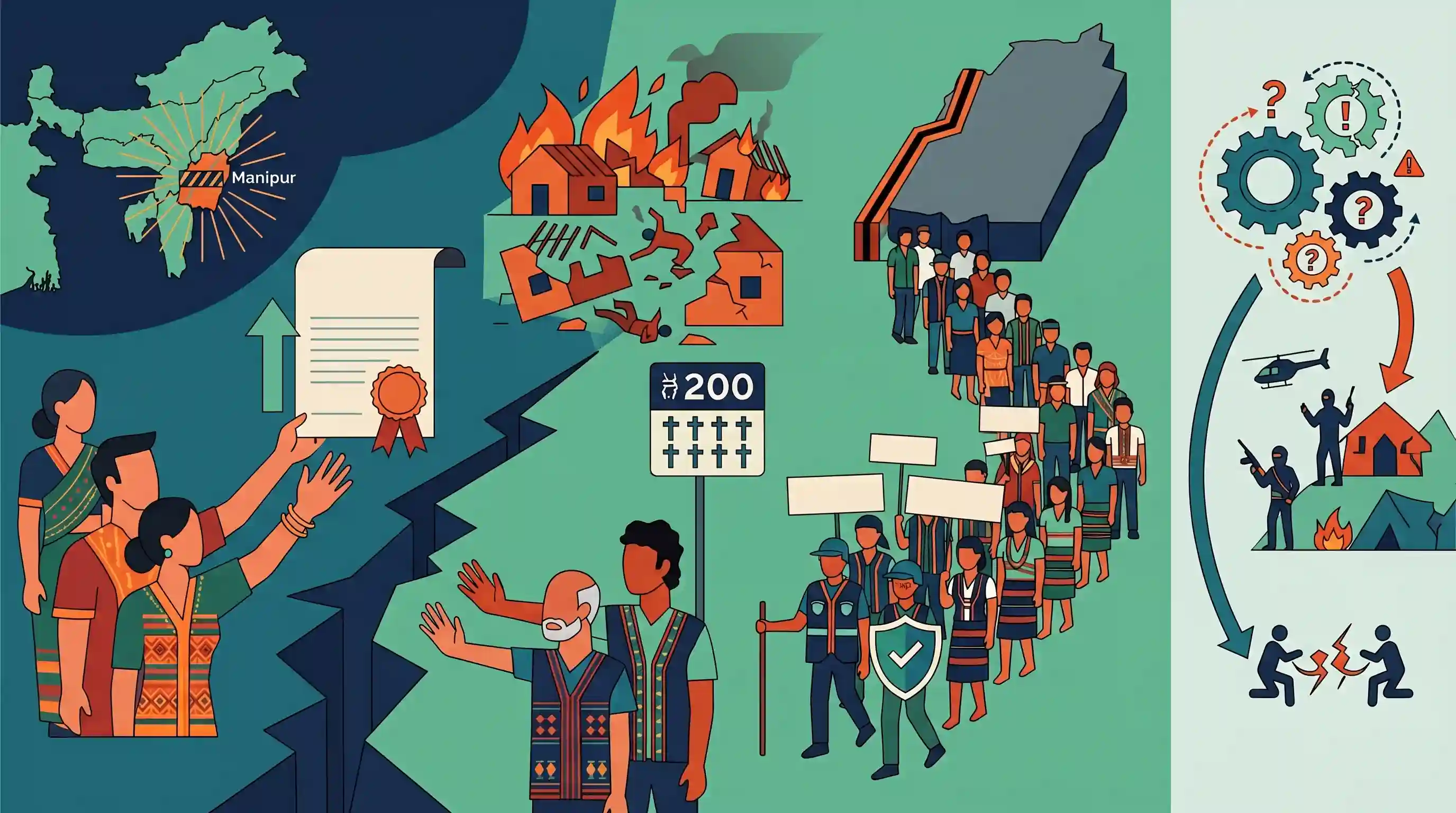
Why It Matters
The ongoing ethnic violence in Manipur serves as a critical case study for UPSC aspirants on the complexities of internal security in North East India. It highlights how demands for affirmative action (ST status) can exacerbate historical fault lines, leading to demands for statehood/separate administration (regionalism) and prolonged breakdowns of law and order.
Summary
Protesters in Manipur's Churachandpur district, mobilized by the Central Village Defence Force (CVDF), marched to demand justice for victims of the ongoing ethnic violence. The demonstrators strongly advocated for a separate administration for the region's tribals, highlighting the deep ethnic divide between the Kuki-Zomi and Meitei communities. The violence, which has claimed over 200 lives since May 2023, was initially triggered by protests against the Meitei community's demand for Scheduled Tribe (ST) status. This prolonged unrest underscores complex internal security and governance challenges in North East India.
Key Points
- Protests organized by the Central Village Defence Force (CVDF) took place in Churachandpur, Manipur, demanding justice for victims of the ongoing ethnic conflict.
- Demonstrators actively demanded a separate administration or state for tribals, signifying deep-rooted ethnic alienation and regionalism.
- The ethnic violence originally erupted in May 2023 following a tribal solidarity march against the Meitei community's push for Scheduled Tribe (ST) status.
- The protracted conflict has claimed over 200 lives, presenting significant internal security and governance challenges for the state and central governments.
Important Terms
Scheduled Tribe (ST) Status

Constitutional designation under Article 342 granting protections, job reservations, and land rights. In Manipur, Meitei demands for this status triggered conflict with existing tribal groups.
UPSC context
GS-2 (Social Justice) and GS-3 (Internal Security); tests understanding of affirmative action and ethnic conflict triggers.
Central Village Defence Force (CVDF)
A Kuki-Zomi community-based volunteer group in Churachandpur district providing local defense and mobilizing protests for justice and regional autonomy during the Manipur ethnic crisis.
UPSC context
GS-3 (Internal Security); relevant to the role of non-state actors and local militias in conflict zones.
Separate Administration
A political demand by Kuki-Zomi groups for a distinct administrative setup (like a Union Territory or Sixth Schedule status) independent of the Meitei-dominated Manipur state government.
UPSC context
GS-2 (Federalism) and GS-3 (Regionalism); tests knowledge of administrative solutions to ethnic insurgency.
Kuki-Zomi and Meitei Divide
The primary ethnic groups in Manipur. Meiteis (majority, valley-based) and Kuki-Zomi (tribal, hill-based) have long-standing disputes over land, political representation, and reservation benefits.
UPSC context
GS-1 (Society) and GS-3 (Internal Security); fundamental for understanding ethnic polarization and demographic challenges in NE India.
Hill-Valley Divide
The geographical and legal split in Manipur where the Imphal Valley (10% area) and Hills (90%) follow different land-ownership laws, fueling mutual distrust.
UPSC context
GS-1 (Geography/Society) and GS-3 (Security); explains the spatial dimension of conflict and resource competition.
Internal Security Challenges (Manipur)
The maintenance of peace within a nation's borders. In Manipur, it involves managing ethnic clashes, arms looting, and the role of paramilitary forces like Assam Rifles.
UPSC context
GS-3 (Security); tests analysis of insurgency, border porousness, and law and order breakdown in sensitive regions.
Prelims Trap
"Manipur's tribal hill districts are governed by Autonomous District Councils under the Sixth Schedule."
Manipur is NOT covered under the 6th Schedule (applicable only to Assam, Meghalaya, Tripura, Mizoram). Its hill areas are protected via Article 371C.
Static Concepts Connected
How does Article 371C govern Manipur's hill areas?
- Hill Areas Committee: Empowers the President to form a special committee consisting of Legislative Assembly members (MLAs) elected specifically from the state's Hill areas.
- Governor's Special Responsibility: The State Government’s executive power extends to Hill areas, but the Governor holds special responsibility to secure their proper administration.
- Not 6th Schedule: Unlike the 6th Schedule areas of AMTM, Manipur's hill councils operate under a state legislative act, not direct constitutional autonomy.
What is the statutory process for adding a community to the ST list?
- State Initiation: The process must begin with a formal recommendation from the respective State Government to the Union Ministry of Tribal Affairs.
- Statutory Clearances: The proposal requires mandatory vetting and approval from both the Registrar General of India (RGI) and the National Commission for Scheduled Tribes (NCST).
- Parliamentary Act: Final inclusion requires an Act of Parliament to amend the Constitution (Scheduled Tribes) Order, 1950, as mandated by Article 342.
Cross-Topic Patterns
Border security + FMR suspension
The ethnic violence accelerated the Centre's decision to scrap the India-Myanmar Free Movement Regime (FMR) to block insurgent infiltration, linking internal ethnic polity directly to hard border security.
Asymmetric federalism + Sub-regionalism
Demands for a separate tribal administration highlight the limits of standard state-level governance, demonstrating how sub-regionalism often pivots to demands for elevated Constitutional autonomy like 6th Schedule status.

Expect a tricky 2026 Prelims question pairing Article 371C (Manipur) against the 6th Schedule (AMTM) and the ST-status inclusion process.
Linked PYQs · 3
Linked PYQs · 3
- 2019MainsGS3
Cross-border movement of insurgents is only one of the several security challenges facing the policing of the border in North-East India. Examine the various challenges currently emanating across the India-Myanmar border. Also, discuss the steps to counter the challenges.
- 2017MainsGS3
The North-East region of India has been infested with insurgency for a very long time. Analyze the major reasons for the survival of armed insurgency in this region.
- 2013MainsGS1
Growing feeling of regionalism is an important factor in generation of demand for a separate State. Discuss.
