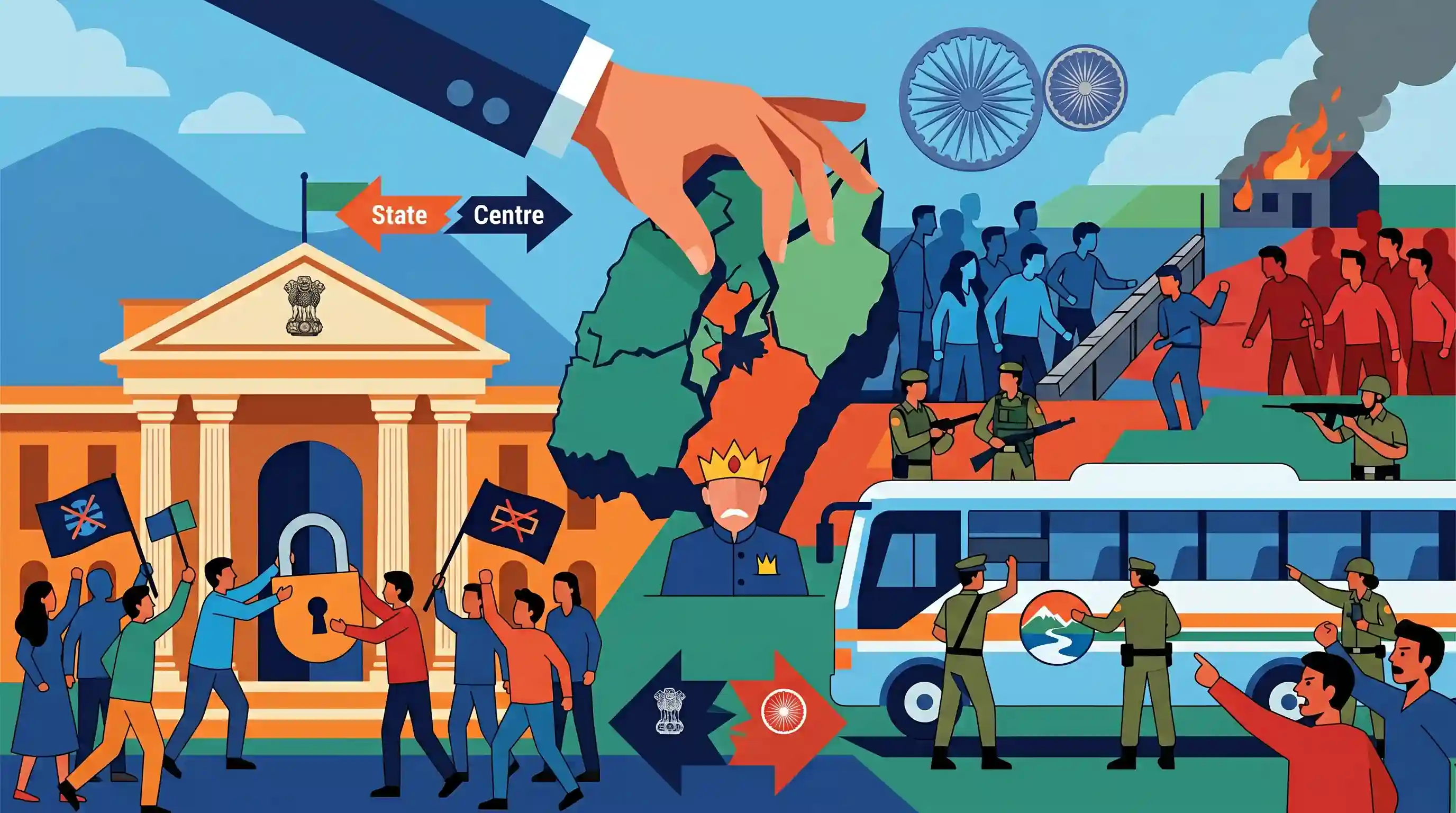
Civil disobedience movement and central office lockdowns in Manipur
Source:The Hindu ↗
Why It Matters
The situation in Manipur presents a live case study on the application and challenges of President's Rule (Article 356), the role of the Governor during an internal emergency, and the complexities of deploying Central forces in areas with deep-seated ethnic fault lines.
Summary
Protesters led by the Meitei organisation COCOMI have intensified a civil disobedience movement in Manipur, locking Central government offices in Imphal. The protests were triggered by an incident where Central armed forces allegedly forced passengers to obscure the 'Manipur State Transport' signage on a bus, which locals viewed as an insult to the state's identity. Demonstrators are demanding an apology from Governor Ajay Kumar Bhalla, who is administering the state under President's Rule, as well as the resignation of key security officials. The unrest underscores the fragile internal security situation and the difficulties of managing state-centre relations amid the ethnic conflict that has persisted since May 2023.
Key Points
- A Meitei organisation, COCOMI, intensified a civil disobedience movement in Manipur by locking Central government offices in Imphal to protest an alleged insult to the State's identity by Central armed forces.
- The trigger was an incident where security personnel allegedly forced passengers to mask the words 'Manipur State Transport' on a state-run bus.
- Protesters are demanding an apology from Governor Ajay Kumar Bhalla, who has been administering the state under President's Rule since February 13, 2025, alongside the resignation of top security officials.
- The incident highlights severe civil-military friction and challenges in governance under President's Rule against the backdrop of prolonged ethnic conflict that began in May 2023.
Important Terms
President's Rule (Article 356)

Constitutional provision allowing the President to assume a State's administration if its machinery fails, transferring executive power to the Union and legislative power to Parliament.
UPSC context
GS Paper II: Emergency Provisions. Tests the understanding of federalism, parliamentary oversight, and the "breakdown of constitutional machinery" criteria.
COCOMI
The Coordinating Committee on Manipur Integrity; a powerful umbrella body of Meitei civil society organisations advocating for Manipur's territorial integrity and community interests.
UPSC context
GS Paper III: Internal Security. Tests knowledge of pressure groups, social organisations, and non-state actors in the North-East's security landscape.
Central Armed Police Forces (CAPF)
Seven security organisations (e.g., CRPF, Assam Rifles) under the Ministry of Home Affairs responsible for internal security, border guarding, and assisting states in maintaining law and order.
UPSC context
GS Paper III: Security Forces and their Mandate. Tests awareness of the division of security responsibilities and the role of central forces.
Article 355
A provision mandating the Union to protect every State against external aggression and internal disturbance, and ensure that State governments function in accordance with the Constitution.
UPSC context
GS Paper II: Centre-State Relations. Often used by the Union as an alternative to Article 356 to take control of security without dismissing the government.
S.R. Bommai Judgment (1994)
A landmark 1994 Supreme Court ruling that restricted the arbitrary use of Article 356, making the President's proclamation subject to judicial review.
UPSC context
GS Paper II: Judicial Review. Essential for understanding constitutional safeguards against the misuse of emergency powers by the Centre.
Civil Disobedience
A non-violent form of protest involving the deliberate and active refusal of citizens to obey certain laws or commands of a government.
UPSC context
GS Paper IV: Ethics. Evaluates the legitimacy of unconventional protest methods and ethical dilemmas between state authority and civil rights.
Prelims Trap
Under Article 356, the State Legislative Assembly is immediately dissolved by the President upon proclamation.
The Assembly is usually kept in suspended animation. It can only be dissolved after the Presidential proclamation is approved by both Houses of Parliament, as established in the S.R. Bommai judgment.
Static Concepts Connected
What are the executive and legislative effects of President's Rule (Article 356)?
- Executive Shift: The President assumes all functions of the State Government, delegating administration to the Governor who acts directly on the Centre's behalf, aided by advisors.
- Legislative Power: The State Assembly is either suspended or dissolved. Parliament is empowered to legislate on subjects in the State List for that specific state.
- Judiciary Untouched: The constitutional powers of the State High Court remain intact and are not assumed by the President.
What constitutes the Union's duty under Article 355?
- Protecting States: The Centre is mandated to protect every state against external aggression and internal disturbance, justifying central paramilitary deployment even without state consent.
- Constitutional Governance: The Union must ensure state governments run per constitutional provisions, providing the foundational legal stepping stone before invoking Article 356.
Cross-Topic Patterns
CAPF deployment + Federal friction
Prolonged CAPF deployment in North-East conflict zones often triggers local sub-nationalist pushback, tightly linking GS-3 (Internal Security) with GS-2 (Centre-State relations and Federalism).
Article 355 + President's Rule
The legal escalation from Article 355's duty to protect against 'internal disturbance' to Article 356's declaration of constitutional breakdown is a recurring Mains evaluation theme.

Expect a multi-statement Prelims Q in 2026 intertwining Articles 355, 356, and S.R. Bommai guidelines on assembly suspension/dissolution.
Linked PYQs · 4
Linked PYQs · 4
- 2023MainsGS2
Account for the legal and political factors responsible for the reduced frequency of using Article 356 by the Union Governments since mid 1990s.
- 2022MainsGS2
Discuss the essential conditions for exercise of the legislative powers by the Governor. Discuss the legality of re-promulgation of ordinances by the Governor without placing them before the Legislature.
- 2017MainsGS3
The North-East region of India has been infested with insurgency for a very long time. Analyze the major reasons for the survival of armed insurgency in this region.
- 2023MainsGS3
What are the internal security challenges being faced by India? Give out the role of Central Intelligence and Investigative Agencies tasked to counter such threats.
