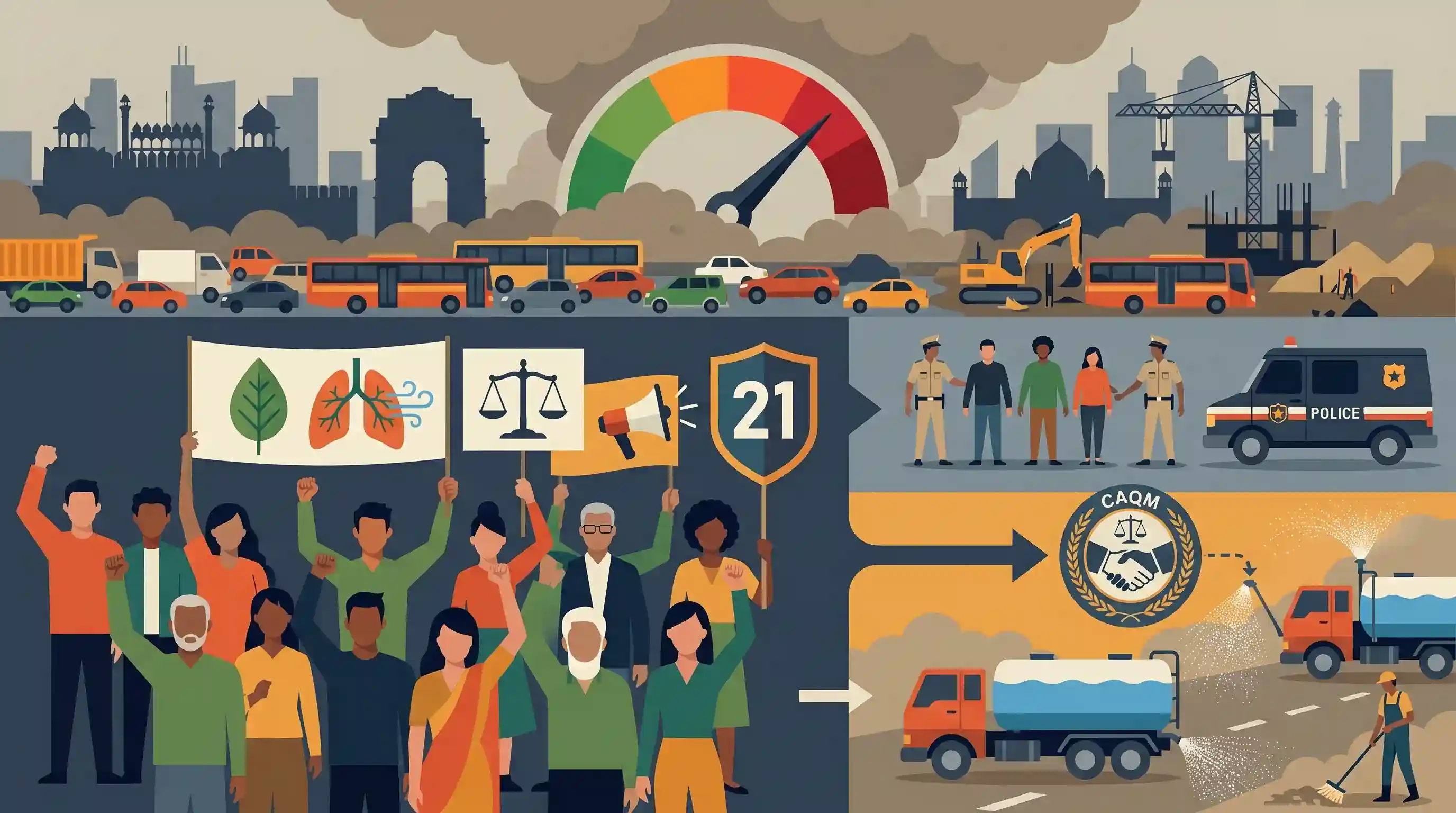
Delhi citizens protest against severe air pollution and poor AQI
Source:The Hindu ↗
Why It Matters
Urban air pollution, particularly in the Delhi-NCR region, is a recurring and highly testable theme in both Prelims and Mains. It intersects GS3 (environmental conservation, pollution control measures like GRAP, AQI) and GS2 (judicial interpretations of Article 21 regarding the right to a clean environment).
Summary
Protests erupted in Delhi as citizens demanded immediate action against the city's worsening air pollution, with the Air Quality Index (AQI) plummeting to 'very poor' levels. Demonstrators asserted their constitutional right to a clean environment, leading to the brief detention of five individuals by the police. In response to the crisis, the Commission for Air Quality Management (CAQM) has enacted Stage III of the Graded Response Action Plan (GRAP), triggering emergency measures such as the deployment of water sprinklers to suppress dust. The ongoing situation highlights the chronic challenge of urban air quality management and the civic pushback invoking Article 21 protections.
Key Points
- Citizens in Delhi protested against severe air pollution and 'very poor' AQI levels, demanding clean air as a fundamental necessity.
- Police briefly detained five protesters, highlighting the continuous friction between asserting the right to protest (Article 19) and maintaining public order.
- The Commission for Air Quality Management (CAQM) has invoked Stage III of the Graded Response Action Plan (GRAP) to combat the hazardous air quality.
- The administrative response includes immediate measures like deploying water sprinklers, alongside broader structural interventions to curb dust and vehicular emissions.
- The protests underline the constitutional imperative where the Right to Life (Article 21) inherently includes the right to a clean and healthy environment.
Important Terms
Graded Response Action Plan (GRAP)

An emergency framework of stage-wise measures activated based on air quality severity to prevent further atmospheric deterioration in the Delhi-NCR region.
UPSC context
GS Paper III (Environment); critical for understanding emergency urban pollution management and judicial activism.
Commission for Air Quality Management (CAQM)
A statutory body established in 2021 to coordinate, research, and enforce air quality standards in Delhi-NCR and adjoining states like Punjab and Haryana.
UPSC context
GS Paper II (Statutory Bodies) and III (Pollution); tests knowledge of environmental governance and federal coordination.
National Clean Air Programme (NCAP)
A long-term national strategy launched in 2019 aiming for a 40% reduction in particulate matter concentration by 2026 across 131 "non-attainment" cities.
UPSC context
GS Paper III (Environment); key for questions on national pollution targets and sustainable urban development.
Article 21 (Right to Clean Environment)
A fundamental right to life and personal liberty, which the Supreme Court has interpreted to include the right to a clean and healthy environment.
UPSC context
GS Paper II (Fundamental Rights); tests understanding of judicial interpretation and environmental jurisprudence.
Non-attainment Cities
Cities that consistently fail to meet the National Ambient Air Quality Standards (NAAQS) for five years, specifically targeted under the NCAP.
UPSC context
GS Paper III (Pollution); essential for discussing localized environmental challenges and target-based policy implementation.
Prelims Trap
"The National Air Quality Index (AQI) considers Carbon Dioxide (CO2) and Methane levels."
The National AQI measures 8 specific pollutants (PM10, PM2.5, NO2, SO2, CO, O3, NH3, Pb). It explicitly excludes CO2 and Methane, which are greenhouse gases, not AQI criteria pollutants.
Static Concepts Connected
What are the powers and jurisdiction of the Commission for Air Quality Management (CAQM)?
- Statutory Status: Established under the CAQM Act 2021, replacing the Supreme Court-appointed Environment Pollution (Prevention and Control) Authority (EPCA).
- Broad Jurisdiction: Covers Delhi-NCR and adjoining areas in Punjab, Haryana, UP, and Rajasthan specifically for matters related to air quality.
- Overriding Authority: Its orders and directions legally prevail over state governments and State Pollution Control Boards in case of any conflict.
What is the Graded Response Action Plan (GRAP) for Delhi-NCR?
- Emergency Framework: An emergency framework of anti-air pollution measures implemented progressively based on the severity of the Air Quality Index (AQI).
- Four Stages: Divided into Stage I (Poor: 201-300), Stage II (Very Poor: 301-400), Stage III (Severe: 401-450), and Stage IV (Severe Plus: >450).
- Enforcement Body: The CAQM is the statutory body responsible for invoking, monitoring, and enforcing the various stages of GRAP across the NCR.
Cross-Topic Patterns
Federalism vs. Environmental Regulation
CAQM’s mandate to enforce clean air in Delhi directly affects agricultural practices (stubble burning) in Punjab/Haryana, creating a classic GS2 federalism vs. GS3 environment overlap.
Article 19 vs. Public Order restrictions
The detention of climate protesters frequently tests the constitutional balance between the Article 19(1)(b) right to peacefully assemble and the State's power to maintain 'public order'.

Expect a Prelims question mixing AQI criteria pollutants (excluding CO2) with the overriding statutory powers of CAQM over State boards.
Linked PYQs · 5
Linked PYQs · 5
- 2021MainsGS3
Describe the key points of the revised Global Air Quality Guidelines (AQGs) recently released by the World Health Organisation (WHO). How are these different from its last update in 2005? What changes in India's National Clean Air Programme are required to achieve these revised standards?
- 2016PrelimsGS1
In the cities of our country, which among the following atmospheric gases are normally considered in calculating the value of Air Quality Index? 1. Carbon dioxide 2. Carbon monoxide 3. Nitrogen dioxide 4. Sulfur dioxide 5. Methane Select the correct answer using the code given below.
- 2025PrelimsGS1
Artificial way of causing rainfall to reduce air pollution makes use of
- 2015MainsGS2
Does the right to clean environment entail legal regulations on burning crackers during Diwali? Discuss in the light of Article 21 of the Indian Constitution and Judgement(s) of the Apex Court in this regard.
- 2022MainsGS2
“The most significant achievement of modern law in India is the constitutionalization of environmental problems by the Supreme Court.” Discuss this statement with the help of relevant case laws.
