COP30 Protests and the Clash Between Climate Diplomacy and Justice
Source:The Hindu ↗
Why It Matters
This article exemplifies the conflict between institutional climate diplomacy and grassroots climate justice. For UPSC aspirants, it is highly relevant for GS-3 (Environmental Conservation and Climate Change) regarding the outcomes and criticisms of COP summits, and for GS-2 (Governance and Social Justice) exploring the role of civil society organizations, environmental pressure groups, and the protection of vulnerable indigenous communities.
Summary
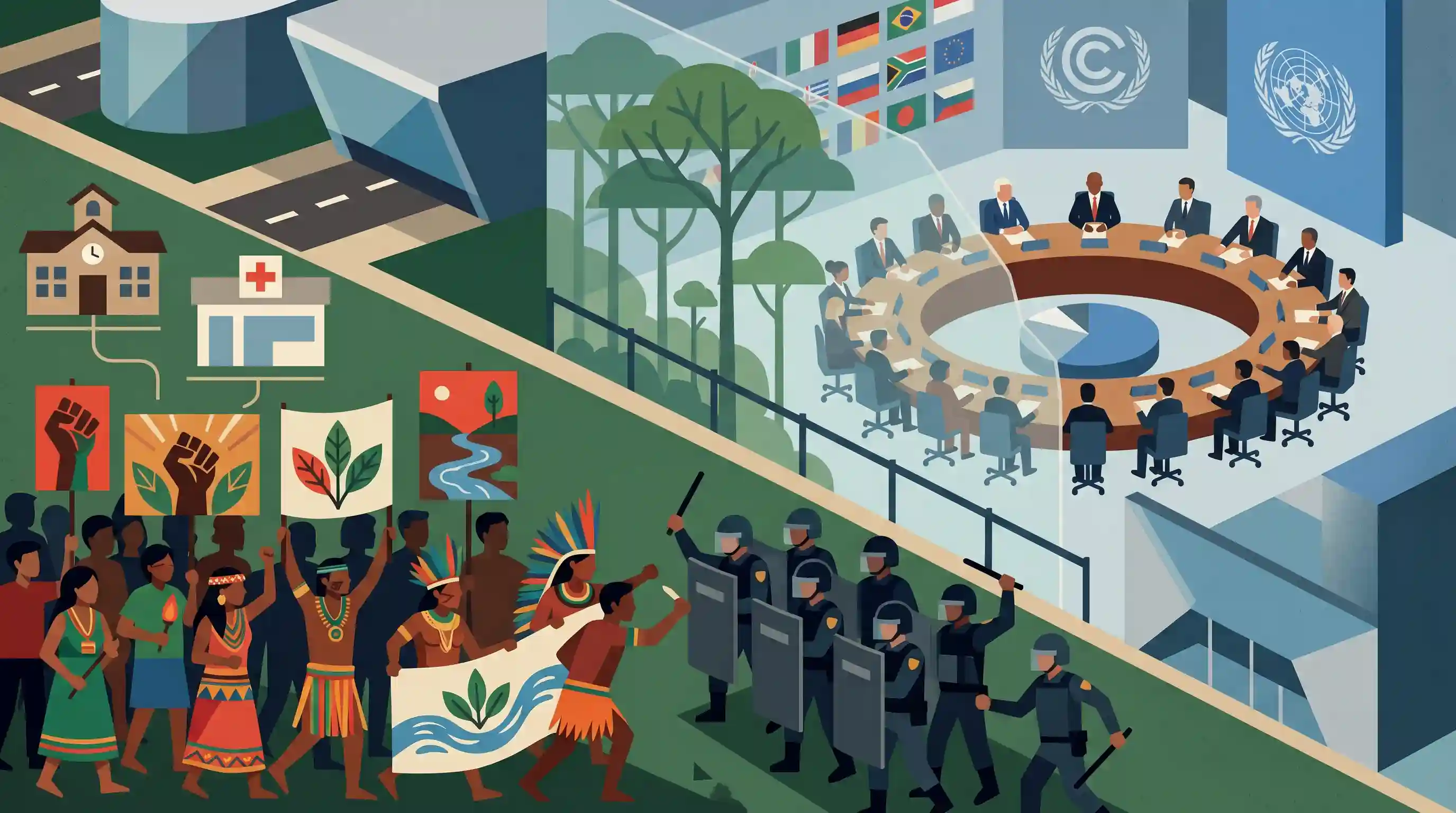
Protests erupted outside the COP30 UN Climate Change Conference in Belém, Brazil, as Indigenous community members and climate activists clashed with security personnel. The demonstrators demanded greater inclusion in the climate negotiations, arguing that decisions regarding the Amazon and climate action should not be made without local participation. They also voiced frustration over the disproportionate spending on conference infrastructure compared to chronic local underfunding in education, healthcare, and forest protection. The unrest highlights the persistent divide between high-level global climate diplomacy and grassroots climate justice initiatives.
Key Points
- Protesters, including Indigenous community members, clashed with security outside the main venue of the COP30 UN Climate Change Conference in Belém, Brazil.
- Activists expressed frustration over their exclusion from the decision-making process, highlighting the slogan 'They cannot decide for us without us.'
- Protesters criticized the extensive funding allocated to conference infrastructure while local needs like education, health, and forest protection are neglected.
- The incident underscores the ongoing tensions between high-level international climate diplomacy and grassroots climate justice movements.
Important Terms
UNFCCC (United Nations Framework Convention on Climate Change)

A 1992 multilateral treaty aimed at stabilizing atmospheric greenhouse gas concentrations. It provides the framework for global climate negotiations and subsequent agreements like the Kyoto Protocol and Paris Agreement.
UPSC context
GS Paper 3: Environment & Ecology. Essential for understanding international climate governance, environmental treaties, and global mitigation strategies.
COP30 (Conference of the Parties)
The 30th UN Climate Change Conference, held in 2025 in Belém, Brazil. It focused on implementing climate finance targets and protecting the Amazon rainforest.
UPSC context
GS Paper 3: International Environmental Summits. Tests knowledge of recent global climate milestones and specific regional initiatives like the Amazon Fund.
Climate Justice
A framework that views global warming as an ethical and political issue rather than purely environmental, highlighting that the burdens of climate change fall disproportionately on vulnerable communities.
UPSC context
GS Paper 3/4: Environment & Ethics. Tests the ability to discuss equity, historical responsibility, and the social impact of environmental policies.
Indigenous Peoples' Rights
The legal and political protections for traditional communities, particularly their right to land, self-determination, and inclusion in environmental decision-making processes.
UPSC context
GS Paper 2: Social Justice/Governance. Relevant for questions on marginalized groups and the Forest Rights Act in India.
Pressure Groups
Organized associations that seek to influence government policy and public opinion on specific issues (like environment) without contesting elections directly.
UPSC context
GS Paper 2: Polity & Governance. Tests the role of civil society and interest groups in shaping democratic policy.
Amazon Rainforest
The world's largest tropical rainforest, located primarily in Brazil, critical for global biodiversity and acting as a major carbon sink to mitigate climate change.
UPSC context
GS Paper 3: Environment/Biodiversity. Tests understanding of critical ecosystems and their role in global climate stabilization and international conservation.
YOUNGO
The official Children and Youth constituency of the UNFCCC, a network of youth activists and NGOs that provides policy inputs into climate negotiations.
UPSC context
GS Paper 2/3: International Institutions. Relevant for discussing the role of non-state actors and youth participation in global diplomacy.
Prelims Trap
"Indigenous communities have formal voting rights in UNFCCC climate negotiations."
Indigenous groups and civil society hold "Observer" status. Formal decision-making, negotiations, and voting are strictly reserved for Party States, despite the existence of the LCIPP.
Static Concepts Connected
What is the Local Communities and Indigenous Peoples Platform (LCIPP)?
- Origin: Established under the UNFCCC framework during COP 21 (Paris).
- Objective: Designed to integrate traditional knowledge, practices, and technologies of indigenous communities into global climate action.
- Limitations: Provides a formal space for dialogue but does not confer voting rights or decision-making power to indigenous groups.
How does 'Climate Justice' function within global environmental governance?
- Ethical Lens: Frames climate change not just as a physical crisis, but as an ethical and human rights issue.
- Vulnerability Focus: Prioritizes safeguarding marginalized groups and indigenous communities who bear the brunt of climate impacts despite minimal emissions.
- Just Transition: Demands that the shift to low-carbon economies includes social protection and alternative livelihoods for affected local workers.
Cross-Topic Patterns
Indigenous Rights & Carbon Sinks
The preservation of global carbon sinks like the Amazon is heavily linked to indigenous land tenure, mirroring India's debates around the Forest Rights Act (FRA) and community forest resource rights.
Event Infrastructure vs Social Sector
The protest against COP30 infrastructure spending echoes a classic GS2 governance theme: the tension between funding international mega-events (like COP or G20) and chronic local underfunding in health and education.

Expect a 2026 Prelims question testing the exact status of Indigenous groups at the UNFCCC, targeting the LCIPP and observer vs. party roles.
Linked PYQs · 3
Linked PYQs · 3
- 2021MainsGS3
Describe the major outcomes of the 26th session of the Conference of the Parties (COP) to the United Nations Framework Convention on Climate Change (UNFCCC). What are the commitments made by India in this conference?
- 2025MainsGS2
What are environmental pressure groups? Discuss their role in raising awareness, influencing policies and advocating for environmental protection in India.
- 2025MainsGS2
Civil Society Organizations are often perceived as being anti-State actors than non-State actors. Do you agree? Justify.
