Supreme Court rulings on limits of peaceful protest and public spaces
Source:The Hindu ↗
Why It Matters
This article is vital for UPSC aspirants as it provides contemporary Supreme Court interpretations on the limits of fundamental rights (Right to Protest vs. Right to Movement under Article 19) and illustrates the principle of judicial restraint concerning executive policy matters, both of which are core components of the GS2 Polity syllabus.
Summary
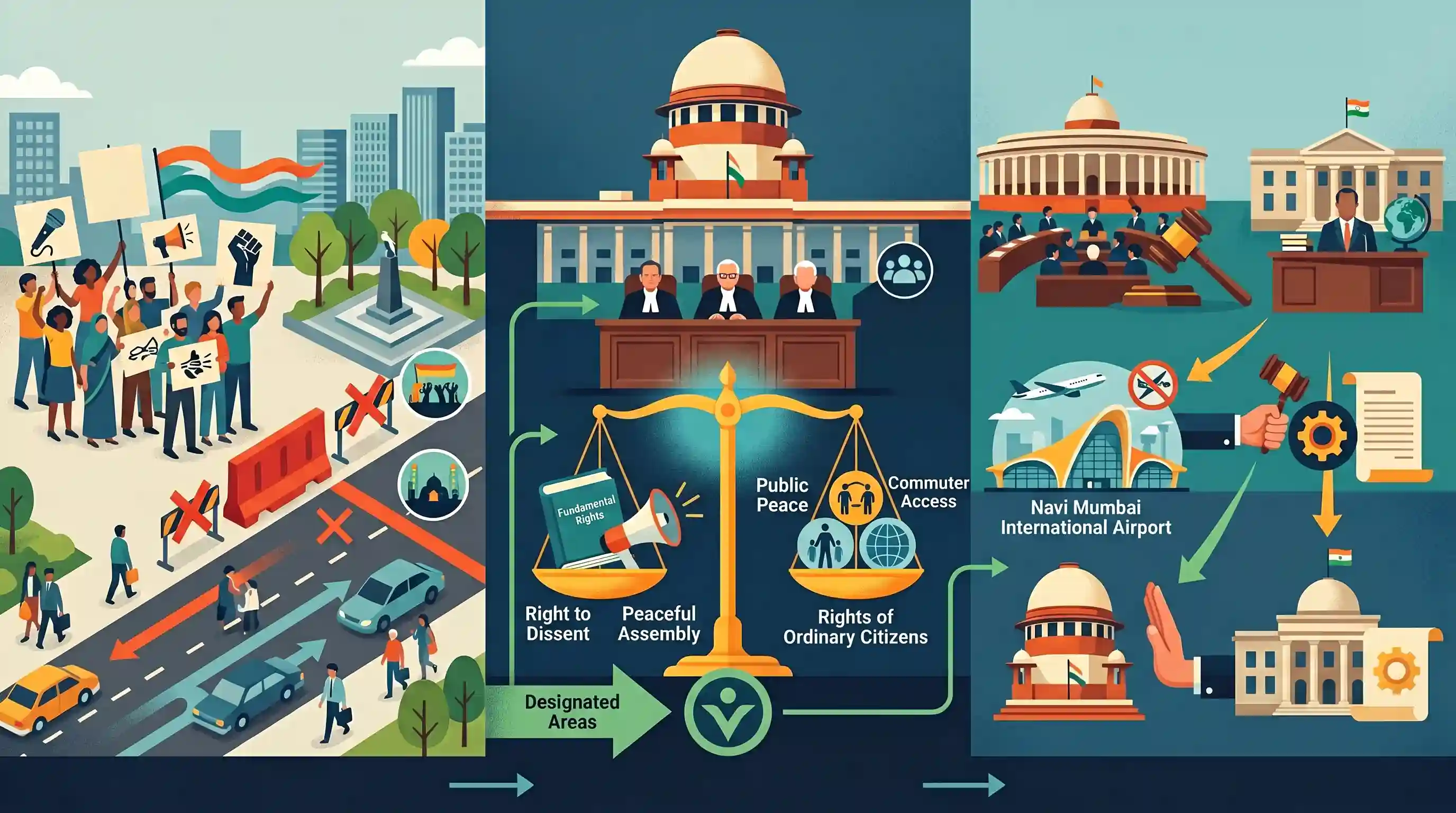
The Supreme Court has reiterated that while peaceful and lawful protest is a fundamental right, it cannot be exercised at the cost of public peace or by indefinitely occupying public spaces. Hearing a petition related to protests over the naming of the Navi Mumbai International Airport, a bench led by Justice Surya Kant emphasized the need to balance the right to dissent with the rights of ordinary citizens and commuters. The Court referenced past rulings, including the 2018 Jantar Mantar judgment and the 2020 Shaheen Bagh verdict, which held that protests must occur in designated areas without obstructing public roads. Additionally, the bench demonstrated judicial restraint by declining to adjudicate on the airport's name, categorizing it as an executive policy matter outside the judiciary's purview.
Key Points
- The Supreme Court ruled that while peaceful protest is a fundamental right, dissent must not disturb the peace or permanently occupy public spaces.
- The right of protesters must be balanced against the right of commuters to free movement, reaffirming the precedent set by the 2020 Shaheen Bagh judgment.
- Protests should be confined to designated areas, as noted in the 2018 ruling that lifted the ban on demonstrations at Jantar Mantar and Boat Club.
- The Court exercised judicial restraint by refusing to intervene in the naming of the Navi Mumbai International Airport, noting that such matters fall strictly under the executive's policy-making domain.
Important Terms
Right to Protest

A fundamental right derived from Article 19(1)(a) (speech) and 19(1)(b) (assembly), allowing citizens to express dissent against the state peacefully and without arms.
UPSC context
GS Paper II: Fundamental Rights. Tests understanding of the scope and limitations of civil liberties in a democracy.
Reasonable Restrictions
Constitutional limitations under Articles 19(2) to 19(6) that allow the State to restrict fundamental rights on grounds like public order, sovereignty, and security of the State.
UPSC context
GS Paper II: Indian Constitution. Essential for analyzing the balance between individual liberty and collective social interests.
Shaheen Bagh Verdict (2020)
A 2020 Supreme Court ruling (Amit Sahni v. Commissioner of Police) stating that public roads and spaces cannot be occupied indefinitely for protests, emphasizing the rights of commuters.
UPSC context
GS Paper II: Judiciary/Judgments. Key case law regarding the geographical and temporal limits of the right to dissent.
Judicial Restraint
A judicial philosophy where courts defer to the executive and legislature on policy matters, avoiding interference unless there is a clear constitutional violation.
UPSC context
GS Paper II: Separation of Powers. Tests the concept of judicial boundaries versus judicial activism.
Public Order
A legal ground under the Constitution used to restrict assembly or speech to maintain communal peace, safety, and the normal functioning of society.
UPSC context
GS Paper II: Polity. Crucial for understanding the state's power to regulate fundamental rights for the common good.
Prelims Trap
"The Right to Protest is an explicitly guaranteed Fundamental Right under Article 19 of the Constitution."
The right to protest is NOT explicitly mentioned in the Constitution. It is an inferred right drawn cumulatively from Freedom of Speech (19(1)(a)) and Assembly (19(1)(b)).
Static Concepts Connected
What are the constitutional restrictions on the Right to Assemble peacefully?
- Sovereignty and Integrity: The right can be restricted if the assembly threatens the territorial integrity or sovereignty of India under Article 19(3).
- Public Order: It can be curtailed to prevent riots, affray, or disruption of public peace (as emphasized in the Shaheen Bagh and Jantar Mantar judgments).
- Without Arms: Article 19(1)(b) specifically grants the right to assemble "peaceably and without arms", entirely excluding armed gatherings from constitutional protection.
What is the Doctrine of Judicial Restraint?
- Executive Autonomy: A principle where judges limit their own power, leaving policy-making and administrative matters (like naming infrastructure) strictly to the executive and legislature.
- Separation of Powers: It prevents judicial overreach by respecting the constitutional boundaries and maintaining the separation of powers between the three organs of the State.
Cross-Topic Patterns
Intra-Part III Rights Conflict
The Shaheen Bagh precedent frequently tests how the Court resolves conflicts between one group's right to protest and another group's right to free movement (Article 19(1)(d)).
Judicial Review vs Executive Policy
Refusal to intervene in the airport's naming shows courts sidestepping political domains, aligning with recent dismissals of PILs targeting executive decisions on infrastructure projects.

Expect a multi-statement Prelims question testing the derived nature of the right to protest, its reasonable restrictions, and Shaheen Bagh.
Linked PYQs · 3
Linked PYQs · 3
- 2022MainsGS2
“Right of movement and residence throughout the territory of India are freely available to the Indian citizens, but these rights are not absolute.” Comment.
- 2020MainsGS2
Judicial Legislation is antithetical to the doctrine of separation of powers as envisaged in the Indian Constitution. In this context justify the filing of large number of public interest petitions praying for issuing guidelines to executive authorities.
- 2019MainsGS2
Do you think that Constitution of India does not accept principle of strict separation of powers rather it is based on the principle of 'checks and balance'? Explain.
