Union Carbide waste disposal plan sparks protests in Dhar
Source:The Hindu ↗
Why It Matters
This current affair directly links two of MPPSC\'s favorite static topics: the Bhopal Gas Tragedy (history, gas leaked, dates) and Pithampur\'s industrial profile (geography, automobile clusters). Understanding the contemporary challenges of Bhopal\'s industrial legacy is vital for state-level environmental and administrative questions.
Summary
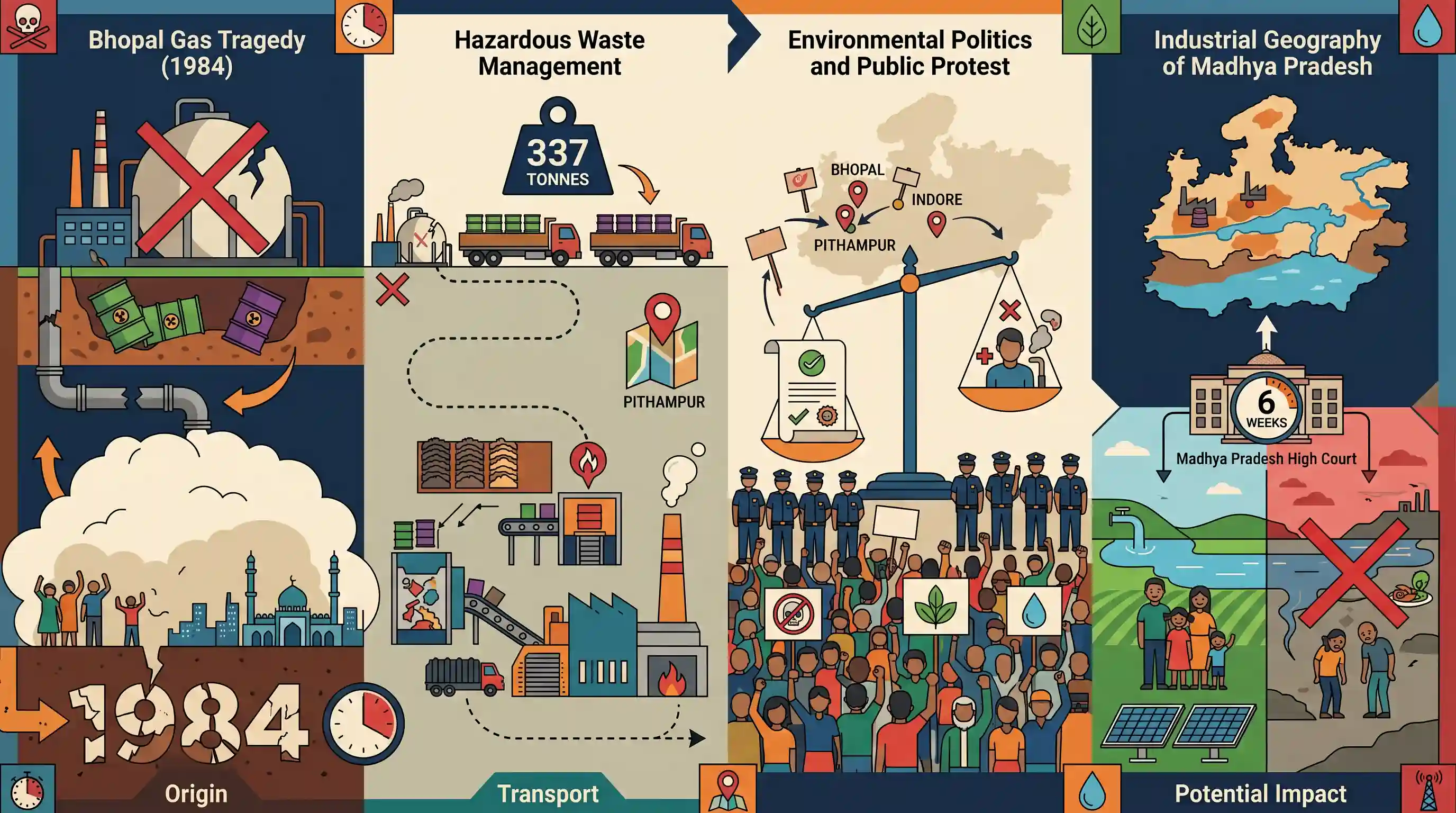
Protests erupted in Indore and Pithampur (Dhar district) against the Madhya Pradesh government\'s decision to incinerate 337 tonnes of decades-old toxic chemical waste from the defunct Union Carbide factory at a private facility in Pithampur. Activists and local organizations claim the incineration poses severe health and environmental risks to the local population. The waste dates back to the Bhopal Gas Tragedy of 1984. The Madhya Pradesh High Court has granted the state government six weeks to complete the disposal safely in accordance with prescribed environmental protocols.
Key Points
- Protests broke out in Indore and the industrial town of Pithampur (Dhar district) against the state government\'s plan to incinerate 337 tonnes of hazardous waste from the defunct Union Carbide pesticide plant in Bhopal.
- Protesters, led by groups like the United Kisan Morcha and trade unions, argue that incinerating chemical waste poses massive health and environmental hazards to the residents of Indore, Dhar, and neighboring areas.
- Pithampur, situated in the Dhar district near Indore, is a major industrial hub recognized as the \'Detroit of Madhya Pradesh\' / \'Detroit of India\' due to its massive automobile industry cluster.
- The hazardous waste is a remnant of the infamous Bhopal Gas Tragedy which occurred on the night of December 2-3, 1984, when highly toxic Methyl Isocyanate (MIC) gas leaked from the Union Carbide India Limited (UCIL) pesticide factory, resulting in thousands of deaths.
- The Madhya Pradesh High Court has granted the state government a six-week window to safely dispose of the chemical waste following strict environmental and safety guidelines.
Important Terms
Union Carbide India Limited

A chemical company whose pesticide plant in Bhopal was the site of the catastrophic 1984 tragedy, leaving behind toxic chemical waste that requires safe disposal.
UPSC context
GS Paper III (Disaster Management & Environment); tests knowledge of industrial disasters, hazardous waste management, and liability.
Madhya Pradesh High Court
The highest judicial body in the state of Madhya Pradesh, which has directed the state government to complete the safe disposal of legacy industrial chemical waste.
UPSC context
GS Paper II (Judiciary); tests role of courts in environmental adjudication and enforcing ecological safety protocols.
United Kisan Morcha
An alliance of agrarian organisations in India that participates in socio-economic protests, including regional environmental campaigns against hazardous waste incineration.
UPSC context
GS Paper II (Pressure Groups); tests the role of non-governmental agrarian networks in socio-environmental issues.
Indian National Trade Union Congress
A major national trade union centre in India, established in 1947, which represents industrial workers and advocates for labour welfare and environmental safety.
UPSC context
GS Paper I (Modern History) & GS Paper II (Pressure Groups); tests history of trade unions and worker activism in India.
Prelims Trap
The Public Liability Insurance Act, 1991, covers compensation claims of both factory workmen and external public victims.
The Act explicitly excludes factory workmen (covered under labor laws) to focus purely on providing rapid 'no-fault' relief to third-party public bystanders.
Static Concepts Connected
What is the Public Liability Insurance Act, 1991, and its 'No-Fault' principle?
- No-Fault Principle: Claimants do not need to prove wrongful act, negligence, or default of any person to receive immediate interim relief.
- Workmen Exclusion: Excludes factory employees (workmen) who are instead covered under separate labor legislation, targeting only third-party public victims.
- Mandatory Insurance: Compels industrial owners handling hazardous substances beyond threshold limits to buy mandatory public liability insurance policies.
How does India regulate transboundary and domestic hazardous waste movement?
- Import Prohibition: Completely bans import of hazardous wastes from other nations for disposal, allowing imports only for resource recovery or recycling.
- Manifest System: Enforces a strict seven-copy physical/digital documentation system (Form 10) to track hazardous waste shipments from generator to facility.
- Authorization Authority: State Pollution Control Boards (SPCBs) hold sole power to grant, renew, or refuse authorization for handling hazardous waste.
Cross-Topic Patterns
Environmental Federalism and NIMBY Politics
Highlights the friction between judicial mandates for toxic waste clearance and local community resistance driven by the 'Not In My Backyard' (NIMBY) environmental hazard response.
Parens Patriae in Ecological Damage
The Bhopal Act of 1985 institutionalized this doctrine, enabling the sovereign state to represent victims, a precedent now used in multi-party climate change litigation.

Public Liability Insurance Act's exclusion of workmen and 'no-fault liability' clauses likely to feature in 2026 environmental law MCQ.
Linked PYQs · 4
Linked PYQs · 4
- 2021MPPSC_PRELIMSGS1
In which year Bhopal Gas disaster occurred?
- 2013MPPSC_PRELIMSGS1
When did the Bhopal Gas tragedy happened?
- 2008MPPSC_PRELIMSGS1
Gas released during Bhopal gas tragedy was:
- 2008MPPSC_PRELIMSGS1
Where is the automobile Industry cluster of Madhya Pradesh?
