Manipur blockade protests escalate as groups breach buffer zone
Source:Indian Express ↗
Why It Matters
The prolonged ethnic violence in Manipur directly relates to internal security challenges in North East India. It illustrates the complexities of managing inter-community disputes, the logistical challenges of border state geography (e.g., highway blockades), and the critical role of central security forces in maintaining 'buffer zones' to prevent civil war-like situations.
Summary
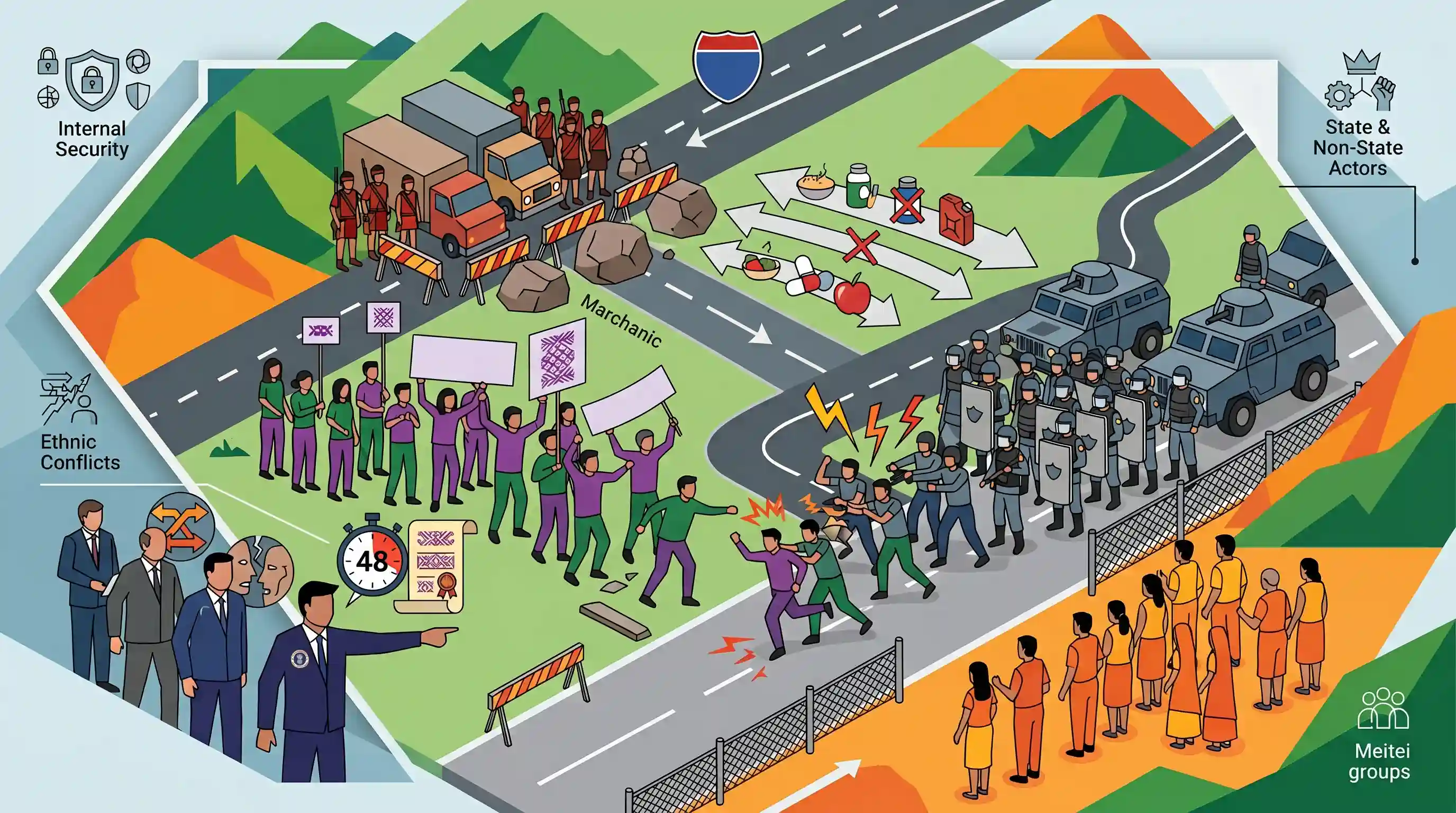
The ethnic conflict in Manipur has escalated with Kuki-Zo groups clashing with security forces while protesting an 'economic blockade' imposed by Naga groups on National Highway-2. The blockade has cut off essential supplies to Kuki-Zo areas in Kangpokpi district. Tensions flared when protesters tried to enter the 'buffer zone' managed by Central forces to separate Meitei and Kuki-Zo communities. A Kuki-Zo organization has issued a 48-hour ultimatum to the state and central governments to restore highway traffic, highlighting the increasingly complex multi-ethnic dimensions of the region's security crisis.
Key Points
- Protests erupted in Manipur's Kangpokpi district as Kuki-Zo groups demonstrated against an 'economic blockade' imposed by Naga groups along National Highway-2.
- Security forces deployed tear gas when protesters attempted to breach the designated 'buffer zone' separating Kuki-Zo and Meitei areas.
- The economic blockade has severely restricted the flow of essential goods into Kuki-Zo dominated territories.
- The Kuki-Zo organization, Committee on Tribal Unity (CoTU), has issued a 48-hour ultimatum to the Centre and the Manipur government to lift the blockade.
- The conflict indicates a complex escalation in Manipur, expanding the ethnic friction to involve Naga groups alongside the ongoing Kuki-Meitei divide.
Important Terms
Committee on Tribal Unity (CoTU)

A socio-political organization in Manipur's Kangpokpi district representing Kuki-Zo interests, focusing on community security, relief, and political advocacy during the ongoing ethnic conflict.
UPSC context
GS Paper III (Internal Security). Tests knowledge of non-state actors and civil society's role in conflict zones.
Economic Blockade
A tactical obstruction of essential transport routes, primarily National Highways, used by ethnic groups to disrupt essential supplies and pressure the government or rival communities.
UPSC context
GS Paper III (Internal Security). Relevant for understanding logistical vulnerabilities and ethnic pressure tactics in Northeast India.
Buffer Zone
Security corridors patrolled by Central forces in Manipur to physically separate warring ethnic communities; though intended as temporary peace measures, they often function as de-facto internal borders.
UPSC context
GS Paper III (Internal Security). Tests understanding of conflict management and the socio-political impact of territorial separation.
National Highway-2 (NH-2)
The primary highway connecting Imphal (Manipur) to Dimapur (Nagaland); it serves as a critical lifeline for essential goods, frequently targeted by ethnic blockades in the region.
UPSC context
GS Paper I (Geography) and III (Security). Highlights the strategic importance of infrastructure in landlocked, conflict-prone states.
Kuki-Zo
An umbrella term for ethnically related Tibeto-Burman tribes (including Kuki, Chin, and Zomi) inhabiting the hills of Manipur, Mizoram, and parts of neighboring Myanmar.
UPSC context
GS Paper I (Society) and III (Internal Security). Central to studying ethnic identity politics and communal conflict dynamics.
United Naga Council (UNC)
The apex civil organization representing Naga tribes in Manipur, often advocating for Naga territorial interests and known for using economic blockades as political leverage.
UPSC context
GS Paper III (Internal Security). Key for analyzing Naga-Kuki ethnic tensions and regional self-determination movements.
Suspension of Operations (SoO) Agreement
A tripartite ceasefire agreement between the Centre, Manipur government, and Kuki-Zo insurgent groups, intended to facilitate political settlement by confining armed cadres to designated camps.
UPSC context
GS Paper III (Internal Security). Crucial for exams covering peace processes and the management of insurgencies.
Prelims Trap
"The 'buffer zones' in Manipur are statutory areas notified under the Armed Forces (Special Powers) Act."
Buffer zones in Manipur are purely operational, temporary security demarcations created by Central Forces to physically separate warring ethnic groups. They lack any constitutional or statutory backing.
Static Concepts Connected
What are the special constitutional provisions for Manipur's administration?
- Article 371C: Empowers the President to constitute a Hill Areas Committee comprising Members of the Legislative Assembly elected from the state's designated Hill Areas.
- Governor's Responsibility: The Governor holds special responsibility to secure the proper functioning of this committee and must submit an annual report to the President on hill administration.
Why are economic blockades a frequent internal security threat in Manipur?
- Topographical vulnerability: Manipur is a landlocked state heavily reliant on narrow, single-artery mountain highways (like NH-2 and NH-37) to import essential goods from neighboring states.
- Strategic choke points: Ethnic groups dominating the hill districts easily choke these routes, using blockades as asymmetric political weapons to extract concessions from rival groups and the state.
Cross-Topic Patterns
Weaponization of topography
Geography makes landlocked North Eastern states structurally vulnerable. The use of economic blockades on single-artery highways seamlessly merges GS1 Physical Geography with GS3 Internal Security challenges.
Multi-polar ethnic conflicts
Initially a binary Kuki-Meitei clash, the intervention of Naga groups against Kuki-Zo areas demonstrates how tribal friction in the North East often evolves into complex, multi-front security crises.

Expect a Mains GS3 question on the 'weaponization of transport corridors' by non-state actors, or map-matching of NE highways.
Linked PYQs · 2
Linked PYQs · 2
- 2017MainsGS3
The North-East region of India has been infested with insurgency for a very long time. Analyze the major reasons for the survival of armed insurgency in this region.
- 2019MainsGS3
Cross-border movement of insurgents is only one of the several security challenges facing the policing of the border in North-East India. Examine the various challenges currently emanating across the India-Myanmar border. Also, discuss the steps to counter the challenges.
