Rural Non-Farm Employment Growth Dynamics and Structural Shifts
Source:Indian Express ↗
Why It Matters
Understanding the drivers of rural non-farm employment is vital for civil services aspirants to evaluate structural transformation, rural distress, and employment policies in India's economy.
Summary
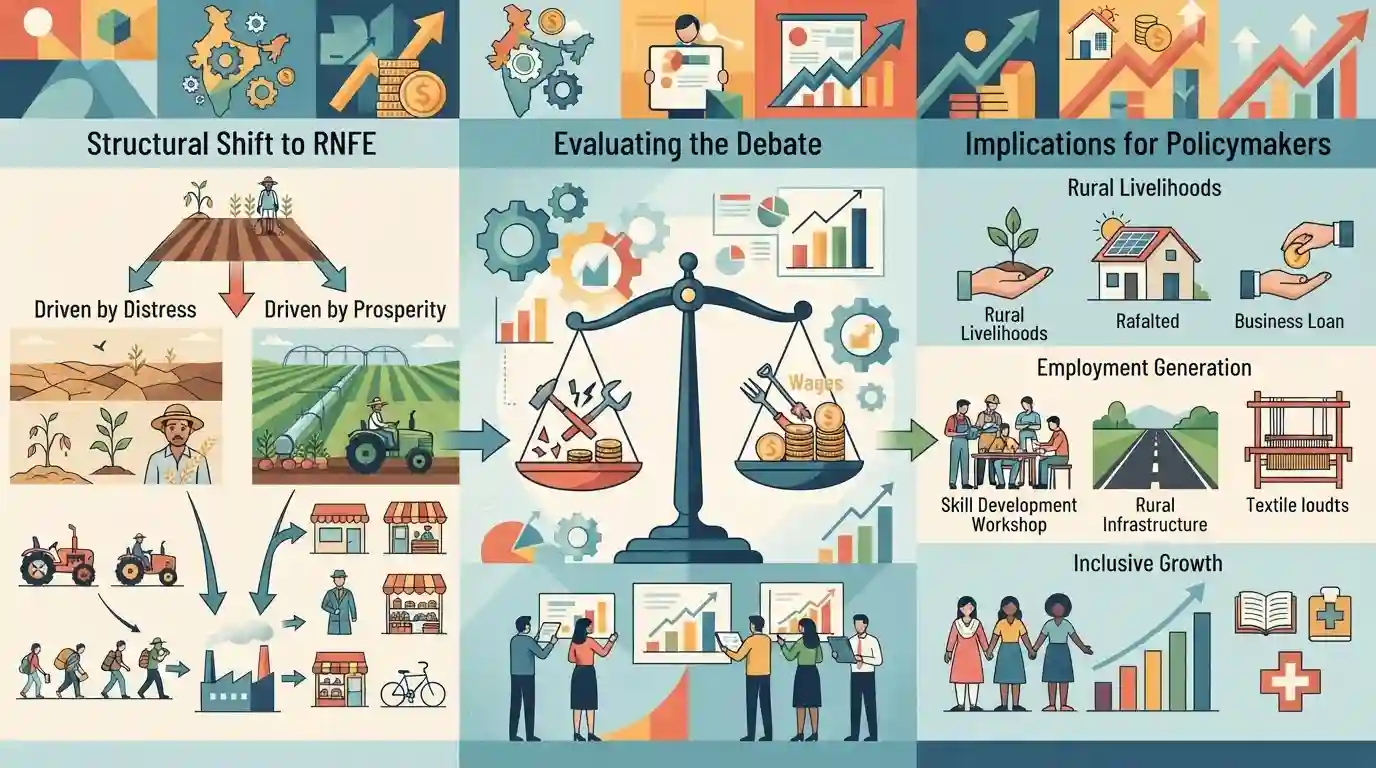
The article examines the growth of rural non-farm employment (RNFE) in India, evaluating the core debate of whether this structural shift is propelled by economic prosperity or agrarian distress. It highlights the implications for policymakers addressing rural livelihoods, employment generation, and inclusive growth.
Key Points
- Rural non-farm employment (RNFE) has grown significantly in India, raising questions about whether it is driven by economic prosperity or agrarian distress.
- Distress-led diversification occurs when workers are pushed out of low-income agriculture into informal, low-paying rural non-farm jobs (such as construction or petty trade) due to unviable farm incomes.
- Prosperity-led diversification happens when rising rural incomes, commercialization of agriculture, and better infrastructure create demand-driven, high-productivity non-farm opportunities.
- Analyzing RNFE trends is crucial for formulating effective rural development, employment generation, and poverty alleviation policies.
Important Terms
Periodic Labour Force Survey (PLFS)

A nationwide survey launched by the National Statistical Office (NSO) to measure employment, unemployment, and labor force metrics across rural and urban India at regular intervals.
UPSC context
UPSC GS Paper III (Indian Economy): Essential for assessing employment generation, structural shifts, and rural labor market trends.
Ministry of Labour and Employment
A central government ministry responsible for protecting workers' interests, regulating labor conditions, administering social security, and formulating employment-related policies.
UPSC context
UPSC GS Paper II & III: Relevant to social justice, labor legislation, governance, and institutional mechanisms for welfare.
Labour Bureau
An attached office under the Ministry of Labour and Employment that collects, compiles, and analyzes labor statistics, price indices, and employment data in India.
UPSC context
UPSC GS Paper III (Inclusive Growth/Data Analytics): Tests knowledge of official statistical bodies tracking labor economics and employment metrics.
Static Concepts Connected
What is the difference between distress-led and prosperity-led rural non-farm employment diversification?
- Distress-led push: Driven by unviable farm incomes, pushing surplus or impoverished labor out of agriculture into low-paying, informal jobs like casual construction or petty services.
- Prosperity-led pull: Propelled by rising rural purchasing power, better rural connectivity, and commercial agriculture, creating demand-driven, high-productivity non-farm opportunities.
Cross-Topic Patterns
Structural transformation and surplus labor models
The shift from agriculture to rural non-farm employment directly connects to structural transformation theories, illustrating how surplus labor moves across sectors during development.
PLFS data and rural poverty metrics
Data sources like the PLFS track these rural workforce transitions, linking employment metrics directly to poverty alleviation policy design.

Distress vs. prosperity-led RNFE diversification is a prime candidate for a Mains analytical question on structural employment shifts.
Linked PYQs · 2
Linked PYQs · 2
- 2015MainsGS3
Livestock rearing has a big potential for providing non-farm employment and income in rural areas. Discuss suggesting suitable measures to promote this sector in India.
- 2020PrelimsGS1
With reference to the Indian economy after the 1991 economic liberalization, consider the following statements: 1. Worker productivity (₹ per worker at 2004-05 prices) increased in urban areas while it decreased in rural areas. 2. The percentage share of rural areas in the workforce steadily increased. 3. In rural areas, the growth in non-farm economy increased. 4. The growth rate in rural employment decreased. Which of the statements given above is/are correct?
