Draft Electricity Amendment Bill 2025 Sparks Federalism Debate
Source:The Hindu ↗
Why It Matters
The issue highlights ongoing Centre-State tensions over subjects in the Concurrent List. Comparing the proposed Electricity Council to the GST Council provides a vital case study on cooperative vs. coercive federalism, a frequent theme in GS2.
Summary
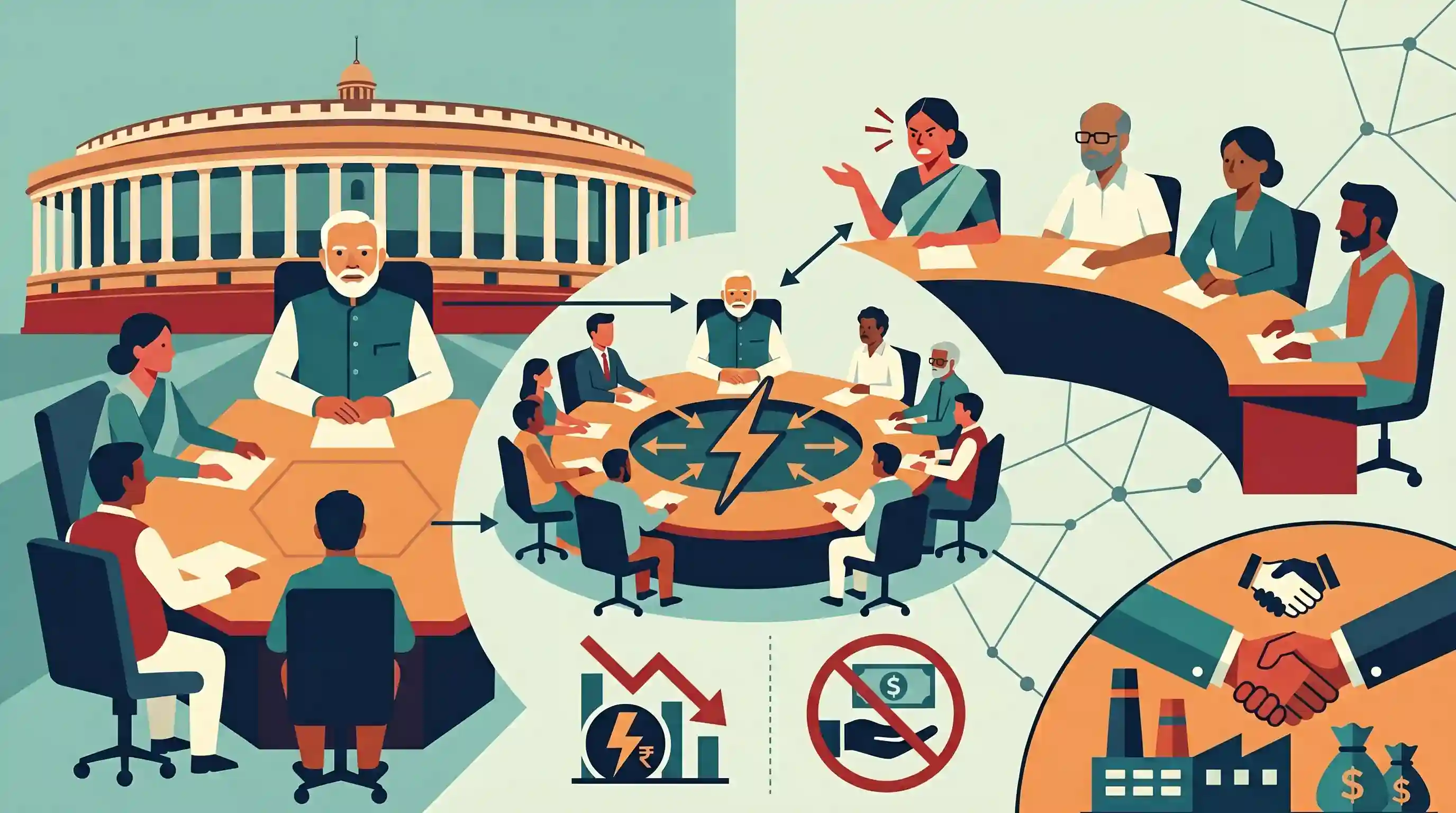
The Union Government's draft Electricity (Amendment) Bill, 2025 has sparked federalism concerns with its proposal to establish a national-level 'Electricity Council'. Analogous to the GST Council, the body would be chaired by the Union Power Minister and include State Power Ministers. States like Kerala have strongly opposed the move, asserting that electricity is a Concurrent List subject. Critics argue that such a council could encroach on State autonomy, centralize tariff control, restrict state-level power subsidies, and potentially act as a stepping stone toward the privatization of the power distribution sector.
Key Points
- The draft Electricity (Amendment) Bill, 2025 proposes to create a national-level 'Electricity Council' to advise on tariffs and power sector matters.
- The Council would be chaired by the Union Power Minister, with State Power Ministers acting as members.
- Kerala has raised federalism concerns, arguing the Council might dilute state powers over electricity, which is a Concurrent List subject (Entry 38).
- States fear the move mirrors the GST Council model, potentially centralizing decisions on tariffs and subsidies and paving the way for privatization of distribution networks.
Important Terms
Electricity (Amendment) Bill 2025

A proposed legislation (released October 2025) seeking to reform India's power sector by introducing competition in distribution, mandating cost-reflective tariffs, and rationalizing cross-subsidies to improve DISCOM financial health.
UPSC context
GS Paper 3: Infrastructure (Energy) and GS Paper 2: Governance (Policy interventions for sector development).
Electricity Council
A national-level body proposed in the 2025 Bill, chaired by the Union Power Minister, designed to advise governments and facilitate consensus on electricity reforms and policy alignment.
UPSC context
GS Paper 2: Federalism (Inter-state coordination) and Statutory Bodies. Tests understanding of cooperative federalism vs centralization.
Electricity Act 2003
The landmark legislation that unbundled India's power sector into generation, transmission, and distribution, introducing competition, de-licensing generation, and establishing regulatory commissions (CERC/SERCs).
UPSC context
GS Paper 3: Infrastructure. Fundamental knowledge for any energy-related question or reform analysis.
GST Council
A constitutional body (Article 279A) chaired by the Union Finance Minister that makes recommendations on GST matters; used as a reference for the proposed Electricity Council's structure.
UPSC context
GS Paper 2: Federalism and Indian Economy. Often cited as a model for "Cooperative Federalism" in policy debates.
Concurrent List (Electricity)
Entry 38 of List III in the Seventh Schedule, allowing both Centre and States to legislate on electricity, though central law prevails in case of conflict (Article 254).
UPSC context
GS Paper 2: Indian Constitution (Seventh Schedule). Vital for understanding legislative jurisdiction and federal friction in reforms.
Prelims Trap
Electricity is a State List subject, giving state governments exclusive jurisdiction over power distribution and tariffs.
Electricity is actually in the Concurrent List (Entry 38). While states heavily manage distribution (Discoms), the Centre has concurrent power to legislate on electricity reforms.
Static Concepts Connected
What is the economic concept of cross-subsidization in India's power sector?
- The Mechanism: Charging commercial and industrial consumers higher electricity tariffs to subsidize the cost of power for agricultural and residential users.
- Economic Impact: It artificially inflates input costs for domestic industries, making Indian manufacturing less competitive in global markets.
- Regressive Nature: Economic Surveys repeatedly argue that untargeted power subsidies are regressive, often benefiting high-consuming wealthier households rather than the absolute poor.
How does Article 254 resolve legislative conflicts on Concurrent List subjects like Electricity?
- Doctrine of Repugnancy: If a State law contradicts a Central law on a Concurrent List subject, the Central law prevails and the State law is void to the extent of repugnancy.
- Presidential Exception: If the State law was explicitly reserved for the consideration of the President and received their assent, it prevails over the Central law within that specific state.
Cross-Topic Patterns
The 'Council-ization' of Federalism
Using apex councils (GST Council, proposed Electricity Council) reflects a growing governance pattern: shifting economic decision-making in state/concurrent domains to centralized, Centre-led deliberative bodies.
Discom insolvency limits RE Transition
Eliminating cross-subsidies is vital to cure Discom insolvency. Chronically bankrupt Discoms cannot invest in grid modernization necessary to integrate India's target of 500 GW of renewable energy by 2030.

Expect a 2026 Mains GS2 question evaluating the 'Council model' of cooperative federalism, contrasting the GST Council with statutory ones.
Linked PYQs · 3
Linked PYQs · 3
- 2024MainsGS2
What changes has the Union Government recently introduced in the domain of Centre-State relations ? Suggest measures to be adopted to build the trust between the Centre and the States and for strengthening federalism.
- 2019MainsGS2
From the resolution of contentious issues regarding distribution of legislative powers by the courts, 'Principle of Federal Supremacy' and 'Harmonious Construction' have emerged. Explain.
- 2022MainsGS2
“While the national political parties in India favour centralisation, the regional parties are in favour of State autonomy.” Comment.
