Registration Amendment Bill and compulsory property document rules
Source:Indian Express ↗
Why It Matters
The Registration (Amendment) Bill, 2024 is a landmark reform that directly impacts property rights (Article 300A), economic formalization, and governance. For civil servants, understanding how archaic laws are updated to combat modern challenges like black money, money laundering, and benami transactions is crucial, as is navigating the federal dynamics of Concurrent List legislation.
Summary
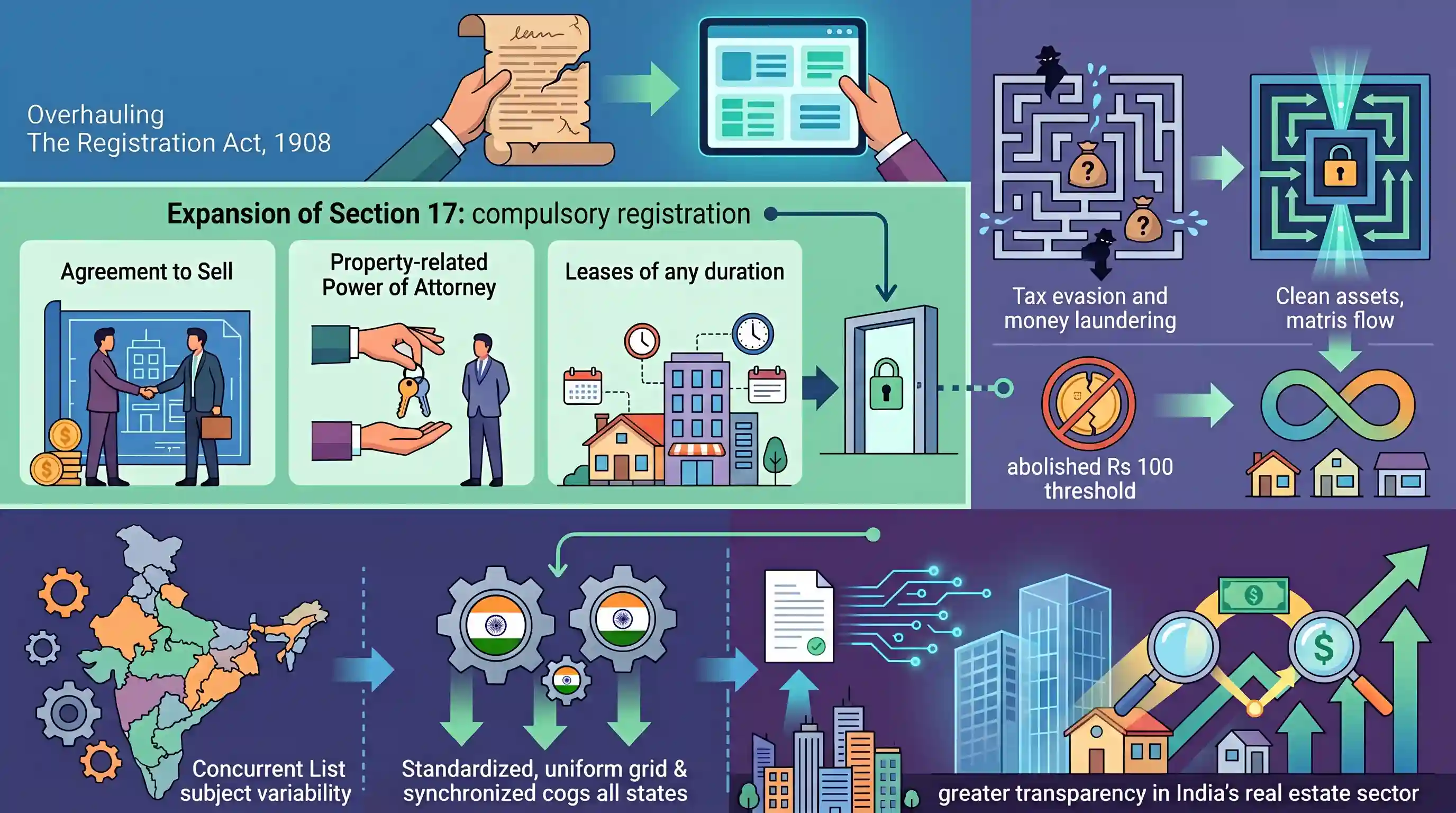
The article outlines the sweeping changes proposed in the Registration (Amendment) Bill, 2024, which overhauls the century-old Registration Act, 1908. By significantly expanding the list of documents under Section 17 that must be compulsorily registered—such as Agreements to Sell (ATS), property-related Powers of Attorney (PoA), and leases of any duration—the government aims to close notorious loopholes used for tax evasion and money laundering. The Bill also abolishes the archaic Rs 100 valuation threshold for mandatory property registration. Functioning as a Concurrent List subject, property registration has historically varied by state; this amendment standardizes the legal framework nationwide, pushing for digitization and greater transparency in India's real estate sector.
Key Points
- The Registration (Amendment) Bill, 2024 expands Section 17 of the Registration Act, 1908 to make the registration of Agreements to Sell (ATS), property-related Powers of Attorney (PoA), and joint development agreements compulsory.
- The Bill removes the archaic Rs 100 value threshold for non-testamentary instruments, mandating the registration of all property transfers regardless of their financial value.
- All immovable property leases must now be registered, removing the previous exemption for leases lasting under one year.
- By formalizing PoA-based property sales and digitizing the process (including anywhere registration and Aadhaar linking), the reform seeks to severely restrict black money, benami transactions, and associated litigation in the real estate sector.
- Because "Registration of deeds and documents" falls under the Concurrent List, the Bill aims to standardize the fragmented, state-amended property registration frameworks into a unified national system.
Important Terms
Registration Act, 1908

The 1908 central legislation governing the registration of documents to ensure public notice, prevent fraud, and establish a permanent legal record of property transactions.
UPSC context
GS II: Government Policies; GS III: Land Reforms. Core act for legal document validity and land governance.
Registration (Amendment) Bill, 2024 (or Registration Bill, 2025)
Proposed legislation aimed at modernizing India's registration system through digitization, mandatory Aadhaar authentication, and expanding the list of documents requiring compulsory registration.
UPSC context
GS II: Statutory Bodies/Acts. Tests knowledge of current legal reforms and Ease of Doing Business.
Transfer of Property Act, 1882
The foundational law governing the transfer of immovable and movable property between living persons, specifying formalities like written deeds and registration for validity.
UPSC context
GS II: Statutory Framework. Critical for understanding property rights and legal procedures for ownership transfer.
Section 17 (Registration Act)
The specific provision in the Registration Act that lists documents—like sale deeds and long-term leases—which must be registered to have legal effect.
UPSC context
GS II: Governance. Tests precision regarding mandatory versus optional legal formalities in property law.
Concurrent List
List III of the Seventh Schedule where both Center and States can legislate; includes "Registration of deeds and documents" and "Transfer of property."
UPSC context
GS II: Federal Structure. Essential for understanding legislative competence and potential Center-State legal conflicts.
Prohibition of Benami Property Transactions Act, 1988
Anti-corruption law prohibiting property holdings where the real beneficiary is different from the person in whose name the property is registered.
UPSC context
GS III: Internal Security/Money Laundering; GS II: Transparency. Tests knowledge of measures against black money.
Agreement to Sell (ATS)
A preliminary contract where a seller agrees to transfer property to a buyer later; the new Bill mandates its registration to prevent fraud.
UPSC context
GS III: Economy/Real Estate. Relevant for understanding the formalization of the real estate sector.
Prelims Trap
Property registration falls exclusively under the State List because land is a State subject.
While 'Land' is strictly in the State List (Entry 18), 'Registration of deeds and documents' is in the Concurrent List (Entry 6), allowing Parliament to enact this nationwide amendment.
Static Concepts Connected
How are Land and Property divided in the 7th Schedule?
- State List: Land, land tenures, agricultural loans, and rent collection fall under State List (Entry 18).
- Concurrent List: Transfer of property (other than agricultural land) and registration of deeds/documents fall under Concurrent List (Entry 6).
What constitutes a Benami transaction under Indian Law?
- Definition: A transaction where a property is transferred to one person, but the consideration (payment) is provided by another person.
- Fictitious Ownership: Includes properties held in fictitious names, or where the owner is unaware of/denies knowledge of the ownership.
- Objective: The core objective is to curb the parking of black money in real estate through proxy owners.
Cross-Topic Patterns
DILRMP + RERA + Digital Stack
The push for Aadhaar-linked 'anywhere registration' complements the Digital India Land Records Modernisation Programme (DILRMP) and RERA, creating a unified digital stack to formalize the real estate economy.
Centralizing Concurrent List subjects
By overhauling a 1908 Act, the Centre uses its Concurrent List powers to override fragmented state-level rules, echoing recent centralizing legislative trends in sectors like cooperatives and environmental regulation.

Expect a 2026 Prelims question testing the 7th Schedule distinction between 'Land' (State List) and 'Registration of Deeds' (Concurrent).
Linked PYQs · 4
Linked PYQs · 4
- 2017PrelimsGS1
With reference to the 'Prohibition of Benami Property Transactions Act, 1988 (PBPT Act)', consider the following statements: 1. A property transaction is not treated as a benami transaction if the owner of the property is not aware of the transaction. 2. Properties held benami are liable for confiscation by the Government. 3. The Act provides for three authorities for investigations but does not provide for any appellate mechanism. Which of the statements given above is/are correct?
- 2021PrelimsGS1
What is the position of the Right to Property in India?
- 2021MainsGS3
Discuss how emerging technologies and globalisation contribute to money laundering. Elaborate measures to tackle the problem of money laundering both at national and international levels.
- 2013MainsGS3
Money laundering poses a serious security threat to a country's economic sovereignty. What is its significance for India and what steps are required to be taken to control this menace?
