India-UK CETA Trade Agreement Contours and UPSC Trade Policy Insights
Source:The Hindu ↗
Why It Matters
This article highlights the evolving landscape of India's economic diplomacy and its approach to Free Trade Agreements (FTAs). Understanding the contours of the India-UK CETA—such as tariff elimination strategies, protection of domestic agriculture, and service sector mobility—is crucial for analyzing India's trade policies and future negotiations with the EU and the US in the Mains exam.
Summary
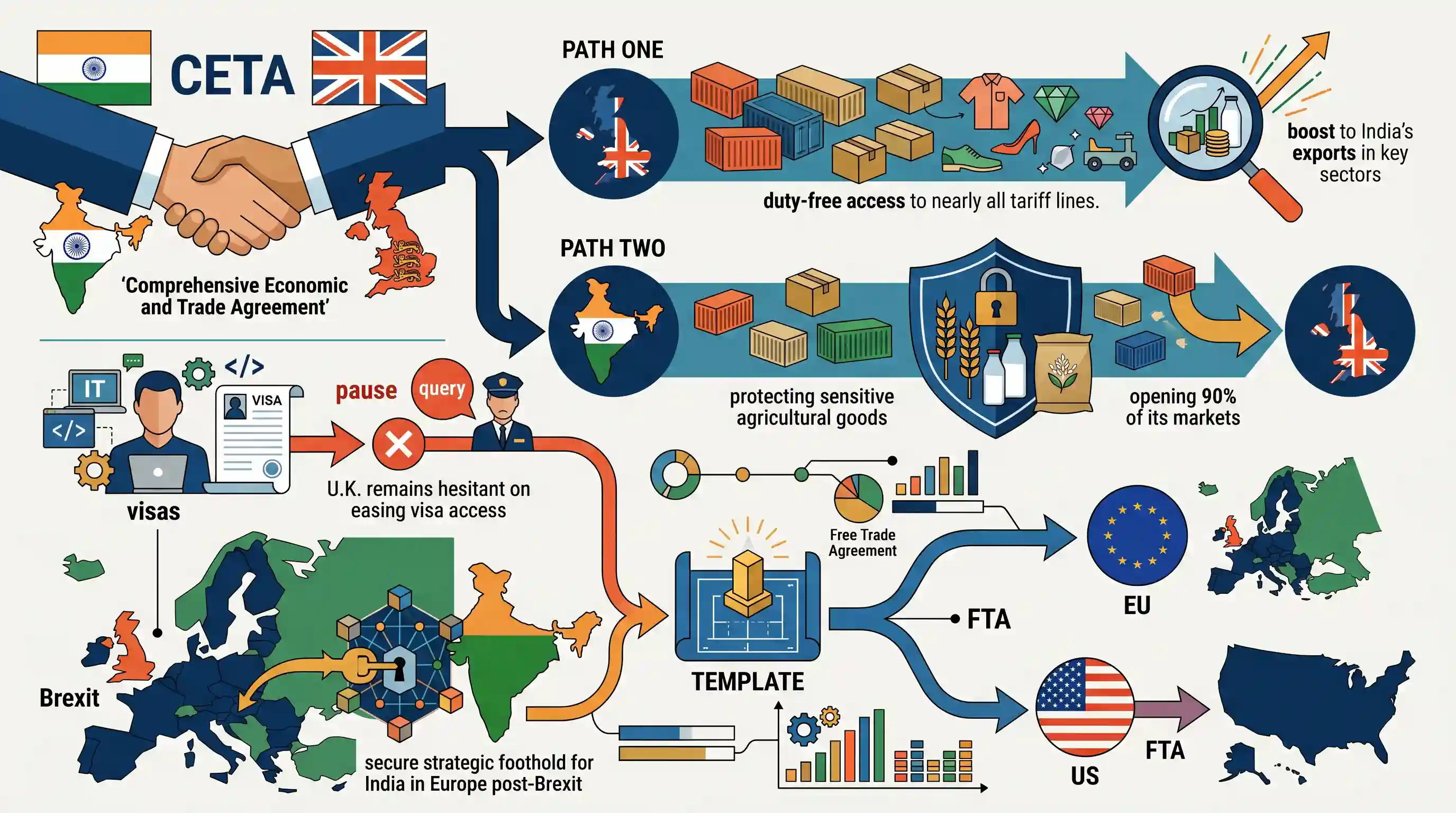
The proposed Comprehensive Economic and Trade Agreement (CETA) between India and the United Kingdom represents a promising compromise that balances mutual trade benefits with domestic protections. The U.K. will offer duty-free access to nearly all its tariff lines, boosting India's exports in key sectors, while India is opening 90% of its markets but protecting sensitive agricultural goods. Although the U.K. remains hesitant on easing visa access for Indian IT professionals, the agreement secures a strategic foothold for India in Europe post-Brexit. Most importantly, the CETA framework is poised to become a template for India's future Free Trade Agreements with major economic blocs like the EU and the US.
Key Points
- India and the United Kingdom have finalized major contours of the Comprehensive Economic and Trade Agreement (CETA).
- The U.K. is providing duty-free access to 99% of its tariff lines, benefiting Indian exports in agriculture, textiles, leather, and chemicals.
- India has opened 90% of its tariff lines but has carefully excluded agricultural products like dairy, apples, oats, and edible oils to protect local farmers.
- India will gradually reduce duties on automobile imports by 100 percentage points over a decade, utilizing graded quotas.
- Despite significant trade concessions, the U.K. remains conservative on visa policies, offering a small quota for specific professions while ignoring broader categories like IT workers.
- The CETA serves as a critical post-Brexit gateway to Europe and sets a strategic template for India's upcoming FTA negotiations with the EU and the US.
Important Terms
Comprehensive Economic and Trade Agreement (CETA)

An official trade pact between India and the UK (signed 2025) designed to double bilateral trade through comprehensive tariff reductions and streamlined professional mobility.
UPSC context
GS Paper II (Bilateral Agreements) and GS Paper III (Economy). Essential for understanding India's trade diversification and strategic post-Brexit engagement.
Free Trade Agreements (FTAs)
A treaty between two or more nations to reduce or eliminate trade barriers like tariffs and quotas, fostering cross-border economic integration.
UPSC context
GS Paper III (Economy). Core concept for analyzing liberalization, export growth, and India's navigation of global trade blocs.
Brexit
The 2020 exit of the United Kingdom from the European Union, which compelled the UK to forge independent bilateral trade deals with economies like India.
UPSC context
GS Paper II (Policies of developed countries). Provides the geopolitical context for the UK's "Global Britain" strategy and India's European market access.
Duty-Free Access
A provision in trade deals allowing goods to enter a country without customs duties, significantly boosting the price competitiveness of exports.
UPSC context
GS Paper III (Economy). Relevant for assessing the growth potential of labor-intensive sectors like textiles, agriculture, and jewelry.
Tariff Lines
Specific categories of products in a country's customs schedule. Negotiating these determines which industries get market access or domestic protection.
UPSC context
GS Paper III (Economy). Tests technical understanding of market access negotiations and "sensitive lists" like India's dairy and agriculture.
Double Contribution Convention (DCC)
A pact (often part of an FTA) that prevents workers from paying social security taxes in two countries for the same income.
UPSC context
GS Paper II (International Relations) and GS Paper III (Economy). Critical for the competitiveness of India's IT and service exports.
Prelims Trap
"The India-UK CETA creates a fully duty-free regime across all sectors, including agriculture, and guarantees free movement of IT professionals."
FTAs rarely cover 100% of tariff lines. India explicitly excluded sensitive agri-products (dairy), and the UK remained highly restrictive on GATS Mode 4 (visas).
Static Concepts Connected
What are the four modes of service supply under WTO GATS?
- Mode 1 (Cross-border): Services cross the border without the provider or consumer moving (e.g., BPO, telemedicine).
- Mode 2 (Consumption): The consumer travels to the foreign country to consume the service (e.g., tourism, foreign education).
- Mode 3 (Commercial): A service provider establishes a physical branch or subsidiary in another country (e.g., foreign banks).
- Mode 4 (Natural Persons): Individuals travel temporarily to another country to provide services (e.g., Indian IT professionals on visas).
How does a Tariff Rate Quota (TRQ) function in international trade agreements?
- In-Quota Rate: Imports up to a specifically agreed quantity (the quota) are allowed entry at a lower, or zero, tariff rate.
- Over-Quota Rate: Any imports exceeding that specific quantity face a significantly higher, often prohibitive, tariff rate.
- Surge Protection: It allows gradual market access for partners while safeguarding domestic producers (like automobile makers) from sudden, overwhelming import surges.
Cross-Topic Patterns
Totalisation Pacts & Services Exports
The Double Contribution Convention prevents Indian short-term workers from paying dual social security. This directly boosts the cost-competitiveness of India's service exports, linking bilateral diplomacy with India's Balance of Payments (BOP).
New-Age FTA Templates & Atmanirbhar Bharat
Excluding dairy while using Tariff Rate Quotas (TRQs) for autos highlights India's shift from generic early-2000s FTAs to heavily calibrated deals that protect rural livelihoods and Atmanirbhar manufacturing goals simultaneously.

Expect a 2026 prelims question pairing 'Tariff Rate Quotas' and 'GATS Mode 4' with India's defensive (agri) and offensive (IT) FTA goals.
Linked PYQs · 4
Linked PYQs · 4
- 2011MainsGS2
Compared to the South Asian Free Trade Area (SAFTA), the Bay of Bengal Initiative for Multisectoral Technical and Economic Cooperation Free Trade Area (BIMSTEC FTA) seems to be more promising." Critically evaluate.
- 2014MainsGS2
The aim of Information Technology Agreements (ITAs) is to lower all taxes and tariffs on information technology products by signatories to zero. What impact would such agreements have on India's interests?
- 2016PrelimsGS1
The term 'Regional Comprehensive Economic Partnership' often appears in the news in the context of the affairs of a group of countries known as
- 2018PrelimsGS1
Consider the following countries: 1. Australia 2. Canada 3. China 4. India 5. Japan 6. USA Which of the above are among the 'free-trade partners' of ASEAN?
