India UK Trade Agreement Tariffs and Bilateral Economic Strategy
Source:The Hindu ↗
Why It Matters
Trade agreements are a core component of both GS2 (International Relations) and GS3 (Indian Economy). Understanding the specific sectoral compromises (like agriculture and auto manufacturing vs. professional visas) helps answer questions on the impact of FTAs on domestic industry and India's broader global trade strategy.
Summary
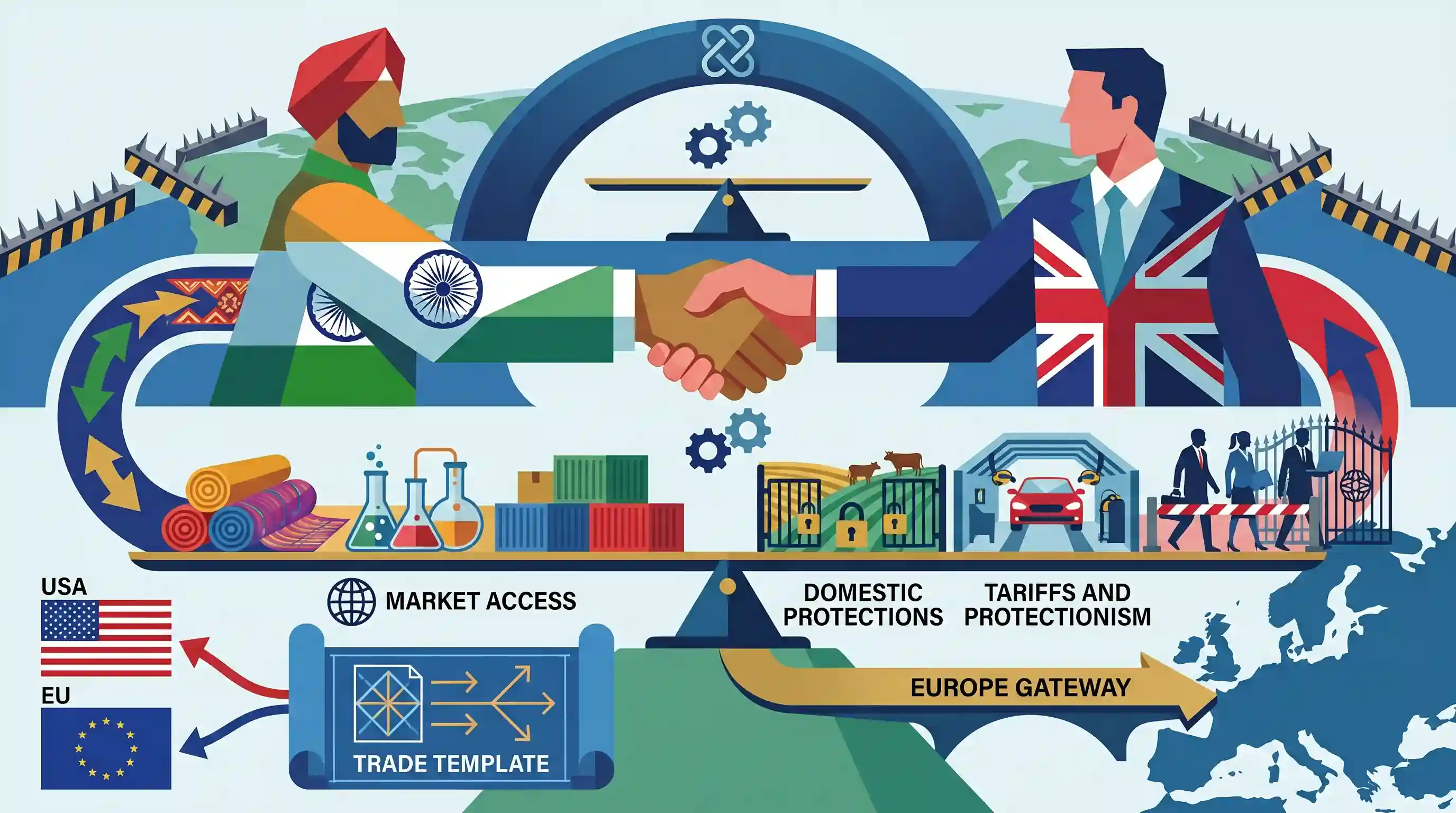
The newly signed India-UK Comprehensive Economic and Trade Agreement (CETA) represents a strategic compromise that balances market access with domestic protections. While providing expansive duty-free access for goods, India safeguarded its agricultural and automotive sectors, and the UK limited concessions on the movement of IT and business professionals. Beyond immediate bilateral gains in sectors like textiles and chemicals, the deal positions the UK as a crucial gateway to Europe and establishes a negotiating template for India's upcoming trade deals with the US and the EU amidst rising global protectionism.
Key Points
- India and the UK have signed the Comprehensive Economic and Trade Agreement (CETA), providing duty-free access for 99% of UK tariff lines and 90% of Indian tariff lines.
- The UK remained conservative on professional mobility, restricting visas to a quota of 1,800 for niche roles rather than broad IT and business categories.
- India protected domestic interests by excluding key agricultural goods (dairy, apples, oats, edible oils) and applying a 10-year graded quota to significant automobile tariff reductions.
- The agreement positions the UK as a duty-free gateway for Indian goods destined for broader European markets.
- This bilateral deal sets a foundational template for India's future trade negotiations with larger economies, such as the United States and the European Union.
Important Terms
India-UK Comprehensive Economic and Trade Agreement (CETA)

A bilateral trade pact signed in 2025 to eliminate 99% of tariffs, double trade by 2030, and deepen strategic ties between India and the UK.
UPSC context
GS II (IR) & GS III (Economy); tests understanding of bilateral trade diplomacy and India's post-Brexit strategic shift.
Mode 4 (Movement of Natural Persons)
Under the WTO's GATS, it refers to the temporary entry of service providers (professionals) across borders to supply specific services.
UPSC context
GS III (Economy); essential for Indian service sector exports and labor mobility negotiations in global trade deals.
Rules of Origin (RoO)
Criteria used in trade agreements to determine the national source of a product, ensuring preferential tariff benefits apply only to member countries.
UPSC context
GS III (Economy); tests knowledge of preventing trade circumvention and protecting domestic industries from third-country dumping.
Tariff Rate Quota (TRQ)
A two-tiered tariff system allowing a limited quantity of imports at lower duties, with higher rates applied to imports exceeding that quota.
UPSC context
GS III (Economy); used to protect sensitive domestic sectors like agriculture while providing calibrated market access to partners.
Geographical Indications (GI)
An intellectual property tag for products whose quality or reputation is essentially attributable to their specific geographical origin (e.g., Basmati rice, Scotch whisky).
UPSC context
GS III (IPR); relevant for trade negotiations involving agricultural protections and traditional knowledge branding.
Non-Tariff Barriers (NTBs)
Trade restrictions like technical standards, health regulations, or licensing requirements that discourage imports without using customs duties or taxes.
UPSC context
GS III (Economy); explores obstacles to Indian exports despite tariff reductions in developed global markets.
Prelims Trap
The India-UK CETA provides comprehensive duty-free access across all sectors including agriculture and ensures unrestricted professional mobility.
UPSC uses extreme words like 'all' or 'unrestricted' to trick candidates. India explicitly excluded sensitive agricultural goods (dairy, apples), and the UK strictly capped Mode 4 professional visas to 1,800.
Static Concepts Connected
What are the 4 modes of services supply under WTO's GATS?
- Mode 1: Cross-border supply, where a service crosses a national border without people moving (e.g., software services from India to the UK).
- Mode 2: Consumption abroad, where consumers travel to the supplying country (e.g., tourism or international students).
- Mode 3: Commercial presence, where a foreign company sets up a subsidiary or branch in another country to provide a service.
- Mode 4: Presence of natural persons, where individuals travel temporarily to another country to provide services (e.g., IT professionals). This is historically India's primary demand in FTAs.
How does a Comprehensive Economic Agreement differ from a standard FTA?
- Scope of goods: Traditional FTAs primarily focus on lowering or eliminating tariffs and quotas on the trade of physical goods.
- Comprehensive coverage: CECA, CEPA, and CETAs are much broader, integrating services, foreign investments, intellectual property rights, customs cooperation, and regulatory harmonization.
Cross-Topic Patterns
Dairy protectionism mirrors RCEP exit
Excluding dairy from the UK CETA directly parallels India's 2019 withdrawal from RCEP, highlighting a consistent policy of shielding domestic small-holder dairy farmers from heavily subsidized international imports.
Trade policy vs. Domestic immigration
India's traditional demand for Mode 4 (movement of natural persons) liberalization is hitting a wall against Western domestic immigration politics, resulting in strict visa quotas in recent FTAs like UK CETA and Australia ECTA.

Expect a 2026 prelims question pairing the India-UK CETA with WTO's GATS Mode 4, testing exceptions for agriculture and professional mobility.
Linked PYQs · 3
Linked PYQs · 3
- 2025MainsGS3
What are the challenges before the Indian economy when the world is moving away from free trade and multilateralism to protectionism and bilateralism? How can these challenges be met?
- 2020MainsGS2
The judicial systems in India and UK seem to be converging as well as diverging in recent times. Highlight the key points of convergence and divergence between the two nations in terms of their judicial practices.
- 2016PrelimsGS1
Which of the following best describes the term 'import cover', sometimes seen in the news?
