Dehradun Residents Propose Tabebuia as Official Memorial Tree
Source:garhwalpost ↗
Why It Matters
Understanding the ecological traits of urban flora (such as invasive vs. non-invasive species) is vital for sustainable environment management. Additionally, state-specific cultural practices like the Harela festival are frequent subjects in UKPSC PCS Prelims.
Summary
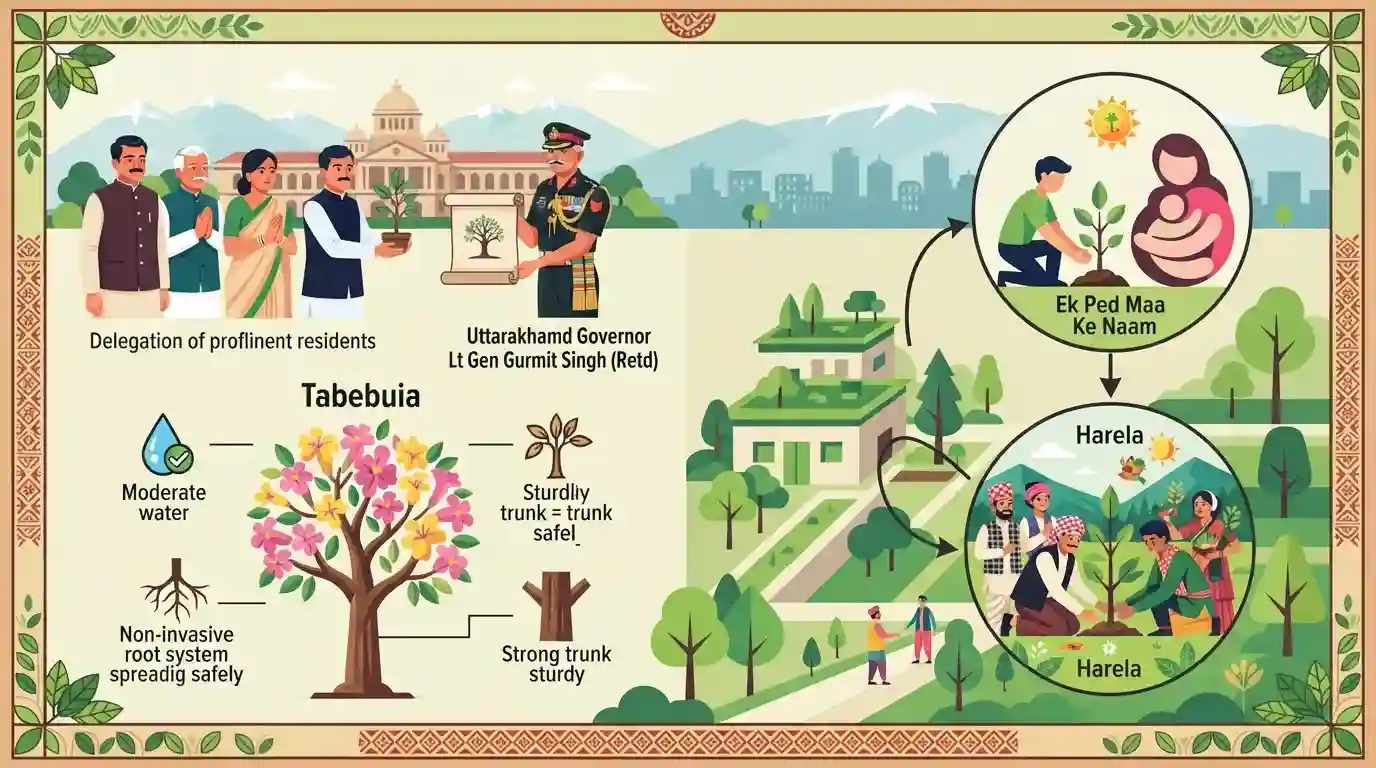
A delegation of prominent residents in Dehradun has urged Uttarakhand Governor Lt Gen Gurmit Singh (Retd) to officially declare the Tabebuia as the city's 'memorial tree'. Known for its vibrant seasonal blooms, the Tabebuia species is being advocated for its ecological benefits—it is non-invasive, sturdy, and requires moderate water. The citizens envision adopting the tree for commemorative plantations under the ambit of Prime Minister Narendra Modi's 'Ek Ped Maa Ke Naam' campaign, beautifully complementing the ethos of Uttarakhand's tree-planting festival, Harela.
Key Points
- Prominent residents of Dehradun met Governor Lt Gen Gurmit Singh (Retd) to propose declaring the Tabebuia species as the official 'memorial tree' of Dehradun.
- The proposal seeks to integrate the Tabebuia tree with the Prime Minister's 'Ek Ped Maa Ke Naam' campaign and the state's traditional Harela festival, both of which emphasize plantation.
- Tabebuia (such as the pink Tabebuia rosea and yellow Tabebuia argentea) is championed because it is non-invasive, deep-rooted, hardy, and has moderate water needs, making it ideal for the local ecosystem.
- The vibrant blossoms of the Tabebuia attract essential pollinators, contributing positively to urban biodiversity while avoiding the pitfalls of invasive plant species.
Important Terms
Tabebuia

A hardy, non-invasive flowering tree species known for vibrant blooms. Dehradun residents have proposed declaring it the city's official "memorial tree" for urban commemorative plantations due to its low water needs and sturdy roots.
UPSC context
Relevant for UKPSC Paper 7 (Environment). Tests awareness of state urban forestry initiatives and current environmental conservation proposals in Dehradun.
Ek Ped Maa Ke Naam
A national environmental campaign launched by PM Narendra Modi on World Environment Day 2024. It encourages citizens to plant trees in honor of their mothers, blending cultural values with global climate action and afforestation goals.
UPSC context
Important for UKPSC Current Affairs and Environment sections. Tests knowledge of national afforestation schemes and their implementation in Uttarakhand.
Harela festival
A traditional agrarian festival of Uttarakhand, primarily celebrated in Kumaon, marking the monsoon's onset and the sowing season. Meaning "Day of Green," it is culturally linked to nature worship and widespread state-supported tree-planting campaigns.
UPSC context
Core topic for UKPSC Paper 5 (Uttarakhand Culture). Tests knowledge of regional agrarian festivals, state heritage, and local environmental traditions.
Prelims Trap
"Tabebuia is an endemic tree of Uttarakhand and serves as the State Tree."
Tabebuia is an introduced ornamental native to the Neotropics, not an endemic Himalayan tree. Buransh (Rhododendron) is Uttarakhand's State Tree.
Static Concepts Connected
What is the cultural and ecological significance of Uttarakhand's Harela festival?
- Monsoon onset: Celebrates the arrival of the monsoon and the new agricultural sowing cycle, predominantly in the Kumaon region.
- Seed sowing: Five to seven types of seeds are traditionally sown in small baskets indoors, symbolizing a prosperous future harvest.
- Modern conservation: The state government has deeply integrated the festival with mass afforestation and state-wide sapling plantation drives.
How do non-invasive alien species differ from invasive species in urban ecology?
- Shared origin: Both are introduced species originating outside their natural geographical range (exotic to the region).
- Ecological impact: Invasive species (e.g., Lantana) aggressively spread and threaten local biodiversity; non-invasive exotics do not disrupt native ecosystems.
- Urban utility: Non-invasive exotics (like Tabebuia) are often utilized in cities for aesthetic appeal, shade, and low maintenance.
Cross-Topic Patterns
Harela + National Plantation Campaigns
Linking traditional festivals like Harela with national drives like 'Ek Ped Maa Ke Naam' demonstrates leveraging regional cultural capital to achieve India's modern climate and afforestation targets.
Urban Forestry vs. Endemic Ecology
The promotion of Tabebuia, a non-native ornamental, highlights the recurring debate in urban forestry between prioritizing aesthetic, non-invasive exotics and preserving endemic Himalayan biodiversity.

Expect a multi-statement question combining Harela's cultural traditions (sowing 5-7 seeds) with recent plantation schemes.
Linked PYQs · 2
Linked PYQs · 2
- 2016UKPSC_PRELIMSGS1
'HARELA' festival of Uttarakhand is related to:
- 2024UKPSC_PRELIMSGS1
According to Forest Survey Report-2021, which of the following district has highest percentage of forest cover (% forest cover to total geographical area of the district) in Uttarakhand ?
