RBI Bulletin Assessment of Geopolitical Risks and Macroeconomy
Source:The Hindu ↗
Why It Matters
Understanding how geopolitical conflicts and protectionist policies affect the Indian economy is critical for GS Paper 3. The proposal for an Economic Stabilisation Fund and measures to ensure energy security are direct examples of policy actions needed to safeguard macroeconomic stability against external shocks.
Summary
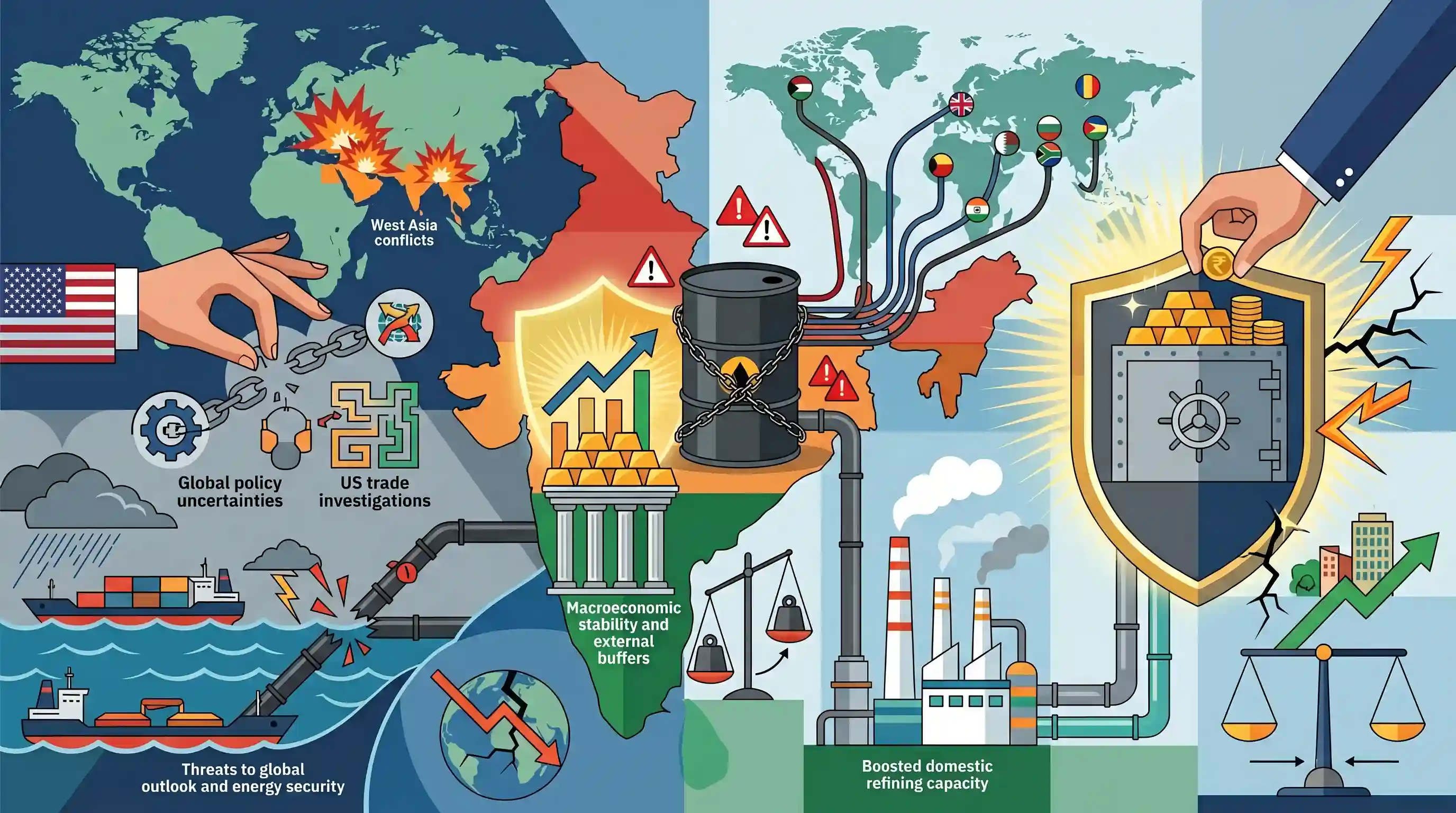
The Reserve Bank of India (RBI) Bulletin’s "State of the Economy" article warns that prolonged conflicts in West Asia and global policy uncertainties, such as US trade investigations, threaten the global economic outlook, energy security, and supply chains. While India’s macroeconomic fundamentals and external buffers have strengthened its resilience against global volatility, its heavy reliance on crude oil imports remains a vulnerability requiring continuous monitoring. To mitigate risks, India has diversified its oil import sources and boosted domestic refining capacity. Furthermore, the RBI highlights the potential creation of an Economic Stabilisation Fund to provide fiscal headroom and cushion the economy against future external shocks.
Key Points
- A prolonged conflict in West Asia and policy uncertainties like US trade investigations threaten global energy security, supply chains, and the broader economic outlook.
- India's capacity to absorb external shocks has improved, backed by strong macroeconomic fundamentals, resilient growth, and external sector buffers.
- The RBI Bulletin suggests the creation of an 'Economic Stabilisation Fund' to build fiscal headroom and buffer the economy against global headwinds.
- Due to heavy reliance on crude oil imports, India is proactively managing its energy security by diversifying import sources and augmenting domestic refining capacity.
Important Terms
Economic Stabilisation Fund (ESF)

A ₹1 lakh crore fiscal buffer proposed to shield the Indian economy from external shocks like oil price spikes and supply chain disruptions without breaching fiscal deficit targets.
UPSC context
GS Paper III: Indian Economy. Crucial for understanding counter-cyclical fiscal policy and shock-absorption mechanisms in budgeting.
Energy Security
The ability of a nation to ensure a reliable and affordable energy supply, which for India involves diversifying crude oil imports and increasing domestic refining capacity.
UPSC context
GS Paper III: Infrastructure/Energy. Tests knowledge of India's strategic petroleum reserves and import-dependency risks.
State of the Economy (RBI Bulletin)
A monthly analytical article by RBI researchers that assesses domestic and global economic conditions, flagging emerging risks like geopolitical tensions and trade policy uncertainties.
UPSC context
GS Paper III: Indian Economy. A primary source for authentic data on inflation, growth projections, and monetary policy stances.
Fiscal Headroom
The flexibility in a government's budget that allows for emergency spending (e.g., fuel subsidies) without compromising long-term fiscal targets or sustainability.
UPSC context
GS Paper III: Fiscal Policy. Important for discussions on the FRBM Act and managing fiscal deficits during global volatility.
Macroeconomic Stability
The robustness of an economy characterized by low inflation, sustainable fiscal deficits, and strong external buffers (like forex reserves) to withstand global volatility.
UPSC context
GS Paper III: Indian Economy. A core theme for questions on economic resilience and India's response to global headwinds.
Supply Chain Resilience
The capacity of global trade networks to anticipate and recover from disruptions, such as West Asia conflicts or trade investigations, through diversification and domestic capacity.
UPSC context
GS Paper II & III: International Relations/Economy. Relevant for discussing Global Value Chains (GVCs) and strategic trade autonomy.
Prelims Trap
The Economic Stabilisation Fund is a monetary policy tool managed exclusively by the RBI.
The ESF is a counter-cyclical fiscal buffer introduced by the government to manage shocks without breaching deficit targets, not a monetary policy tool managed by the RBI.
Static Concepts Connected
What is Counter-Cyclical Fiscal Policy?
- Core Mechanism: The government increases spending/cuts taxes during a downturn, and reduces spending/raises taxes during an economic boom.
- Macroeconomic Purpose: It smooths out the business cycle, preventing severe overheating during booms and deep contractions during recessions.
- Buffer Utility: Funds like the ESF act as a ready pool for counter-cyclical spending without derailing mandated fiscal deficit targets.
How does India manage its Strategic Petroleum Reserves (SPR)?
- Nodal Agency: Managed by Indian Strategic Petroleum Reserves Limited (ISPRL), a Special Purpose Vehicle under the Ministry of Petroleum and Natural Gas.
- Key Locations: Phase I storage facilities are located in underground rock caverns at Visakhapatnam, Mangaluru, and Padur.
- Strategic Buffer: Together with Oil Marketing Companies' storage, the SPR provides a vital buffer of several days to insulate against global supply disruptions.
Cross-Topic Patterns
Maritime chokepoints and imported inflation
Disruptions in the Strait of Hormuz directly spike India's crude import bill, simultaneously widening the Current Account Deficit and injecting imported inflation into the domestic economy.
Forex reserves as import cover buffers
UPSC often tests Forex reserve components alongside their practical utility, such as India's current 11-month import cover acting as a primary shield against external supply-side shocks.

Expect a multi-statement question on the Economic Stabilisation Fund, linking its utility to counter-cyclical fiscal policy and CAD management.
Linked PYQs · 4
Linked PYQs · 4
- 2018MainsGS3
How would the recent phenomena of protectionism and currency manipulations in world trade affect macroeconomic stability of India?
- 2025MainsGS3
What are the challenges before the Indian economy when the world is moving away from free trade and multilateralism to protectionism and bilateralism? How can these challenges be met?
- 2024MainsGS2
‘The West is fostering India as an alternative to reduce dependence on China's supply chain and as a strategic ally to counter China's political and economic dominance.’ Explain this statement with examples.
- 2025MainsGS3
Explain how the Fiscal Health Index (FHI) can be used as a tool for assessing the fiscal performance of states in India. In what way would it encourage the states to adopt prudent and sustainable fiscal policies?
