Calcutta High Court Rules on Railway Land Occupation Rights
Source:millennium-post ↗
Why It Matters
This judgment reinforces key administrative and constitutional laws regarding public/government land management and limits the rights of unauthorised occupants. It directly highlights the legal framework of the Public Premises (Eviction of Unauthorised Occupants) Act, 1971, and relates to state-specific general knowledge regarding India's first metro (Kolkata Metro) and the oldest High Court (Calcutta High Court).
Summary
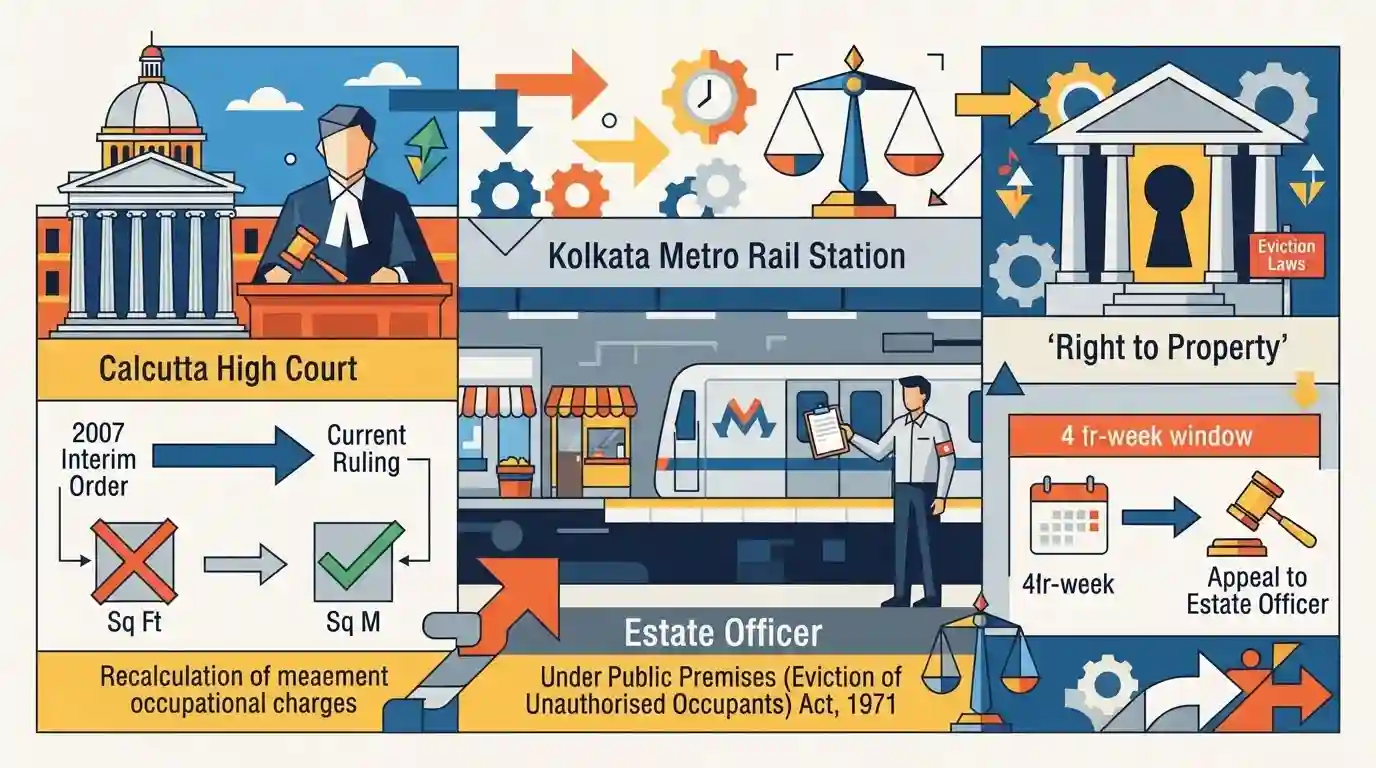
The Calcutta High Court ruled that prolonged occupation of Railway premises does not establish a right to remain in possession after the expiry of a licence. Hearing a case concerning shopkeepers at the Tollygunge Metro Railway Station, Justice Partha Sarathi Chatterjee upheld the eviction proceedings under the Public Premises (Eviction of Unauthorised Occupants) Act, 1971. However, the High Court directed a recalculation of occupational charges by rectifying a 2007 interim order error, changing the charge basis from 'square foot' to 'square metre' (at Rs 10,000/year). It allowed the petitioners four weeks to appeal the eviction before the Estate Officer under Section 9 of the Act.
Key Points
- The Calcutta High Court held that prolonged occupation of railway premises under an expired licence does not confer a legal or indefeasible right to remain in possession.
- The ruling arose from three writ petitions by shopkeepers at Kolkata's Tollygunge Metro Railway Station, whose licences (executed in 1993-94) expired on March 31, 2005.
- The court upheld the eviction proceedings initiated under the Public Premises (Eviction of Unauthorised Occupants) Act, 1971, giving petitioners four weeks to file appeals under Section 9 of the Act.
- The Court corrected a typographical error from a 2007 interim order, changing the occupational charge from 'Rs 10,000 per square foot' to 'Rs 10,000 per square metre' per year, retroactive to May 1, 2005.
Important Terms
Public Premises (Eviction of Unauthorised Occupants) Act, 1971

A central act providing a swift administrative mechanism to evict unauthorized occupants from properties owned or controlled by the central government, public sector undertakings, and other statutory bodies.
UPSC context
WBCS GS Paper V (Polity), testing administrative laws, central government property rights, and tenant eviction procedures.
Calcutta High Court
Established on July 1, 1862, under the High Courts Act, 1861, it is India’s oldest High Court, exercising jurisdiction over West Bengal and the Andaman and Nicobar Islands.
UPSC context
WBCS GS Paper V (Judiciary), testing historical legal systems, jurisdiction, and regional judiciary milestones.
Metro Railway Kolkata
India's first rapid transit system, launched in October 1984. It operates as the only metro network in India classified directly as an official zone of the Indian Railways.
UPSC context
WBCS GS Paper III (West Bengal Geography), testing urban transport systems, historical infrastructure, and local railway administration.
Indian Railways
The state-owned national rail transport network of India, managed by the Ministry of Railways, which has three of its administrative zonal headquarters located in Kolkata.
UPSC context
WBCS GS Paper III (Economic Geography), testing national transport networks, infrastructure hubs, and administrative divisions in West Bengal.
Prelims Trap
Aspirants may believe adverse possession applies to government/railway land under the standard 12-year limitation period.
Under the Limitation Act, 1963, the period for claiming adverse possession against government property is 30 years, not the standard 12 years applicable to private land, and cannot be claimed by licensees.
Static Concepts Connected
What is the constitutional status of the Right to Property in India?
- Amendment history: It is no longer a Fundamental Right. It was deleted from Article 19(1)(f) and Article 31 by the 44th Amendment Act, 1978.
- Current status: It is now a legal and constitutional right under Article 300A in Part XII of the Constitution.
- Legal protection: The state can deprive a person of private property only by 'authority of law' and with legislative sanction.
What are the key historical facts about the Calcutta High Court?
- Establishment: Established on July 1, 1862, under the High Courts Act of 1861, making it the oldest High Court in India.
- Jurisdiction: Holds territorial jurisdiction over both West Bengal and the Union Territory of Andaman and Nicobar Islands.
- Key figures: Sir Barnes Peacock was the first colonial Chief Justice; Justice Phani Bhushan Chakravartti was the first Indian permanent CJ post-independence.
Cross-Topic Patterns
Article 300A + Infrastructure Eviction
Balances the constitutional right to property under Article 300A with the state's eminent domain power to reclaim land for public utilities like Metro Railways.
Public Premises Act + Natural Justice
Eviction under the 1971 Act requires Estate Officers to act as quasi-judicial authorities, ensuring due process before eviction of unauthorised occupants.

Calcutta HC jurisdiction over UTs and Article 300A legal limits remain high-yield for combined polity-GK questions.
Linked PYQs · 3
Linked PYQs · 3
- 2019WBCS_PRELIMSGS1
Metro rail was started in Kolkata in
- 2019WBCS_PRELIMSGS1
First railway line was started in West Bengal between
- 2017WBCS_PRELIMSGS1
The first railway line of India was operationalised in 1853 between
