Great Indian Bustard Captive Release and Rewilding Challenges
Source:Indian Express ↗
આ શા માટે મહત્વનું છે
The Great Indian Bustard is one of India's most critically endangered species, making recovery programs, captive breeding, and rewilding strategies vital topics for wildlife conservation and biodiversity management under GS Paper III.
સારાંશ
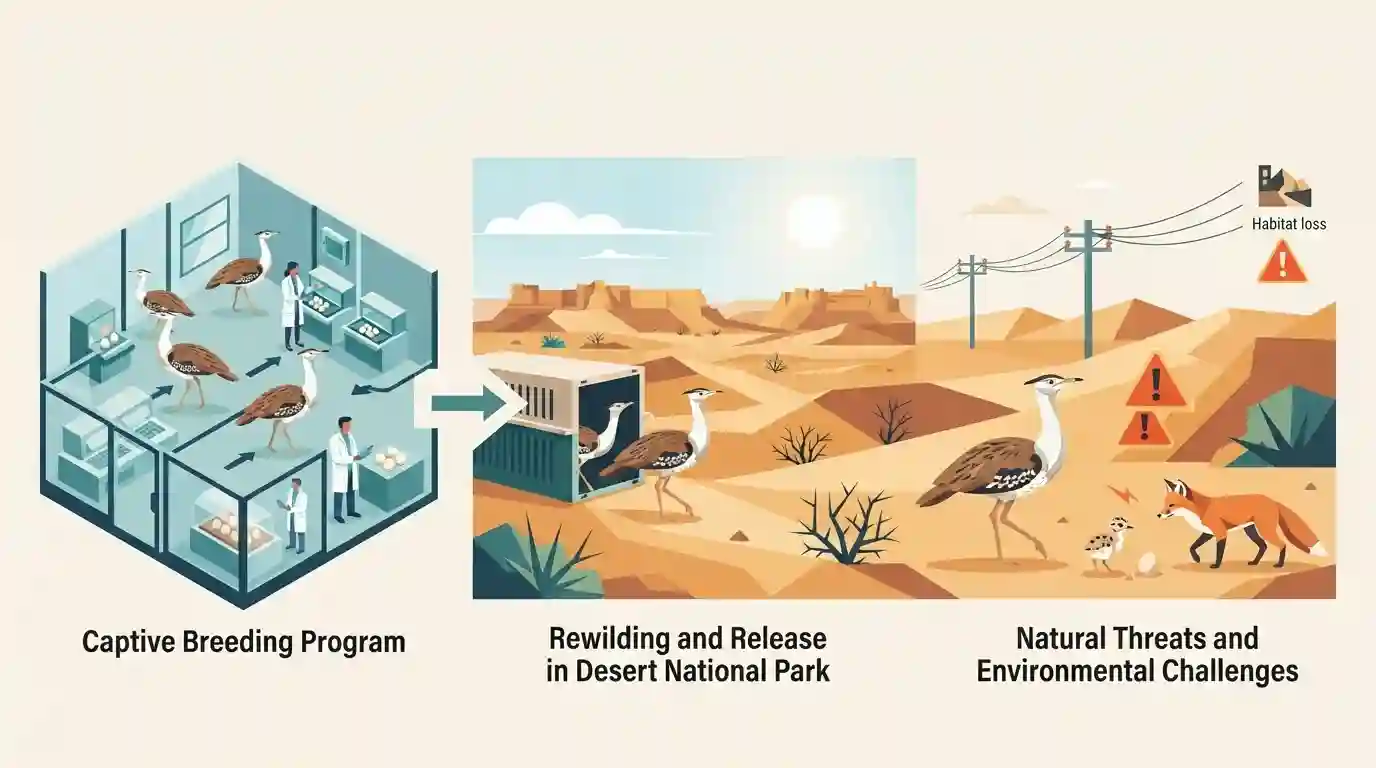
The article discusses the conservation challenges facing the Project Great Indian Bustard, specifically focusing on the captive release and rewilding plan in Jaisalmer's Desert National Park. While captive breeding programs aim to boost the population of the critically endangered bird, threats such as fox predation in their natural habitat pose significant hurdles to successful reintroduction.
મુખ્ય મુદ્દા
- The captive release and rewilding plan for the critically endangered Great Indian Bustard (GIB) faces serious challenges, including fox predation in the Desert National Park, Jaisalmer.
- Conservationists are evaluating predator management strategies to protect captive-bred GIBs being introduced into the wild.
- The initiative highlights the complexities involved in species recovery programs, blending captive breeding with wild habitat adaptation and threat mitigation.
મહત્વપૂર્ણ શબ્દો
Project Great Indian Bustard

A species-specific conservation initiative launched to save the critically endangered Great Indian Bustard from extinction through ex-situ captive breeding, habitat protection, and rewilding programs in Rajasthan.
UPSC context
UPSC Prelims/Mains (GS Paper III): Important species conservation projects, endemic wildlife, and challenges in rewilding endangered fauna.
Desert National Park
Located in Jaisalmer and Barmer districts of Rajasthan, it is a premier protected area and natural habitat for the critically endangered Great Indian Bustard, characterized by fragile desert ecosystems.
UPSC context
UPSC Prelims: Protected areas of India, national parks, and key habitats of endangered species like the Great Indian Bustard.
પ્રિલિમ્સ ટ્રેપ
Desert National Park is a typical sand-dune ecosystem with no major native flora or water bodies, hosting migratory flocks of GIB.
Aspirants often assume Desert National Park is exclusively a desert landscape devoid of water bodies, or that GIB is a migratory bird crossing international borders extensively, which is incorrect.
સંલગ્ન સ્થિર ખ્યાલો
What are the key ecological characteristics and legal protection status of the Great Indian Bustard (GIB)?
- IUCN Status: Critically Endangered status on the IUCN Red List due to sharp population declines.
- Legal Protection: Protected under Schedule I of the Wildlife (Protection) Act, 1972, granting it the highest level of legal protection in India.
- Habitat & Range: State bird of Rajasthan, primarily inhabiting arid and semi-arid grasslands like Desert National Park, Jaisalmer.
- Primary Threats: Faces severe mortality risks from overhead high-voltage transmission lines due to poor frontal vision and heavy body build.
આંતર-વિષય પેટર્ન
Renewable Energy Transmission vs. Endemic Fauna
Linear infrastructure expansion across fragile arid ecosystems threatens endangered avifauna, pitting renewable energy transmission corridors against critical wildlife habitats.
Captive Breeding vs. In-situ Habitat Realities
Ex-situ conservation breeding efforts must systematically address in-situ ecological bottlenecks like invasive/native predation and habitat fragmentation during rewilding phases.

GIB status, legal protection, transmission line mitigation (SC-appointed committee), and captive breeding challenges are high-yield UPSC themes.
સંલગ્ન PYQ · 1
સંલગ્ન PYQ · 1
- 2020PrelimsGS1
With reference to India's Desert National Park, which of the following statements are correct? 1. It is spread over two districts. 2. There is no human habitation inside the Park. 3. It is one of the natural habitats of Great Indian Bustard. Select the correct answer using the code given below:
