Great Indian Bustard Captive Breeding and Rewilding Challenges
Source:Indian Express ↗
આ શા માટે મહત્વનું છે
The article evaluates the practical challenges of species reintroduction and captive breeding for critically endangered species like the Great Indian Bustard, connecting directly to GS3 biodiversity conservation, wildlife management, and ecological challenges.
સારાંશ
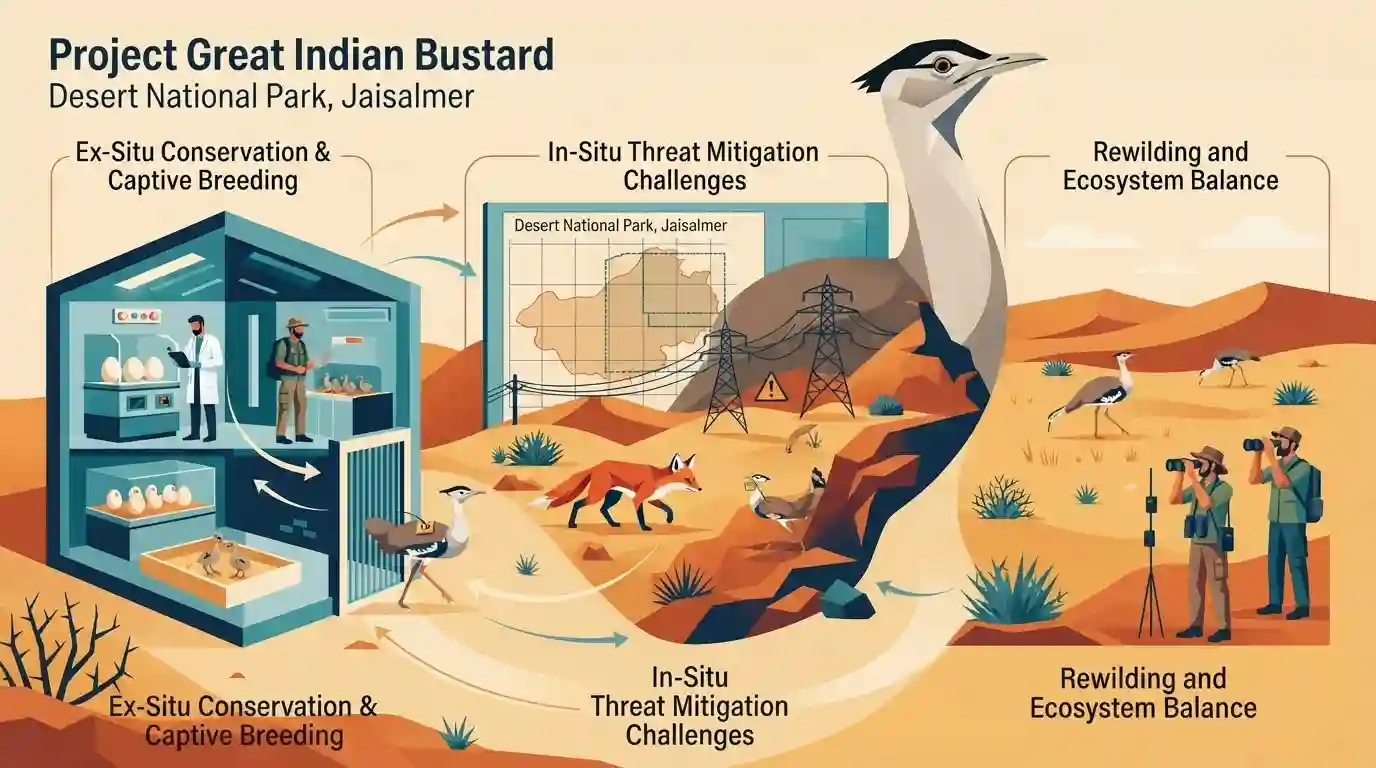
The article outlines the implementation challenges faced by 'Project Great Indian Bustard' in Jaisalmer’s Desert National Park, focusing on captive release and rewilding hurdles such as red fox predation. It highlights the delicate balance required between ex-situ breeding programs and effective in-situ threat mitigation for India's critically endangered state bird of Rajasthan.
મુખ્ય મુદ્દા
- The Great Indian Bustard (GIB) captive breeding and release program faces critical survival challenges, notably from native red fox predation in Rajasthan's Desert National Park (Jaisalmer).
- Rewilding efforts require intense post-release monitoring, predator management, and habitat protection to ensure captive-bred birds adapt successfully to the wild.
- GIB remains one of India's most critically endangered species, heavily impacted by overhead power transmission lines, habitat degradation, and predation.
- The strategy underscores the complex ecological trade-offs and field hurdles involved in ex-situ conservation transitioning to in-situ reintroduction.
મહત્વપૂર્ણ શબ્દો
Project Great Indian Bustard

A species recovery program launched to protect and save India's critically endangered Great Indian Bustard through captive breeding, habitat improvement, and in-situ threat mitigation.
UPSC context
Important for GS Paper III (Environment, Biodiversity Conservation, and Species Recovery Programs).
Desert National Park
A protected area located in Rajasthan's Jaisalmer and Barmer districts, representing the Thar Desert ecosystem and serving as the primary natural habitat for the Great Indian Bustard.
UPSC context
Important for GS Paper III (Protected Area Network, National Parks, and Desert Ecosystem Conservation).
Wildlife Institute of India
An autonomous institution under the Ministry of Environment, Forest and Climate Change that provides scientific guidance and technical support for wildlife research and conservation projects in India.
UPSC context
Important for GS Paper III (Environmental Governance, Research Institutions, and Conservation Policy).
પ્રિલિમ્સ ટ્રેપ
Captive breeding programs fully eliminate the extinction risk of critically endangered species upon release into protected areas.
Aspirants often assume ex-situ captive release alone solves extinction risks, overlooking in-situ threats like native predator pressure and overhead transmission lines.
સંલગ્ન સ્થિર ખ્યાલો
What are the key legal protections and IUCN status of the Great Indian Bustard in India?
- IUCN Status: Critically Endangered under the IUCN Red List due to extremely small, declining populations.
- Legal Protection: Protected under Schedule I of the Wildlife (Protection) Act, 1972, affording the highest degree of legal protection.
- Habitat Range: Found primarily in Rajasthan's Thar Desert, with smaller fragmented populations in Gujarat, Maharashtra, and Andhra Pradesh.
આંતર-વિષય પેટર્ન
GIB Conservation vs. Renewable Energy Targets
Judicial mandates for undergrounding power cables to protect GIB collide directly with India's aggressive renewable energy capacity targets in the Thar desert.
Ex-situ Breeding vs. In-situ Rewilding Trade-offs
The shift from ex-situ captive breeding to in-situ rewilding mirrors similar complex struggles seen in Project Tiger and vulture conservation programs.

GIB conservation + power line mitigation + IUCN status will likely feature as a statement-based prelims question.
સંલગ્ન PYQ · 1
સંલગ્ન PYQ · 1
- 2020PrelimsGS1
With reference to India's Desert National Park, which of the following statements are correct? 1. It is spread over two districts. 2. There is no human habitation inside the Park. 3. It is one of the natural habitats of Great Indian Bustard. Select the correct answer using the code given below:
