Bihar Deputy CM Defends Liquor Prohibition Policy and Social Impact
Source:uniindia ↗
Why It Matters
The socio-economic impact of Bihar's prohibition policy is a recurring theme in state governance discussions. BPSC frequently tests knowledge of major state policies like the 2016 liquor ban, its socio-economic rationale (reducing domestic violence, uplifting marginalized families), and the historical context of temperance movements in Bihar.
Summary
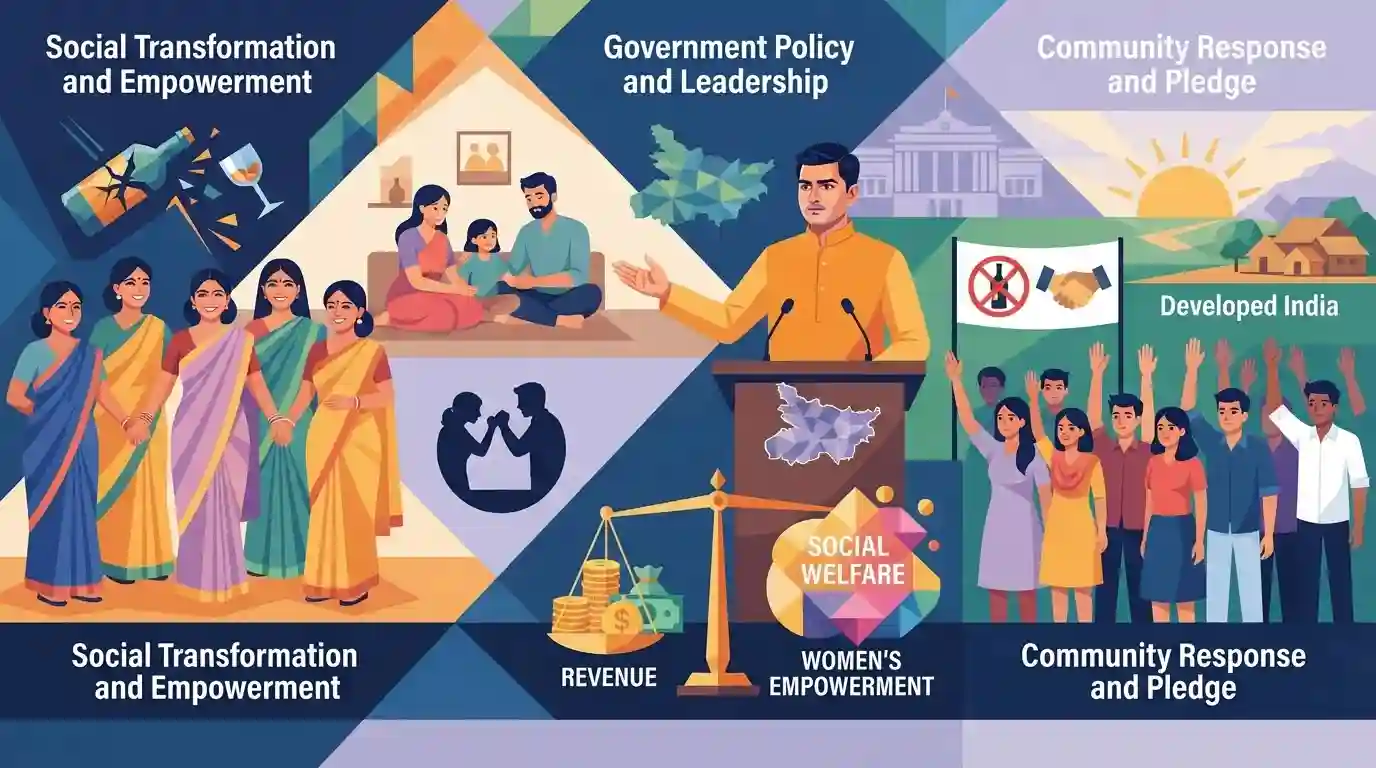
Bihar Deputy Chief Minister Samrat Choudhary strongly defended the state's 2016 liquor prohibition policy, asserting that its positive social transformation, particularly the reduction in domestic violence, outweighs the massive loss in state revenue. Speaking at the launch of the 'Drug-Free Youth for a Developed India Pledge Campaign', he credited CM Nitish Kumar for implementing the ban in response to persistent demands from women. The policy underscores the state's commitment to prioritizing social welfare and women's empowerment over financial considerations.
Key Points
- Bihar Deputy CM Samrat Choudhary emphasized that the 2016 liquor prohibition policy has significantly transformed society, notably reducing domestic violence and crimes against women.
- The state government continues to prioritize societal welfare and women's empowerment over the substantial loss in state excise revenue caused by the liquor ban.
- The prohibition was initially implemented by Chief Minister Nitish Kumar in response to widespread demands from women across the state.
- These remarks were delivered during the launch event for PM Narendra Modi's ‘Drug-Free Youth for a Developed India Pledge Campaign’, aligning the state's prohibition stance with national anti-drug initiatives.
Important Terms
Bihar Prohibition and Excise Act, 2016

A state law enforcing a complete ban on the manufacture, sale, and consumption of liquor in Bihar. While causing substantial revenue loss, it aims to enhance social welfare by curbing domestic violence.
UPSC context
Relevant for GS Paper 2 (Government Policies). Tests understanding of social legislation, state capacity, and governance trade-offs.
Drug-Free Youth for a Developed India Campaign
A nationwide initiative run by the Ministry of Youth Affairs and Sports mobilizing youth to pledge against drug addiction. It aims to build a healthy, empowered society essential for a developed India by 2047.
UPSC context
Important for GS Paper 2 (Social Justice). Tests knowledge of demographic dividend utilization and national anti-substance abuse initiatives.
Article 47 of the Indian Constitution
A Directive Principle of State Policy (DPSP) instructing the State to raise the standard of living, improve public health, and endeavor to prohibit the consumption of intoxicating drinks and injurious drugs.
UPSC context
Crucial for GS Paper 2 (Indian Constitution). Serves as the constitutional basis and justification for state-level liquor prohibition policies.
Social vs. Fiscal Policy Trade-off
The governance dilemma where qualitative social benefits—such as reduced family distress and women's empowerment through prohibition—are prioritized over the quantifiable loss of state excise revenue.
UPSC context
Key for GS Paper 4 (Ethics in Governance). Tests the ability to analyze ethical decision-making and policy cost-benefit dynamics.
Prelims Trap
Alcoholic liquor for human consumption is taxed under GST, with revenues shared equally between the Centre and States.
Alcohol for human consumption is constitutionally excluded from the GST regime. States retain exclusive powers to levy excise duty and VAT on it, making it a critical independent revenue source.
Static Concepts Connected
What is the constitutional framework governing alcohol in India?
- Seventh Schedule Entry: Entry 8 of the State List (Seventh Schedule) gives states exclusive power to regulate the manufacture, possession, transport, purchase, and sale of intoxicating liquors.
- Article 47 DPSP: Article 47 (Directive Principles of State Policy) directs the State to endeavour to bring about prohibition of consumption of health-injurious intoxicating drinks and drugs.
- Taxation Autonomy: Entry 51 of the State List empowers states to levy excise duty on alcohol for human consumption, keeping it outside the GST net.
What are the key pillars of the Nasha Mukt Bharat Abhiyaan (NMBA)?
- Nodal Ministry: Launched in 2020, it is spearheaded by the Ministry of Social Justice and Empowerment to address substance abuse in vulnerable districts.
- Three-Pronged Strategy: Uses a three-pronged approach: supply reduction (via NCB), demand reduction (via Social Justice outreach), and treatment/harm reduction (via Health Ministry).
Cross-Topic Patterns
DPSP implementation vs. Federal Finance
Prohibition clashes directly with fiscal federalism, as states forfeit excise duties (often 15-20% of own tax revenues) to enforce non-justiciable DPSPs like Article 47.
Prohibition and Shadow Economies
Severe legal bans often trigger illicit trade, shifting state challenges from excise regulation to criminal justice and public health crises caused by spurious liquor.

Expect questions testing the exclusion of alcohol from GST alongside Article 47 (DPSP) and Entry 51 of the State List in 2026.
Linked PYQs · 1
Linked PYQs · 1
- 2018BPSC_PRELIMSGS1
Gandhi's Non-Cooperation Movement urged people to avoid alcohol. This resulted in a serious loss of revenue for the government. The government of a province circulated a list of prominent individuals who drank alcohol as a device to persuade people to start drinking again. Name the province.
