Contaminated Sites Rules and Polluter Pays Principle Implementation
Source:The Hindu ↗
Why It Matters
This topic directly addresses the ongoing issue of legacy chemical contamination and environmental justice in India. It is highly relevant for GS3 Environmental Pollution and Governance, showcasing the evolution of the Environment Protection Act and the formalization of the 'polluter pays' principle into actionable administrative rules with criminal liability provisions.
Summary
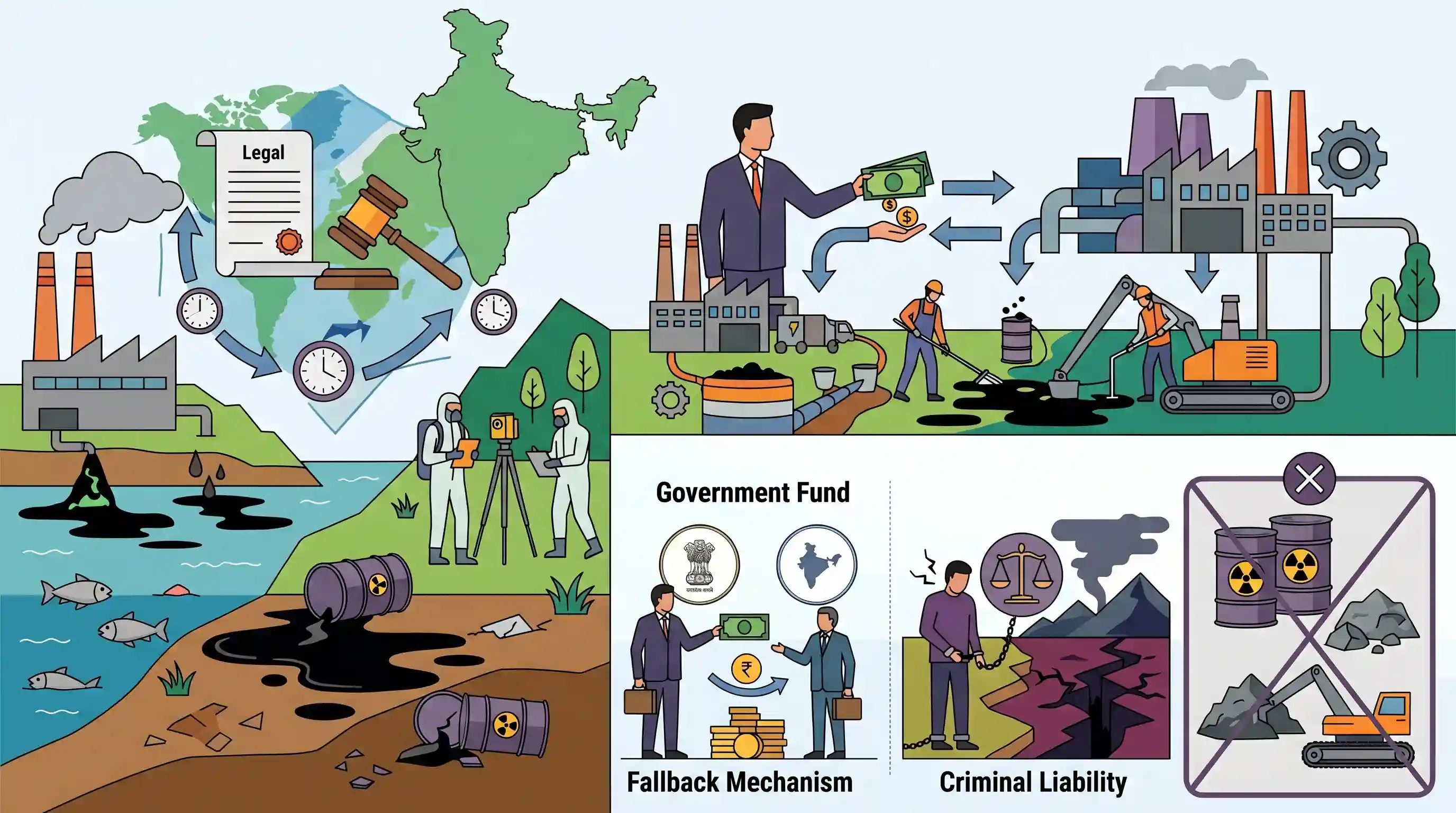
The Environment Ministry has notified the "Environment Protection (Management of Contaminated Sites) Rules, 2025" under the Environment Protection Act, establishing a structured, legally binding process to identify, assess, and remediate historically chemically contaminated sites across India. The framework imposes strict timelines on district and state authorities for site assessment and remediation planning. Crucially, it enforces the 'polluter pays' principle by mandating that identified polluters bear the cleanup costs, while providing a fallback funding mechanism through Central and State governments. The rules also incorporate provisions for criminal liability under the Bharatiya Nyaya Sanhita for severe contamination impacts, though they explicitly exclude certain waste types like radioactive and mining waste.
Key Points
- The Environment Ministry has notified the Environment Protection (Management of Contaminated Sites) Rules, 2025 under the Environment Protection Act to legally codify the remediation process.
- The Central Pollution Control Board defines contaminated sites as areas where historical dumping of hazardous waste has elevated chemical concentrations above safety levels.
- The rules mandate district administrations to prepare half-yearly reports on suspected sites, followed by a preliminary assessment by the State Board within 90 days.
- Enforcing the 'polluter pays' principle, the State Board must identify the responsible polluter within 90 days to bear remediation costs; if unable to pay or unidentified, the Centre and State split the costs.
- Criminal liability can be invoked under the Bharatiya Nyaya Sanhita (2023) for polluters whose contamination results in loss of life or property damage.
- The new rules exclude radioactive waste, mining operations, marine oil pollution, and solid waste dumpsites, as these are regulated by other specific legislations.
Important Terms
Environment Protection (Management of Contaminated Sites) Rules, 2025

2025 regulations under the EPA establishing a legally binding framework to identify, assess, and remediate chemically contaminated land and water through structured timelines and accountability mechanisms.
UPSC context
GS III: Environment. Crucial for questions on hazardous waste management, environmental governance, and recent legal reforms in pollution control.
Environment Protection Act, 1986
A 1986 "umbrella" legislation enacted post-Bhopal gas tragedy under Article 253 to protect and improve the environment and coordinate various central and state authorities.
UPSC context
GS III: Environment; GS II: Statutory Bodies. Core legislation for environmental standards, penalties, and international treaty implementation.
Polluter Pays Principle
An environmental policy principle where those responsible for pollution bear the costs of its management, cleanup, and mitigation to prevent societal burden.
UPSC context
GS III: Environmental Ethics and Economy. Tests understanding of liability, sustainable development, and judicial doctrines in environmental law.
Bharatiya Nyaya Sanhita, 2023
India's new unified criminal code effective from July 2024, replacing the IPC and incorporating specific provisions for environmental offences like public nuisance and water pollution.
UPSC context
GS II: Polity and Governance. Important for understanding the intersection of criminal law and environmental protection.
Central Pollution Control Board (CPCB)
A statutory body under the Ministry of Environment that sets national standards, develops monitoring portals, and oversees environmental quality nationwide.
UPSC context
GS II: Statutory Bodies. Key agency for environmental monitoring, standard-setting, and pollution control data management.
State Pollution Control Board (SPCB)
State-level regulatory bodies responsible for assessing local pollution, declaring contaminated sites, identifying polluters, and enforcing remediation plans under national rules.
UPSC context
GS II: Federalism and Governance. Highlights the decentralized enforcement and administrative role of states in environmental protection.
Hazardous and Other Wastes Rules, 2016
Regulations defining safe handling and movement of hazardous materials, specifically listing 189 chemicals used as thresholds for declaring sites contaminated in 2025.
UPSC context
GS III: Pollution and Waste Management. Vital for technical standards and regulatory criteria in industrial waste handling.
Prelims Trap
"The rules apply uniformly to all contaminated sites in India, including radioactive and mining waste areas."
UPSC often tests rule applicability. These 2025 rules explicitly exclude radioactive waste, mining operations, marine oil spills, and solid waste dumpsites, as they fall under different legislations.
Static Concepts Connected
How is the 'Polluter Pays' principle applied in Indian environmental jurisprudence?
- Origin & Absolute Liability: Evolved significantly after the Oleum Gas Leak case (1986), establishing 'Absolute Liability' for hazardous industries without exceptions.
- Remediation Focus: The polluter is responsible not only for compensating victims but also for bearing the financial cost of restoring the degraded environment.
- Statutory Backing: It is explicitly recognized as a guiding principle under Section 20 of the National Green Tribunal Act, 2010.
What are the core regulatory powers under the Environment (Protection) Act, 1986?
- Hazardous Substances: Empowers the Central Government to frame rules for laying down standards and procedures for managing hazardous substances.
- Delegation & Zoning: Provides the legal mechanism to delegate powers, issue directions for closure of polluting industries, and restrict areas for certain industries (Eco-Sensitive Zones).
Cross-Topic Patterns
Eco-crimes under Bharatiya Nyaya Sanhita (BNS)
The explicit linkage of chemical contamination to the BNS (2023) integrates environmental governance with mainstream criminal justice, expanding personal liability beyond the traditional penalties of the Environment Protection Act.
Fiscal Federalism in Environmental Cleanup
The rule mandating Centre and State to split remediation costs if the polluter defaults or is unidentified introduces fiscal federalism directly into localized environmental hazard management.

Expect a 2026 Prelims statement tricking candidates on the EXCLUSIONS (radioactive/mining/solid waste) of the 2025 Contaminated Sites Rules.
Linked PYQs · 3
Linked PYQs · 3
- 2022PrelimsGS1
Which one of the following has been constituted under the Environment (Protection) Act, 1986?
- 2024MainsGS3
Industrial pollution of river water is a significant environmental issue in India. Discuss the various mitigation measures to deal with this problem and also the government's initiatives in this regard.
- 2019PrelimsGS1
In India, 'extended producer responsibility' was introduced as an important feature in which of the following?
