Kota Medical College Probe Report on Maternal Deaths
Source:newindianexpress ↗
Why It Matters
This incident highlights the operational vulnerabilities within Rajasthan's public healthcare infrastructure. For RPSC RAS, understanding public health administration, maternal healthcare schemes (such as JSY, JSSK, and PMMVY), and state-level healthcare indicators is highly critical, making this case study prime material for essays and governance-related questions.
Summary
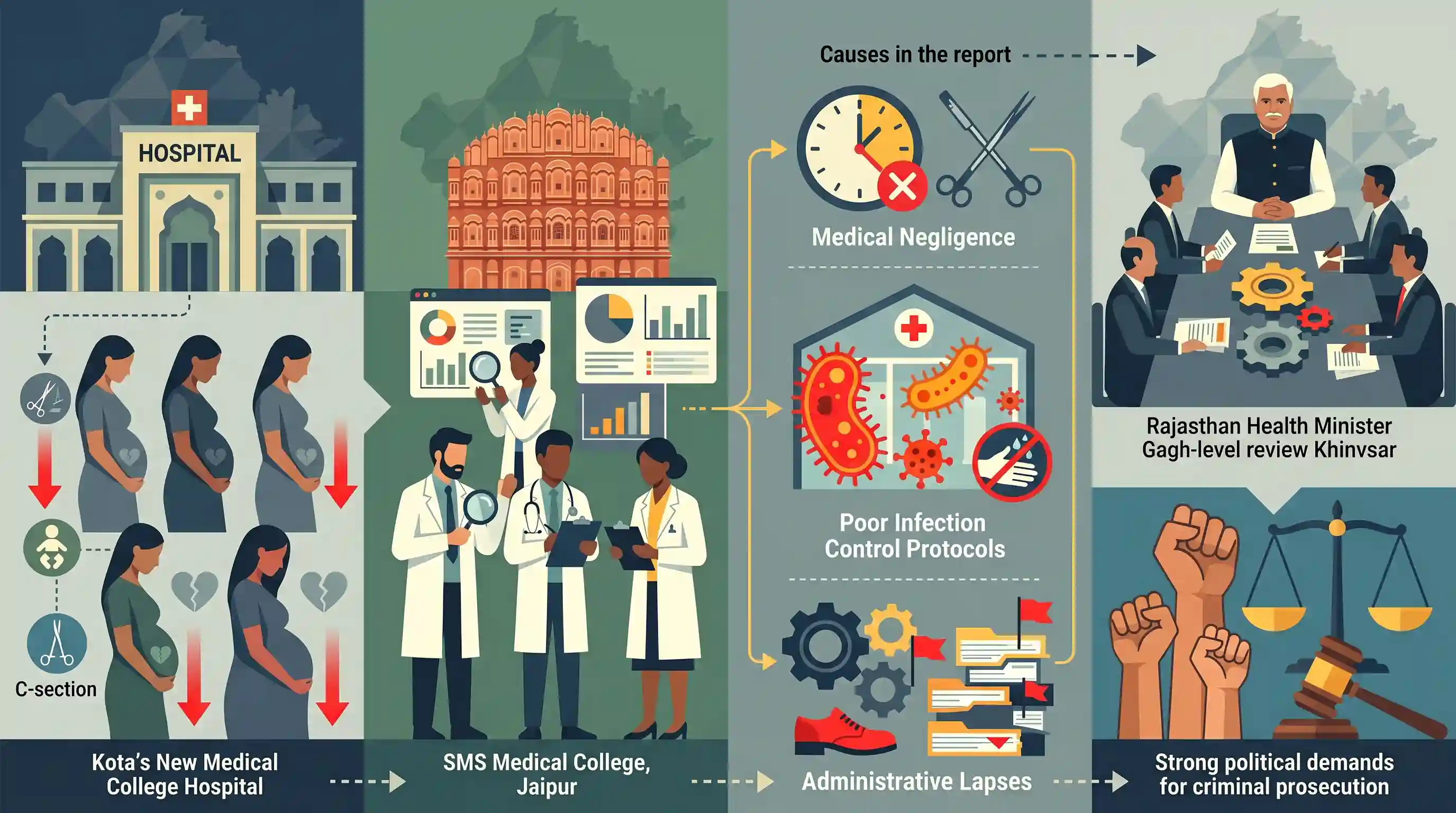
A committee of experts from SMS Medical College, Jaipur, investigated the tragic deaths of five pregnant women post-C-section at Kota's New Medical College Hospital in May 2026. The probe report identified medical negligence, poor infection control protocols, and administrative lapses as the primary causes of the deaths. While clinical findings showed fatal outcomes like multi-organ failure from uterus infections and pulmonary embolisms, Rajasthan Health Minister Gajendra Singh Khinvsar confirmed a state review is underway to decide on further action, amid strong political demands for criminal prosecution of negligent staff.
Key Points
- A high-level probe into the maternal deaths of five pregnant women at Kota's New Medical College Hospital in May 2026 revealed critical medical negligence, administrative failure, and poor infection control.
- The inquiry was conducted by a committee of experts from the premier Sawai Man Singh (SMS) Medical College in Jaipur.
- Specific findings highlighted that one victim, Shirin, developed a severe infection leading to multi-organ failure after an infected uterus was stitched. Other causes of maternal deaths included pulmonary embolism, excessive bleeding, and cardiac complications.
- Health Minister Gajendra Singh Khinvsar confirmed that the government has received the probe report and is initiating a comprehensive review.
- Former Chief Minister Ashok Gehlot and political opposition have demanded swift criminal action and the immediate suspension of the responsible doctors and hospital administrators.
Important Terms
Janani Suraksha Yojana (JSY)

A 100% centrally sponsored safe motherhood scheme under the National Health Mission providing conditional cash transfers to promote institutional delivery and reduce maternal and neonatal mortality among poor pregnant women.
UPSC context
GS Paper II (Welfare Schemes/Health). Tests maternal healthcare interventions, target-based welfare, and rural healthcare delivery mechanisms.
Janani Shishu Suraksha Karyakram (JSSK)
A national health initiative launched in 2011 providing completely free and cashless delivery, C-sections, and treatment for sick infants up to one year at government hospitals to eliminate out-of-pocket costs.
UPSC context
GS Paper II (Health). Tests policies addressing infant-maternal survival rates and elimination of healthcare expenditure barriers.
Pradhan Mantri Matru Vandana Yojana (PMMVY)
A centrally sponsored maternity benefit scheme under the National Food Security Act, 2013, providing ₹5,000 cash incentives to pregnant and lactating mothers for their first live birth.
UPSC context
GS Paper II (Social Justice). Tests maternal nutrition initiatives, conditional cash transfers, and reproductive health policy frameworks.
Mukhyamantri Nishulk Dawa Yojana
Rajasthan's flagship universal free medicine scheme launched in 2011, providing essential generic drugs, surgical items, and sutures completely free of cost to all patients visiting government health facilities.
UPSC context
GS Paper II (State Policies/Health). Exemplifies decentralized healthcare delivery, reduction of out-of-pocket expenditure, and public health infrastructure models.
SMS Medical College, Jaipur
Established in 1947, Sawai Man Singh Medical College is Rajasthan’s premier government medical college and tertiary-level referral hospital, crucial for regional health governance and medical investigations.
UPSC context
GS Paper II (Health Governance). Tests understanding of regional tertiary healthcare infrastructure, medical audits, and state-level healthcare accountability.
Prelims Trap
LaQshya is a direct-benefit cash transfer scheme designed to financially incentivize institutional deliveries in high-burden districts.
LaQshya is a clinical quality-improvement initiative for Labour Rooms and OTs, not a direct financial incentive program like JSY or PMMVY.
Static Concepts Connected
What are India's primary operational frameworks for monitoring and preventing maternal mortality?
- MDSR System: Maternal Death Surveillance and Response conducts clinical and community-level audits of maternal deaths to identify and rectify systemic gaps.
- LaQshya Initiative: Focuses specifically on upgrading the quality of care in Labour Rooms and Maternity Operation Theatres to reduce intrapartum infections and hemorrhage.
- SUMAN Scheme: Guarantees zero-tolerance for preventable maternal/newborn deaths by assuring free, dignified, and quality healthcare services at public facilities.
What is the status of India's MMR targets under Sustainable Development Goal 3?
- SDG Target 3.1: Aims to reduce the global maternal mortality ratio to less than 70 per 100,000 live births by 2030.
- India's Progress: India achieved an MMR of 93 per 100,000 live births (SRS 2019-21), positioning it on track to achieve the global SDG milestone.
Cross-Topic Patterns
Health federalism & clinical standards
While health is a State Subject, achieving SDG 3.1 relies on Central schemes like NHM. Lapses in state hospitals highlight friction in enforcing uniform National Quality Assurance Standards (NQAS) locally.
Administrative law vs. Medical ethics
The debate over criminal prosecution versus systemic administrative audits in public hospitals touches on public service accountability (GS2) and professional medical ethics (GS4).

UPSC may contrast financial-incentive schemes (JSY) with quality-of-care frameworks (LaQshya, NQAS) to test health governance in 2026.
Linked PYQs · 2
Linked PYQs · 2
- 2023RPSC_PRELIMSGS1
Which scheme aims to improve the health and nutritional status of pregnant women and lactating mothers and their infants (0 to 6 months) by promoting the use of appropriate practices, care, and services during pregnancy, safe delivery, and breastfeeding?
- 2016RPSC_PRELIMSGS1
The Chief Minister Free Medicine Scheme was implemented in Rajasthan on
