Baran Mid Day Meal Poisoning Triggers Administrative Probe
Source:etv-bharat ↗
Why It Matters
Incidents like this highlight critical gaps in the implementation and monitoring of flagship nutrition schemes like PM POSHAN (Mid-Day Meal). For RPSC RAS Prelims, understanding the administrative accountability, public health implications, and execution of welfare programs in Rajasthan is essential under the governance and social justice syllabus.
Summary
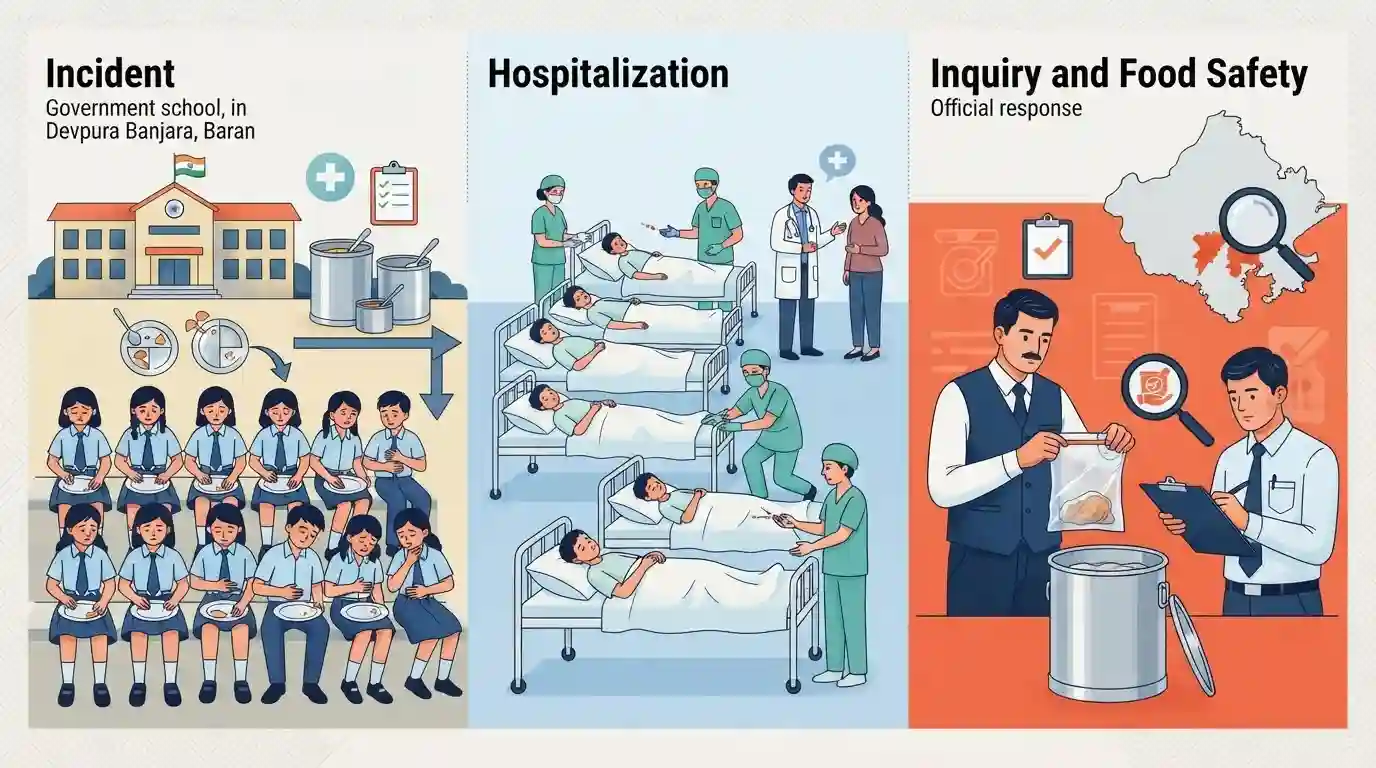
Thirty students from a government school in Devpura Banjara village of Rajasthan's Baran district fell ill due to suspected food poisoning after eating a mid-day meal supplied by an NGO. The children were hospitalized and are now stable. Authorities have ordered an inquiry and collected food samples to determine the cause, highlighting ongoing concerns regarding food safety and quality control in state-run nutrition programs.
Key Points
- Around 30 students of a government upper primary school in Baran district, Rajasthan, fell ill with suspected food poisoning after consuming the mid-day meal.
- The mid-day meal was prepared and supplied by an NGO.
- The students experienced nausea and vomiting but were reported to be in stable condition after medical intervention.
- The administration has ordered a probe into the incident, and food samples have been collected by the health department for testing.
Important Terms
Mid-Day Meal Scheme

A historic centrally sponsored scheme providing free, hot-cooked meals to children in government and government-aided schools (Classes 1–8). It was designed to alleviate classroom hunger, boost school enrollment, and improve child nutrition.
UPSC context
Crucial for GS Paper 2 (Welfare Schemes, Health, Education) as a core intervention linking human capital development with food security.
PM POSHAN
The revamped Mid-Day Meal Scheme (Pradhan Mantri Poshan Shakti Nirman). Managed by the Ministry of Education, it extends hot cooked meals to pre-schoolers (Bal Vatika) alongside Classes 1–8, emphasizing local sourcing and social audits.
UPSC context
Essential for GS Paper 2 (Governance, Social Justice) as the current flagship scheme addressing child malnutrition and educational retention.
NGO (Non-Governmental Organization)
Independent, non-profit organizations operating for social causes. In welfare programs like PM POSHAN, NGOs often partner with the government via Public-Private Partnerships to efficiently operate centralized kitchens, manage logistics, and ensure food safety.
UPSC context
Relevant to GS Paper 2 (Role of NGOs in Development Processes) regarding civic collaboration in implementing large-scale state welfare schemes.
Prelims Trap
"The PM POSHAN scheme is restricted strictly to students of classes I to VIII in government schools."
The revamped PM POSHAN scheme extended coverage beyond classes I-VIII to explicitly include pre-primary or 'Balvatika' students in government and government-aided schools.
Static Concepts Connected
What are the key regulatory mandates of the PM POSHAN Scheme?
- Nutritional Norms: Mandates 450 calories/12g protein for primary and 700 calories/20g protein for upper primary students per school day.
- Mandatory Social Audit: Requires mandatory social audits for the scheme in every district to ensure grassroots community oversight and structural accountability.
- Balvatika Coverage: Extends hot cooked meals to pre-primary students (Balvatikas) studying in government and government-aided schools.
How is food safety regulated in centralized mid-day meal kitchens?
- FSSAI Standards: FSSAI sets strict hygiene and safety standards for centralized kitchens and NGOs supplying meals to government schools.
- Statutory Testing: Under the Food Safety and Standards Act, 2006, Food Safety Officers (FSOs) can randomly collect and test samples.
Cross-Topic Patterns
NGO Accountability in Welfare Delivery
While NGOs enhance scale in schemes like PM POSHAN, recurring food poisoning cases highlight the critical regulatory gap between state delegation and civil society accountability.
PM POSHAN and Bio-fortification
Safety concerns in state-run meals intersect with the ongoing push for distributing fortified rice to combat hidden hunger, demanding stricter FSSAI quality controls at the procurement level.

Expect a prelims statement mixing PM POSHAN's Balvatika extension with its mandatory district-level social audit provisions.
Linked PYQs · 2
Linked PYQs · 2
- 2023RPSC_PRELIMSGS1
Which scheme is associated with the slogan - “No one should sleep hungry”?
- 2024RPSC_PRELIMSGS1
Consider the following statements regarding 'National Food Security Act': A. It legally entitles up to 75% of the rural population and 50% of the urban population to receive subsidized food grains. B. It covers up to 67 cross persons.
