NCTE Probe Identifies Ghost Colleges in Bhopal
Source:times-of-india ↗
Why It Matters
The discovery of 'ghost' colleges underscores critical gaps in the regulatory framework governing teacher education in India. It emphasizes the need for stringent physical verification, transparency, and accountability by statutory bodies like the NCTE and state universities to ensure the quality of higher education.
Summary
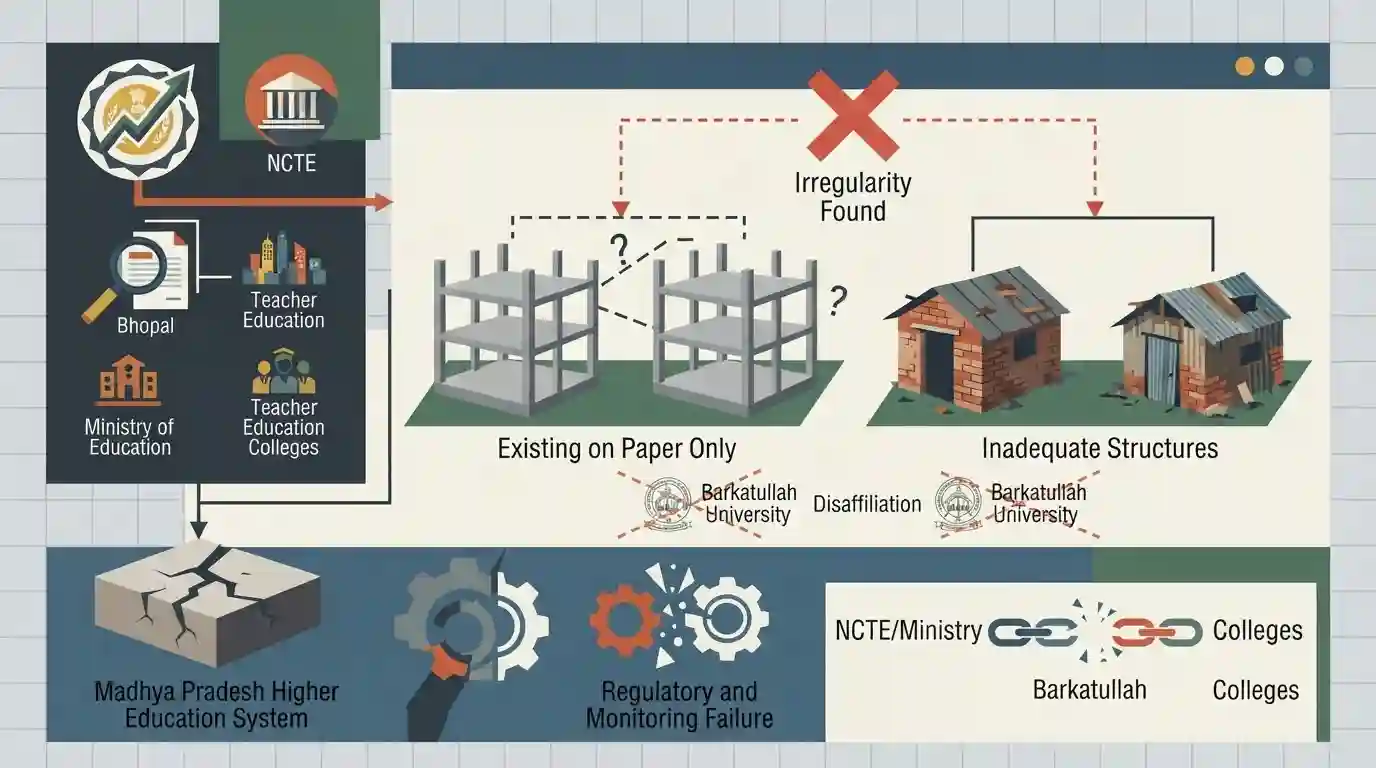
The National Council for Teacher Education (NCTE) has uncovered four 'ghost' teacher education colleges in Bhopal, which were affiliated with Barkatullah University but existed only on paper or in inadequate structures. Ordered by the Union Ministry of Education, the probe highlights severe regulatory and monitoring failures in Madhya Pradesh's higher education system.
Key Points
- A fact-finding team by the National Council for Teacher Education (NCTE) identified four 'ghost' teacher education colleges in Bhopal.
- The colleges, affiliated with Barkatullah University, either did not exist at their registered addresses or operated from severely inadequate facilities like tin sheds.
- The physical inspection was initiated by the Union Ministry of Education following media reports of fraudulent educational institutions.
- The findings expose significant loopholes in the affiliation, accreditation, and monitoring processes of higher education regulators and state universities.
Important Terms
National Council for Teacher Education (NCTE)

A statutory body established under the NCTE Act of 1993, responsible for overseeing standards, procedures, and processes for teacher education programs across India.
UPSC context
Relevant to GS Paper II (Regulatory Bodies, Education). Questions may test its mandate, statutory status, and role in standardizing teacher education.
Ghost colleges
Educational institutions that exist merely on paper or lack adequate infrastructure and faculty, created primarily to claim affiliations, grants, or issue fraudulent degrees without providing actual education.
UPSC context
Relevant to GS Paper II (Issues in Education, Accountability). Demonstrates regulatory failures and governance loopholes in India's higher education sector.
Union Ministry of Education
The central government department responsible for formulating national education policies, implementing the National Education Policy (NEP), and coordinating school and higher education systems.
UPSC context
Relevant to GS Paper II (Government Policies, Education). Crucial for understanding central oversight, funding, and reform initiatives in the education sector.
Prelims Trap
State governments hold the exclusive authority to determine and relax the minimum qualification standards for schoolteachers under the RTE Act, 2009.
Under Section 23(1) of the RTE Act, the Central Government has authorized the NCTE as the sole academic authority to lay down teacher qualifications; states cannot alter these standards.
Static Concepts Connected
What is the statutory mandate and role of the National Council for Teacher Education (NCTE)?
- Origin & Status: Established as a statutory body in 1995 under the NCTE Act, 1993, to oversee and plan the development of teacher education.
- RTE Act Mandate: Designated under Section 23(1) of the RTE Act, 2009 as the academic authority prescribing minimum teacher qualifications.
- TET Guidelines: Responsible for framing mandatory national guidelines for conducting the Teacher Eligibility Test (TET) across states.
What were the key recommendations of the Justice J.S. Verma Commission (2012) on teacher education?
- Regulatory Oversight: Recommended strong regulatory action against sub-standard, standalone private teacher training colleges and structural reform of NCTE.
- Institutional Quality: Advocated for shifting teacher education programs into multi-disciplinary university settings rather than isolated institutes.
- Performance Appraisals: Proposed establishing a transparent, periodic performance appraisal system for Teacher Education Institutions (TEIs).
Cross-Topic Patterns
Regulatory capture in private higher education
High concentration of private self-financed colleges (~90% in teacher education) exposes systemic gaps in regulatory enforcement, where commercial interests bypass quality standards, undermining social sector outcomes.
Centralized standards vs local affiliation
While NCTE sets national qualifications under the RTE Act, state universities control local affiliation. Disconnections in co-ordination lead to implementation gaps in concurrent-list subjects like education.

Quality mandates of RTE Act combined with NCTE’s regulatory oversight of private institutions likely to form a core GS-2 mains question.
Linked PYQs · 2
Linked PYQs · 2
- 2023MPPSC_PRELIMSGS1
The functions of the National Commission for Women are Specified in:
- 2020MPPSC_PRELIMSGS1
The Madhya Pradesh State Election Commission was constituted on
