Opposition concerns over Indian diaspora safety in Middle East
Source:Indian Express ↗
Why It Matters
The escalating conflict in West Asia (Middle East) directly threatens India's vital strategic interests, including the safety of millions of Indian expatriates, energy security, and remittance flows. It highlights the complexities of India's diplomatic balancing act in a multipolar conflict.
Summary
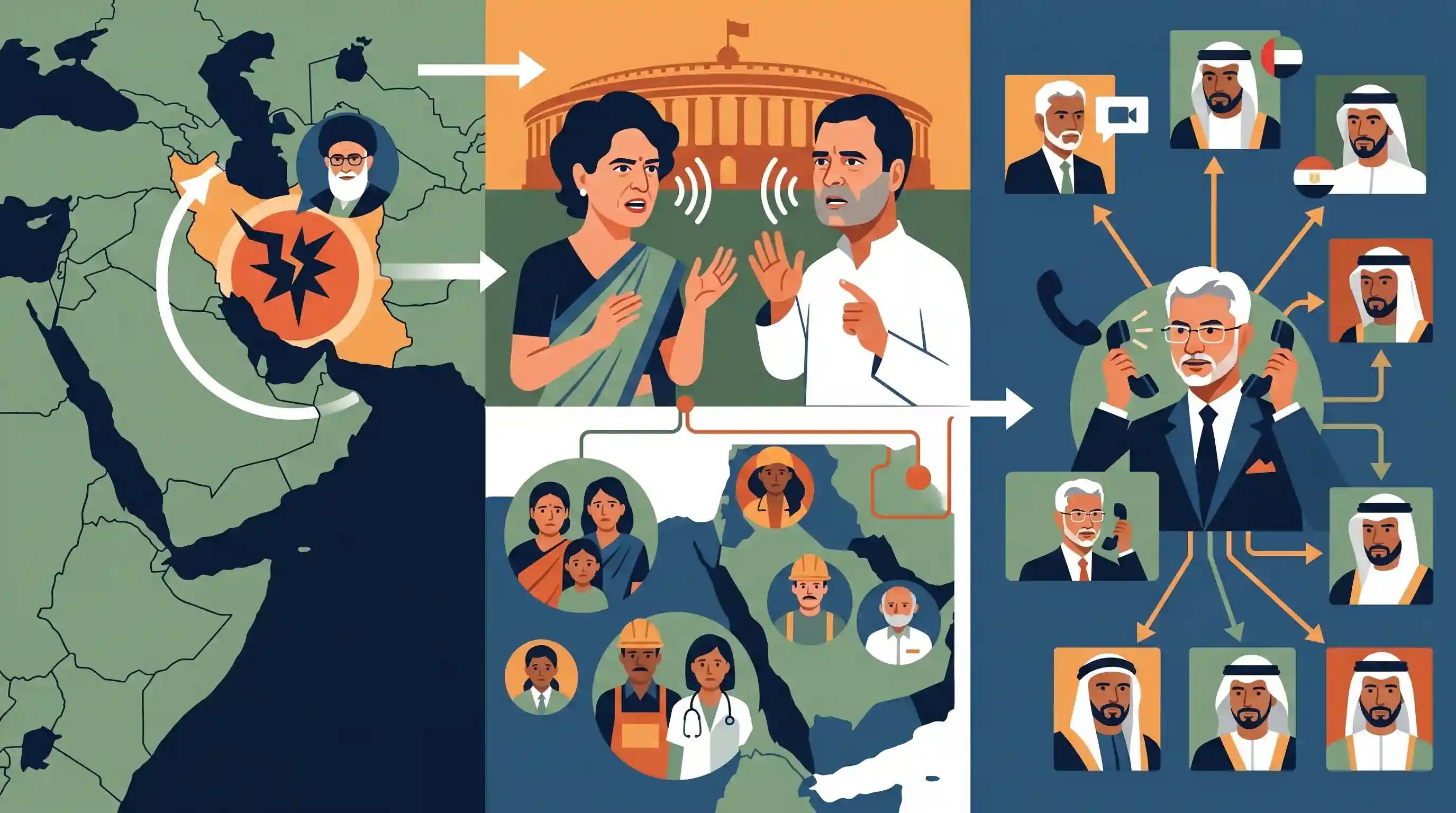
Congress leaders Priyanka Gandhi and Rahul Gandhi have expressed grave concern over the "targeted assassination" of Iran's Supreme Leader Ayatollah Khamenei by US-Israel forces. Condemning the act as a violation of international norms, they urged the Indian government to prioritize the safety and prompt evacuation of the vast Indian diaspora residing in the volatile Middle East region. In response to the escalating geopolitical tensions, External Affairs Minister S Jaishankar has engaged with his counterparts across several West Asian nations to seek assurances regarding the security of Indian citizens.
Key Points
- Congress leaders Priyanka and Rahul Gandhi condemned the US-Israel targeted assassination of Iran's Supreme Leader Ayatollah Khamenei.
- The Opposition urged the Indian government to prioritize the safety and prompt evacuation of the millions of Indians living and working in the Middle East.
- External Affairs Minister S Jaishankar has actively engaged with counterparts in Saudi Arabia, Kuwait, Bahrain, Qatar, UAE, Iran, and Israel to secure safety assurances for Indian citizens.
- The geopolitical escalation in West Asia poses significant challenges to India's foreign policy, particularly concerning diaspora security, energy imports, and regional stability.
Important Terms
West Asia Geopolitics

The strategic power dynamics and resource competition in the Middle East. It involves India's 'Link West' policy, balancing relations between Israel, Iran, and Arab nations for energy and maritime security.
UPSC context
GS Paper II: IR. Tests understanding of regional stability, energy security, and India's multi-alignment strategy.
Indian Diaspora
The 32 million-strong community of Non-Resident Indians (NRIs) and Persons of Indian Origin (PIOs). In West Asia, 9 million Indians provide vital remittances and enhance India's soft power.
UPSC context
GS Paper II: IR. Tests knowledge of the diaspora's economic role and the government's protective mandate during crises.
Targeted Killing
The premeditated use of lethal force by a state against a specific individual outside their custody. Its legality is scrutinized under International Humanitarian Law and the UN Charter's sovereignty principles.
UPSC context
GS Paper II/III: IR and Security. Evaluates understanding of international legal frameworks and state sovereignty.
Supreme Leader (Iran)
The highest political and religious authority in Iran. Based on the principle of 'Velayat-e-faqih', he commands the armed forces and oversees the judiciary and foreign policy.
UPSC context
GS Paper II: IR. Tests awareness of foreign political structures and their impact on regional security.
International Norms
Established standards of behavior and legal principles, such as sovereignty and non-interference, that govern state interactions within the 'rules-based international order'.
UPSC context
GS Paper II: IR. Focuses on global governance, diplomacy, and challenges to state sovereignty.
Remittances
Money sent by migrants to their home country. India is the world's largest recipient, with West Asia contributing significantly to India's foreign exchange reserves and economic stability.
UPSC context
GS Paper III: Economy. Tests understanding of the Balance of Payments and the economic contribution of overseas Indians.
Prelims Trap
"India's 'de-hyphenation' policy requires remaining strictly neutral and avoiding defense ties with rival West Asian states."
De-hyphenation means independently pursuing deep bilateral ties (including defense) with rival nations like Israel and Iran simultaneously, not isolating from them.
Static Concepts Connected
What are India's major recent evacuation operations in West Asia?
- Operation Ajay (2023): Repatriation of Indian citizens from Israel amid the outbreak of the Hamas-Israel conflict.
- Operation Kaveri (2023): Evacuation of Indian citizens from Sudan during the 2023 armed conflict.
- Operation Raahat (2015): Indian Armed Forces evacuated citizens and foreign nationals from Yemen during the military intervention.
Which strategic assets and routes are directly threatened by an Iran-Israel conflict?
- Strait of Hormuz: Connects the Persian Gulf to the Gulf of Oman; a vital chokepoint handling a massive share of India's crude oil imports.
- Chabahar Port: Located in southeastern Iran on the Gulf of Oman, it is India's gateway to Afghanistan and Central Asia, bypassing Pakistan.
- INSTC: The International North-South Transport Corridor relies heavily on stable Iranian transit infrastructure to reach Russia and Europe.
Cross-Topic Patterns
Gulf Instability & Macroeconomic shocks
Conflict disrupting the Strait of Hormuz inflates India's crude import bill, widens the Current Account Deficit (CAD), and triggers imported inflation, linking geopolitics directly to GS3 Macroeconomics.
Diaspora: Asset vs Vulnerability
While 8-9 million Indians in West Asia supply vital remittances (asset), their physical security during regional wars necessitates massive evacuation operations (vulnerability), complicating diplomatic maneuverability.

Strait of Hormuz, Gulf of Oman, and Chabahar's geographic proximity to the conflict zone will likely feature in a 2026 map-based question.
Linked PYQs · 3
Linked PYQs · 3
- 2025MainsGS2
"Energy security constitutes the dominant kingpin of India's foreign policy, and is linked with India's overarching influence in Middle Eastern countries.” How would you integrate energy security with India's foreign policy trajectories in the coming years?
- 2017MainsGS2
The question of India's Energy Security constitutes the most important part of India's economic progress. Analyze India's energy policy cooperation with West Asian countries.
- 2018MainsGS2
In what ways would the ongoing US-Iran Nuclear Pact Controversy affect the national interest of India? How should India respond to this situation?
