Political discourse and executive accountability on livelihood issues
Source:Indian Express ↗
Why It Matters
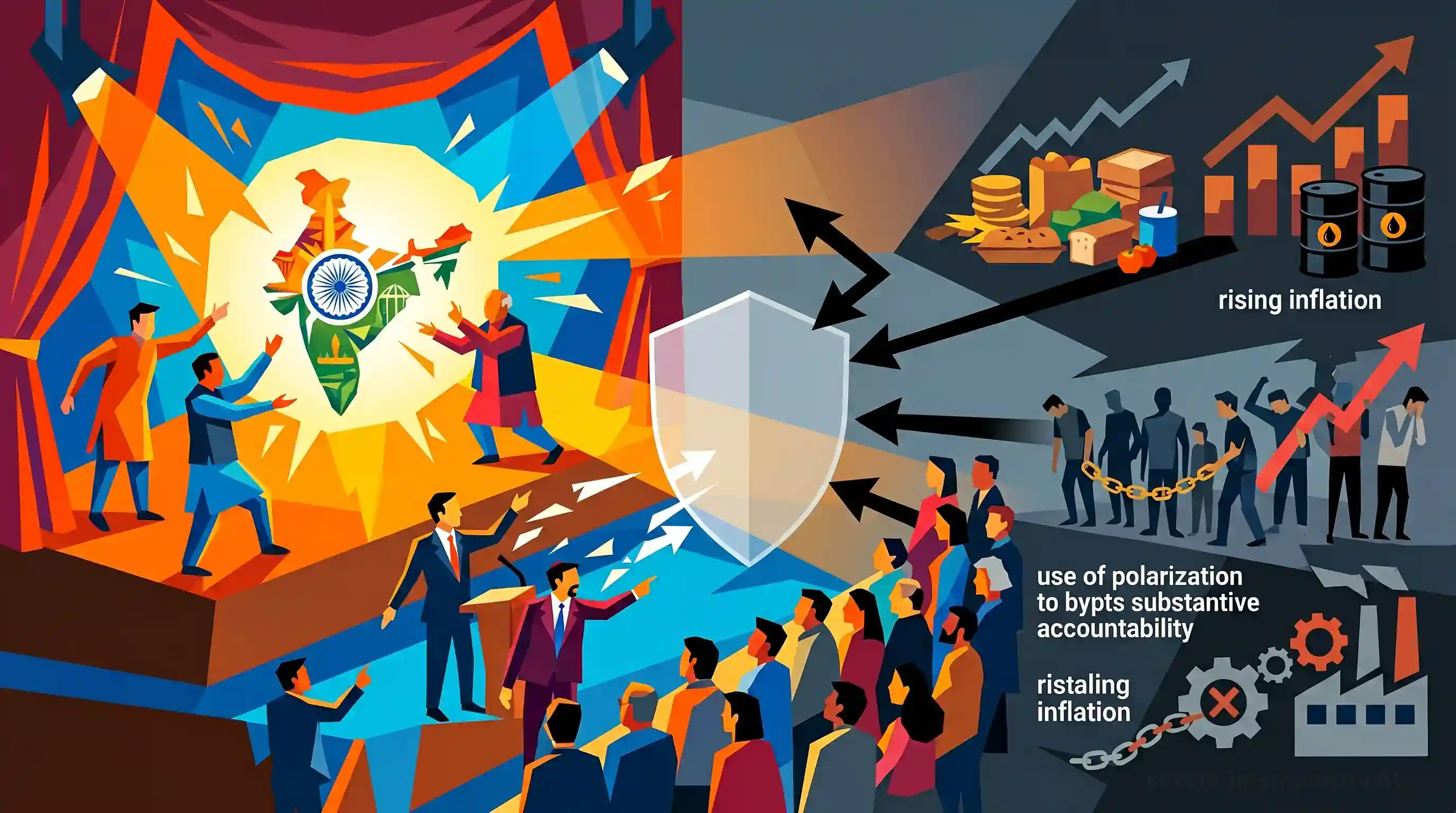
It demonstrates how emotive or nationalistic issues are frequently leveraged in political discourse to distract from substantive socio-economic challenges, highlighting the practical difficulties in holding the executive accountable in a parliamentary democracy.
Summary
Congress leader Priyanka Gandhi criticized PM Modi and the ruling government for stoking a debate around the singing of 'Vande Mataram'. She stated that the controversy was a deliberate political maneuver designed to serve three main purposes: distracting the public from rising inflation, shifting focus away from severe unemployment, and avoiding executive accountability on economic governance. By centering the political discourse on an emotive and nationalistic issue, Gandhi argued, the government is attempting to evade questions on real livelihood crises. This underscores ongoing concerns about the declining quality of issue-based political debates and the use of polarization to bypass substantive accountability.
Key Points
- Congress leader Priyanka Gandhi countered PM Modi over the political debate surrounding the national song, 'Vande Mataram'.
- She alleged that the government deliberately manufactured this emotive controversy as a distraction tactic.
- Gandhi cited three main reasons for the government's push on the debate: diverting public attention from inflation, hiding the crisis of unemployment, and avoiding accountability on substantive governance failures.
- The incident highlights the broader political strategy of using polarizing, nationalistic issues to sideline debates on real economic and livelihood challenges.
Important Terms
Parliament

India's supreme legislative body, comprising the President and two Houses: Lok Sabha and Rajya Sabha. It functions as the primary forum for lawmaking, executive oversight, and national deliberation.
UPSC context
GS Paper II (Polity); essential for understanding the apex institution of governance, legislative procedures, and the representative character of Indian democracy.
Vande Mataram
India's National Song, composed by Bankim Chandra Chattopadhyay in 1875. It served as a vital rallying cry during the independence movement and holds equal status to the National Anthem.
UPSC context
GS Paper I (History/Culture); tests knowledge of national symbols, the Swadeshi movement, and the evolution of cultural nationalism during the freedom struggle.
Indian National Congress
Founded in 1885, it is one of India's oldest political parties. It led the mass movement for independence and traditionally advocates for secularism, social justice, and inclusive development.
UPSC context
GS Paper I (Modern History) and GS Paper II (Polity); central to the study of the freedom struggle and the party system.
Bharatiya Janata Party (BJP)
Formally established in 1980, this national political party advocates for cultural nationalism (Hindutva) and succeeded the Bharatiya Jana Sangh. It currently leads the ruling National Democratic Alliance.
UPSC context
GS Paper II (Polity); relevant for understanding the evolution of political ideologies, the rise of coalition politics, and modern electoral dynamics.
Government Accountability
The constitutional principle (Article 75) ensuring the Council of Ministers is collectively answerable to the Lok Sabha for its actions, enforced through motions, debates, and parliamentary committees.
UPSC context
GS Paper II (Polity/Governance); tests knowledge of checks and balances, the responsibility of the executive to the legislature, and instruments of oversight.
Role of Opposition
Political parties not in power that serve as a check on the government, offer alternative policies, and represent diverse public interests within the legislative framework.
UPSC context
GS Paper II (Polity); critical for analyzing the health of parliamentary democracy, legislative productivity, and the formal recognition of the Leader of Opposition.
Prelims Trap
"Article 51A imposes a Fundamental Duty on citizens to respect both the National Anthem and the National Song."
Article 51A explicitly mandates respect only for the National Anthem and Flag, omitting the National Song. Furthermore, the 1971 Act on insults to national honour excludes it.
Static Concepts Connected
What is the constitutional and statutory status of the National Song 'Vande Mataram'?
- Adoption status: Adopted by the Constituent Assembly on January 24, 1950, granting it equal historical and cultural status with the National Anthem.
- Fundamental Duties: Article 51A(a) mandates respecting the National Anthem and Flag, but omits any explicit mention of the National Song.
- Statutory protection: Unlike the Anthem, disrespecting the National Song is not statutorily penalized under the Prevention of Insults to National Honour Act, 1971.
What constitutes a 'corrupt practice' regarding national symbols under RPA 1951?
- Section 123(3): Section 123(3) of RPA 1951 prohibits candidates from appealing to voters based on religion, race, caste, community, or language.
- National symbols: Using or appealing to national symbols (like the national flag or emblem) to further election prospects is strictly deemed a corrupt practice.
Cross-Topic Patterns
Nationalistic rhetoric & RPA 1951
The line between permitted political speech and "corrupt practices" under Section 123 of RPA 1951 is increasingly tested by the use of emotive national symbols during election cycles.
Identity politics vs. Executive accountability
The shift of political discourse toward identity and nationalistic issues frequently bypasses institutional mechanisms meant to hold the executive accountable for macroeconomic indicators like inflation.

Expect a Prelims statement contrasting the legal protections of the National Anthem (Article 51A, 1971 Act) versus the National Song.
Linked PYQs · 3
Linked PYQs · 3
- 2019MainsGS2
Individual Parliamentarian's role as the national law maker is on a decline, which in turn, has adversely impacted the quality of debates and their outcome. Discuss.
- 2021MainsGS2
To what extent, in your view, the Parliament is able to ensure accountability of the executive in India?
- 2022MainsGS2
Besides the welfare schemes, India needs deft management of inflation and unemployment to serve the poor and the underprivileged sections of the society. Discuss.
