Private Sector Nuclear Energy Safety and Regulation by AERB
Source:The Hindu ↗
Why It Matters
As India looks toward private sector participation to boost clean energy generation and fulfill climate commitments, balancing commercial expansion with robust nuclear safety oversight by the AERB becomes critical for energy security and public safety.
Summary
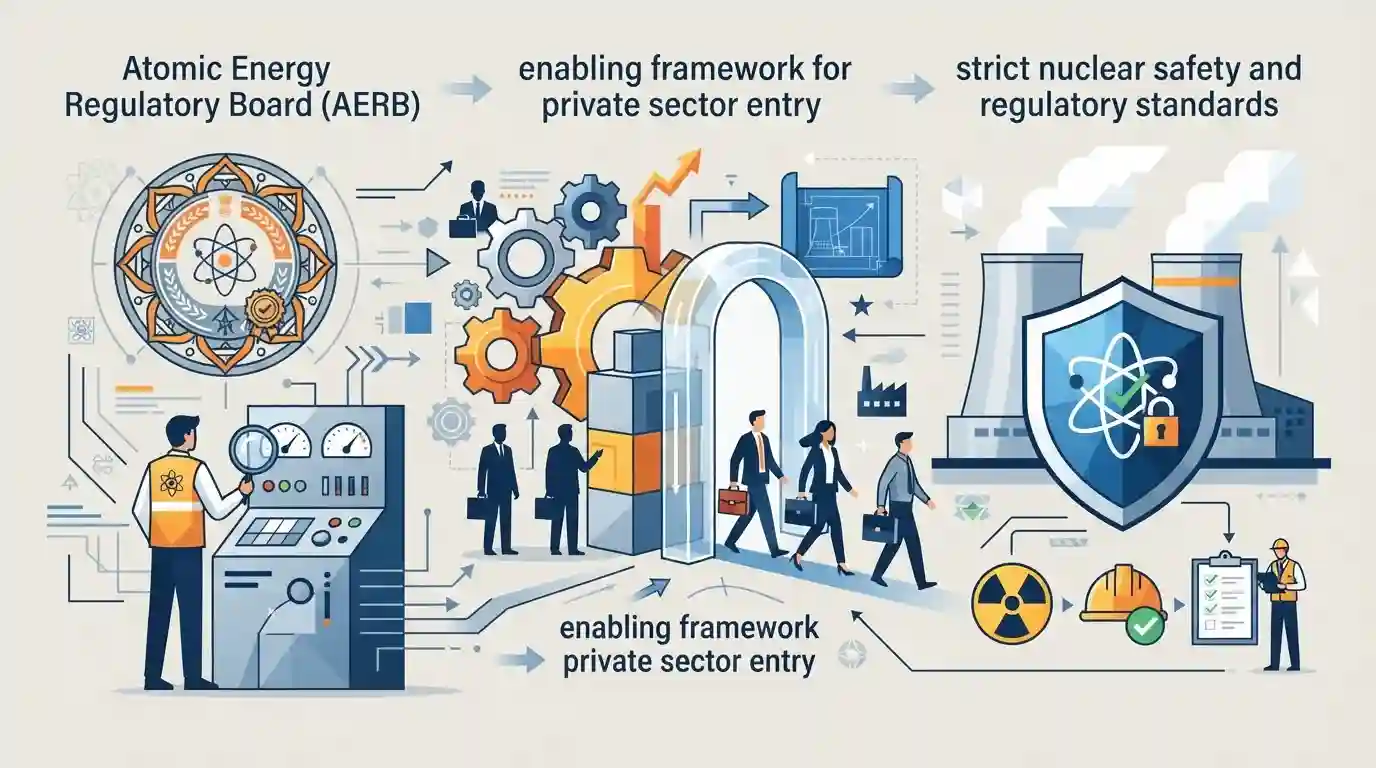
The Chairperson of the Atomic Energy Regulatory Board (AERB) has stated that the entry of the private sector into India's nuclear energy sector will be supported by an enabling regulatory framework, while maintaining strict adherence to nuclear safety and regulatory standards.
Key Points
- The Atomic Energy Regulatory Board (AERB) assures that private sector participation in India's nuclear energy sector will proceed without compromising safety.
- AERB is committed to providing an enabling regulatory environment to facilitate commercial and industrial collaboration in nuclear power.
- Safety standards, rigorous oversight, and statutory compliance remain non-negotiable as India expands clean energy options through nuclear power.
Important Terms
Atomic Energy Regulatory Board (AERB)

India's national nuclear regulatory body established in 1983 under the Atomic Energy Act, 1962, to ensure that the use of nuclear energy and radiation does not pose undue risks to health and the environment.
UPSC context
GS Paper III (Science & Technology / Infrastructure). Tests understanding of regulatory institutions governing India's energy sector and nuclear safety standards.
Static Concepts Connected
What is the statutory status and mandate of the Atomic Energy Regulatory Board (AERB) in India?
- Creation Status: Established in 1983 by the President of India under the Atomic Energy Act, 1962, exercising regulatory powers delegated by the Atomic Energy Commission (AEC).
- Core Mandate: Responsible for ensuring that the use of nuclear energy and radiation does not cause undue risk to health and the environment.
- Regulatory Scope: Issues licenses, prescribes safety standards, and enforces compliance across all nuclear and radiation facilities in India.
Cross-Topic Patterns
Private Nuclear Power & International Liability Regimes
India's shift toward private nuclear partnerships intersects with international liability frameworks (like the Civil Liability for Nuclear Damage Act) and global non-proliferation export control regimes like the NSG.
Nuclear Energy & Net-Zero Decarbonization Pathways
As India expands base-load nuclear generation via private collaboration, it directly complements the National Green Hydrogen Mission and net-zero decarbonization pathways.

AERB statutory status, Atomic Energy Act 1962 modifications, and private sector entry parameters are high-yield for prelims and GS-3.
Linked PYQs · 3
Linked PYQs · 3
- 2017MainsGS3
Give an account of the growth and development of nuclear science and technology in India. What is the advantage of fast breeder reactor programme in India?
- 2020PrelimsGS1
In India, why are some nuclear reactors kept under "IAEA Safeguards" while others are not?
- 2025MainsGS3
The fusion energy programme in India has steadily evolved over the past few decades. Mention India's contributions to the international fusion energy project International Thermonuclear Experimental Reactor (ITER). What will be the implications of the success of this project for the future of global energy?
