Private corporate sector financial performance and sales growth trends
Source:The Hindu ↗
Why It Matters
Corporate sector performance, particularly in manufacturing, is a vital indicator of aggregate economic health, private sector capital expenditure (capex), and employment generation capacity. This data is critical for assessing macroeconomic stability, inflationary cost-push pressures, and foreign capital flows (FIIs/FPIs).
Summary
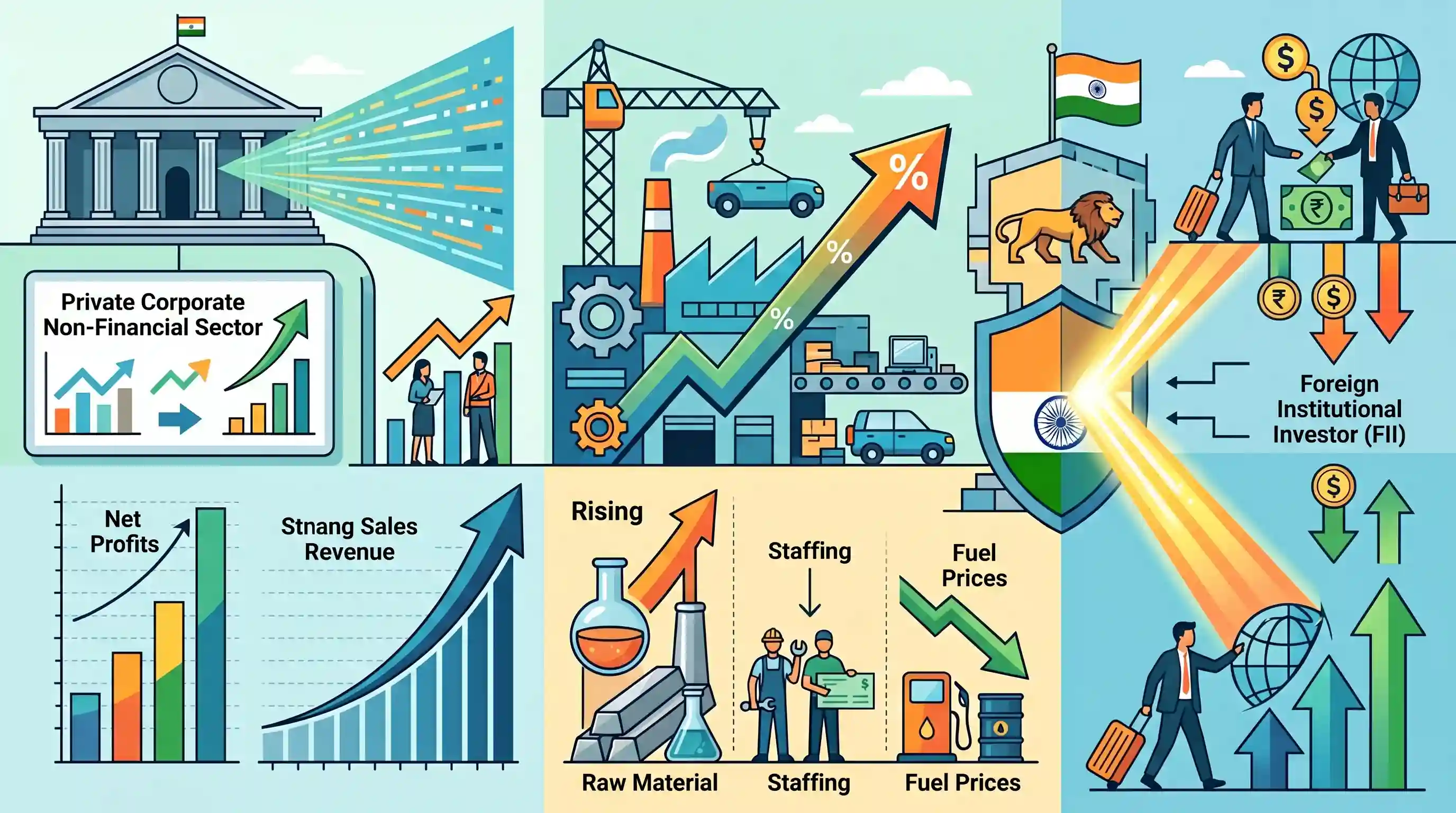
According to Reserve Bank of India (RBI) data, the private corporate non-financial sector saw net profits increase by 5.2% to ₹1.8 lakh crore in the third quarter of FY26. This growth was driven by a 10% expansion in sales revenue—the fastest in 11 quarters. The manufacturing sector was a primary driver, logging an 11.4% rise in sales despite navigating higher raw material and staffing costs, which were somewhat cushioned by a decline in fuel prices. The strong performance data arrives at a critical juncture to counter narratives of subdued private capital expenditure and weak earnings that have contributed to recent foreign institutional investor (FII) outflows from Indian markets.
Key Points
- Net profit of private non-financial companies grew by 5.2% to ₹1.8 lakh crore in Q3 FY26, supported by a robust 10% surge in sales revenue.
- The 10% sales revenue expansion to ₹19.4 lakh crore represents the fastest pace of growth in 11 quarters, indicating recovering aggregate demand.
- The manufacturing sector (over 1,700 companies) recorded an 11.4% increase in sales revenue, driving overall corporate performance.
- Manufacturing firms faced margin pressures from a 12.5% rise in raw material costs and a 9.2% increase in staff costs, though this was partly offset by a 6.4% fall in fuel costs.
- The RBI data provides a crucial reality check against market concerns of subdued private capital expenditure and tepid earnings, which had recently triggered an exodus of FIIs from Indian equities.
Important Terms
Reserve Bank of India (RBI)

India's central bank and regulatory authority for the banking system and monetary policy. It monitors corporate performance to ensure financial stability and manages the country's foreign exchange reserves.
UPSC context
GS Paper 3: Indian Economy. Tests roles in monetary policy, banking supervision, and macroeconomic monitoring.
Foreign Institutional Investors (FIIs)
Foreign investment funds or organizations (e.g., hedge funds, mutual funds) investing in Indian stock and bond markets. Known as 'hot money' due to their high mobility and impact on market volatility.
UPSC context
GS Paper 3: Investment Models. Relevant for understanding capital flows, market liquidity, and currency stability.
Private Capital Expenditure (CapEx)
Spending by private firms to acquire, upgrade, or maintain physical assets like machinery and infrastructure. It is a vital indicator of business confidence and future economic growth capacity.
UPSC context
GS Paper 3: Economic Development. Crucial for analyzing investment cycles and the multiplier effect on growth.
Non-Financial Private Corporate (NFPC) Sector
A segment of the economy comprising private firms involved in manufacturing and services, excluding banking and insurance. It is a major contributor to India's Gross Value Added (GVA).
UPSC context
GS Paper 3: Industrial Growth. Essential for sectoral analysis and measuring corporate health outside the financial sector.
Gross Value Added (GVA)
The measure of the value of goods and services produced in an area, industry, or sector, calculated as total output minus intermediate consumption. It reflects the sector's contribution to GDP.
UPSC context
GS Paper 3: National Income. Fundamental for understanding productivity and the structure of the Indian economy.
Prelims Trap
"The RBI's quarterly corporate performance data includes both financial and non-financial companies to estimate economic growth."
The RBI report strictly tracks listed non-financial companies. Including banks/NBFCs would distort the real sector's performance metrics regarding aggregate demand and industrial input costs.
Static Concepts Connected
What constitutes Gross Fixed Capital Formation (GFCF) in India?
- Definition: It measures the net additions to fixed assets (infrastructure, machinery, etc.) within the domestic economy over a specific period.
- Components: It comprises investments from the public sector (government), private corporate sector, and household sector.
- Current Trend: Recent years show heavy reliance on government capex, while the private corporate sector's share has structurally stagnated around 11-12% of GDP.
How do FII and FDI differ in the Indian context?
- Investment Nature: FII is short-term 'hot money' seeking capital gains in secondary markets; FDI is stable, long-term capital for asset creation or technology transfer.
- Volatility & Triggers: FII is highly sensitive to quarterly corporate earnings and currency shifts. FDI is driven by broad macroeconomic fundamentals and long-term policy predictability.
Cross-Topic Patterns
Twin Balance Sheet Advantage
Rising corporate profits and deleveraged balance sheets, paired with well-capitalized banks, set the stage for a private capex revival, overcoming the 'Twin Balance Sheet' syndrome of the past decade.
MoSPI & National Accounts linkages
MoSPI directly utilizes this RBI quarterly corporate performance data to estimate private sector savings and capital formation (investment) metrics for India's overall GDP calculations.

Expect a multi-statement question on GFCF components, testing the linkage between private non-financial corporate profits and capex.
Linked PYQs · 3
Linked PYQs · 3
- 2023MainsGS3
Faster economic growth requires increased share of the manufacturing sector in GDP, particularly of MSMEs. Comment on the present policies of the Government in this regard.
- 2020MainsGS3
Explain the meaning of investment in an economy in terms of capital formation. Discuss the factors to be considered while designing a concession agreement between a public entity and a private entity.
- 2024PrelimsGS1
Consider the following statements : 1. In India, Non-Banking Financial Companies can access the Liquidity Adjustment Facility window of the Reserve Bank of India. 2. In India, Foreign Institutional Investors can hold the Government Securities (G-Secs). 3. In India, Stock Exchanges can offer separate trading platforms for debts. Which of the statements given above is/are correct?
