PMI Index: October Private Sector Growth Hits Five-Month Low
Source:The Hindu ↗
Why It Matters
PMI is a critical high-frequency indicator of macroeconomic health. Understanding trends in the manufacturing vs. services sectors, as well as export momentum and cost pressures, is essential for GS Paper 3 topics relating to India's economic growth, industrial policies, and inflation management.
Summary
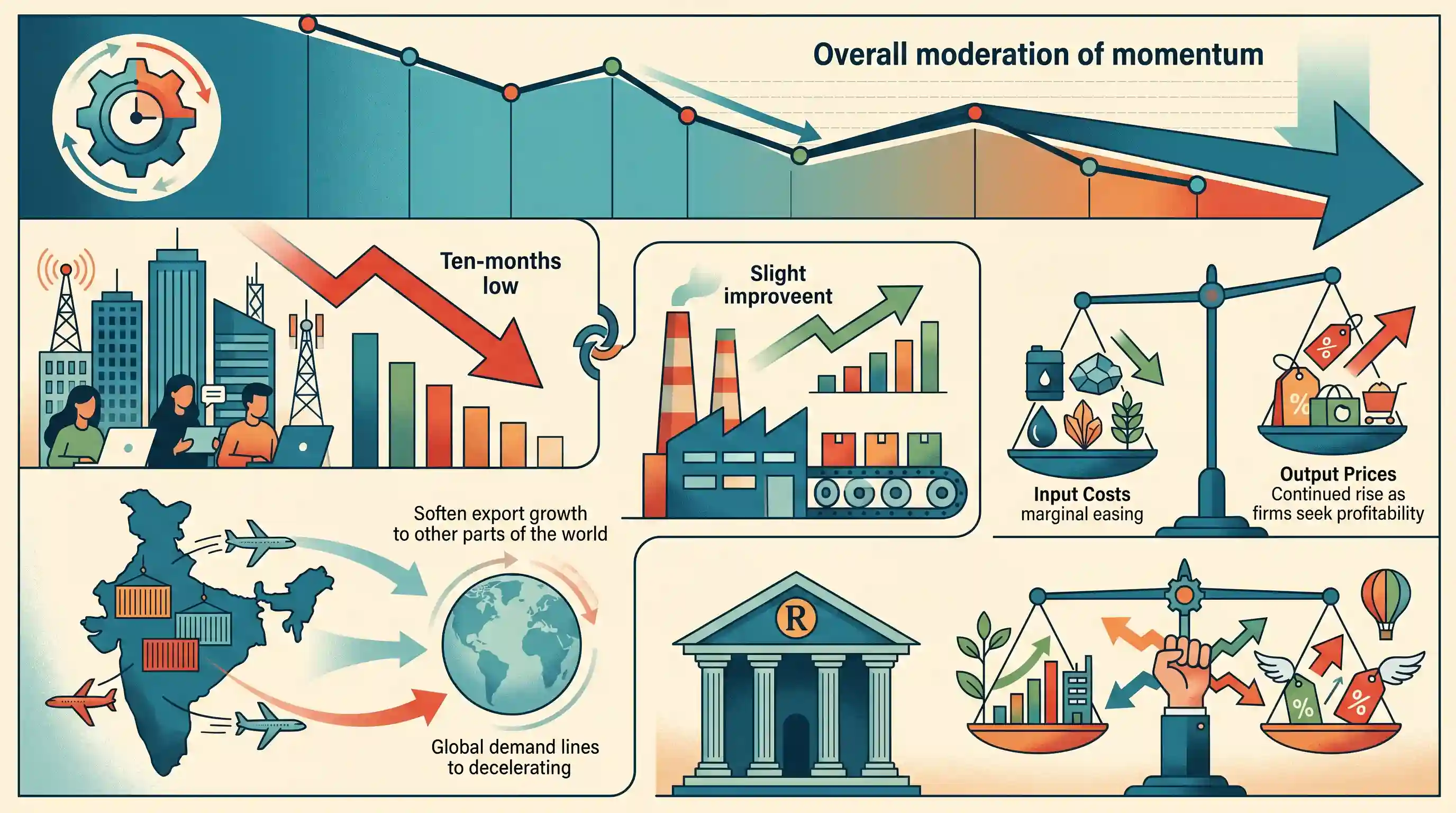
India's private sector growth momentum moderated in October, with the HSBC Flash Composite Purchasing Managers’ Index (PMI) falling to a five-month low of 59.9. The deceleration was largely attributed to a slowdown in the services sector, which hit a ten-month low, while manufacturing showed a slight improvement. Export growth also softened to a five-month low, reflecting a deceleration in international demand for Indian manufactured goods. While input cost pressures eased marginally, output prices continued to rise as firms sought to maintain profitability, signaling mixed macroeconomic signals for the Reserve Bank of India regarding growth and inflation dynamics.
Key Points
- India's HSBC Flash Composite PMI slipped to a five-month low of 59.9 in October, down from 61.0 in September, indicating a moderation in private sector expansion.
- The slowdown was primarily driven by the services sector, where growth cooled to a ten-month low, despite manufacturing sector activity ticking up slightly.
- New export orders expanded at the slowest pace in five months, driven by softer increases in manufacturing exports, highlighting concerns over global demand.
- Input cost inflation eased, bringing relief to cost pressures, but businesses continued to raise their selling prices to protect margins.
Important Terms
Purchasing Managers’ Index (PMI)

An economic indicator derived from monthly surveys of private sector companies, reflecting business activity trends. A reading above 50 indicates expansion, while below 50 signals contraction.
UPSC context
Core Prelims concept (Economic Indicators); GS III (Industrial Growth) topic on tracking real-time economic health vs. official GDP data.
Composite PMI
A weighted average of the Manufacturing and Services indices, providing a comprehensive view of total private sector output and economic momentum.
UPSC context
GS III (Indian Economy); used to assess broad-based growth trends across diverse sectors beyond just industrial production.
Services Sector
The dominant component of India's economy, contributing over 54% to GDP, encompassing IT, finance, trade, and transport. It is the primary driver of India's services-led growth model.
UPSC context
GS III (Structural composition of economy); tests knowledge of sector-wise GDP contribution and the "premature deindustrialization" debate.
Flash Estimate
A preliminary PMI reading released approximately one week before the final data, based on a majority (85-90%) of survey responses to provide an early economic pulse.
UPSC context
Prelims (Current Affairs); identifies the timing and reliability of leading indicators used by policymakers for rapid decision-making.
Reserve Bank of India (RBI)
India's central bank and regulatory authority, responsible for maintaining price stability and supporting growth through its Flexible Inflation Targeting (FIT) framework and monetary policy.
UPSC context
GS III (Monetary Policy); critical for understanding repo rate adjustments, inflation management (CPI), and the bank's role in economic stability.
Manufacturing Sector
The segment of the economy involved in transforming raw materials into finished goods; it accounts for ~15-17% of India's GDP and is the focus of "Make in India."
UPSC context
GS III (Industrial Policy); vital for questions on job creation, the PLI scheme, and achieving a $5 trillion economy.
Prelims Trap
"A steady decline in the PMI reading over consecutive months directly indicates an economic contraction."
Any PMI reading above 50 signifies expansion. A drop from 61.0 to 59.9 means the economy is still growing, just at a slower rate, not contracting.
Static Concepts Connected
What are the core features of the Purchasing Managers' Index (PMI)?
- Leading indicator: It is a survey-based leading indicator that captures private sector business sentiment before official macroeconomic data is published.
- The 50 threshold: A reading above 50 signifies expansion compared to the previous month, below 50 indicates contraction, and exactly 50 means no change.
- Sectoral split: Calculated separately for manufacturing and services. A Composite PMI is derived by weighting both sectors based on their GDP contributions.
How does PMI price tracking differ from the RBI's inflation targeting?
- Producer focus: PMI surveys track input costs and factory-gate output prices, acting as early indicators of wholesale and producer margin pressures.
- RBI mandate: The RBI legally targets retail inflation through the Consumer Price Index (CPI) under the Monetary Policy Framework, not PMI price indices.
Cross-Topic Patterns
PMI Output Prices + RBI Monetary Stance
Rising output prices in PMI data highlight the challenge for the RBI, balancing growth moderation with sticky inflation before initiating rate cuts.
Softening Exports + Global Protectionism
Weakening new export orders in PMI align with India's macro vulnerabilities amid a global economic shift away from free trade towards fragmented protectionism.

Expect a 2026 Prelims statement contrasting PMI's >50 expansion threshold with the base-year indexing method used for the IIP.
Linked PYQs · 4
Linked PYQs · 4
- 2025MainsGS3
What are the challenges before the Indian economy when the world is moving away from free trade and multilateralism to protectionism and bilateralism? How can these challenges be met?
- 2018MainsGS3
How would the recent phenomena of protectionism and currency manipulations in world trade affect macroeconomic stability of India?
- 2023MainsGS3
Faster economic growth requires increased share of the manufacturing sector in GDP, particularly of MSMEs. Comment on the present policies of the Government in this regard.
- 2017MainsGS3
Industrial growth rate has lagged-behind in the overall growth of Gross-Domestic-Product (GDP) in the post-reform period." Give reasons. How far the recent changes in Industrial-Policy are capable of increasing the industrial growth rate?
