Japanese Private Lunar Lander Crash Highlights Deep Space Risks
Source:The Hindu ↗
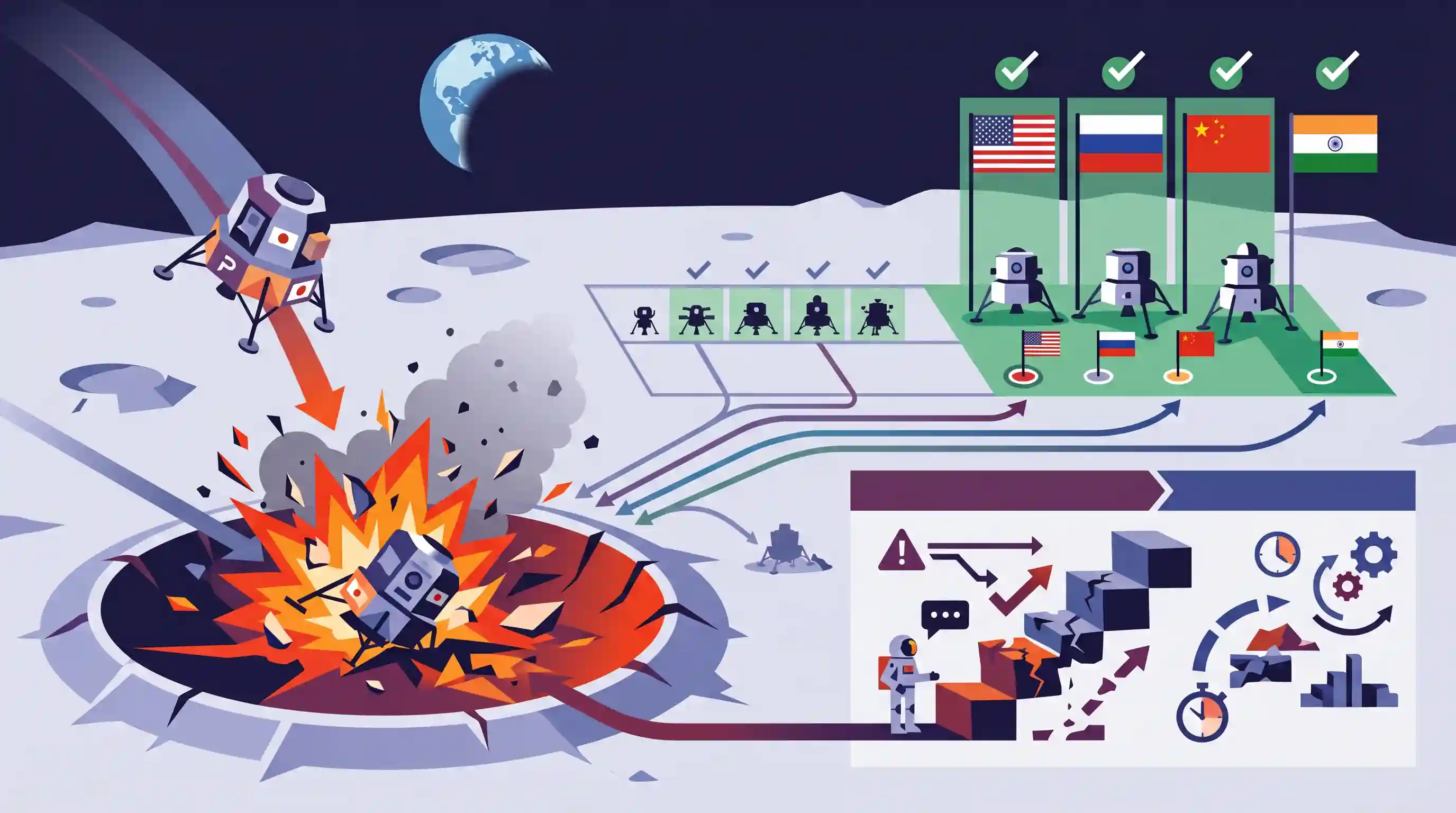
Why It Matters
The failure of a private lunar mission highlights the immense technical complexities of soft-landing on the moon. This provides critical context for appreciating the success of India's Chandrayaan-3 and understanding the ongoing challenges in the commercialization of deep space exploration.
Summary
A private Japanese lunar lander crashed during its descent to the moon, resulting in a mission failure. The incident highlights the immense technical difficulties of achieving a soft lunar landing—a feat so far accomplished by only five national space agencies, including India. The crash serves as a reminder of the high risks and steep learning curves faced by the commercial space sector in executing complex deep-space missions.
Key Points
- A private Japanese lunar lander crashed during its attempt to soft-land on the moon, resulting in a failed mission.
- The failure underscores the severe technical challenges associated with lunar landings, a complex maneuver that only five national space agencies (including India with Chandrayaan-3) have successfully accomplished.
- The crash marks a setback for the commercial space sector's ambitions in deep space exploration and lunar payload delivery.
- It highlights the high risk and steep learning curve for private companies attempting interplanetary missions compared to well-funded government space programs.
Important Terms
ispace

A Tokyo-based private aerospace company specializing in lunar exploration and transportation services via its Hakuto-R program.
UPSC context
GS-3 Space Technology; relevant for understanding private-sector risks and the shift toward commercial lunar logistics in the "NewSpace" era.
Soft Landing
A controlled touchdown of a spacecraft on a celestial body at a speed low enough to avoid damaging the vehicle or its payload.
UPSC context
GS-3 Science & Tech; a critical technical hurdle that distinguishes successful lunar missions like India's Chandrayaan-3.
ISRO (Indian Space Research Organisation)
India’s national space agency, which became the fourth entity globally to successfully achieve a soft lunar landing during the Chandrayaan-3 mission.
UPSC context
GS-3 Achievements in Science & Tech; reflects India’s leadership in cost-effective deep-space exploration.
JAXA (Japan Aerospace Exploration Agency)
Japan’s national aerospace agency; it successfully achieved a lunar soft landing with its SLIM mission in early 2024.
UPSC context
GS-2 International Relations & GS-3 Space; significant for bilateral space cooperation, particularly the joint LUPEX mission with India.
NewSpace
A global movement characterized by the entry of private companies and startups into the space sector, traditionally dominated by state agencies.
UPSC context
GS-3 Economy and Science; pertains to the privatization of space, increasing innovation, and reducing costs through competitive private participation.
LUPEX (Lunar Polar Exploration Mission)
A joint mission between India (ISRO) and Japan (JAXA) aimed at exploring the lunar south pole for water-ice and other resources.
UPSC context
GS-3 Space Technology; a key example of international scientific collaboration and India's strategic partnership with Japan in lunar science.
Prelims Trap
"Private space missions and commercial entities are exempt from UN Outer Space Treaty state liabilities."
Under Article VI of the Outer Space Treaty, state governments bear international responsibility for all national space activities, including those by private entities.
Static Concepts Connected
How does the Outer Space Treaty (1967) regulate private space missions?
- State Liability: Governments hold international responsibility for all national space activities, including those conducted by private commercial entities.
- Authorization Required: Private entities cannot launch independently; they require authorization and continuous supervision by their respective nation states.
- Non-Appropriation: Outer space and celestial bodies cannot be claimed via sovereignty, occupation, or private ownership.
What is India's institutional framework for private space participation?
- IN-SPACe: Acts as a single-window autonomous nodal agency to authorize, regulate, and promote private space activities.
- NSIL: The commercial arm of ISRO responsible for transferring technologies and enabling private sector participation.
- ISRO: Focuses on core R&D, deep space missions, and capacity building, shifting operational flights to private players.
Cross-Topic Patterns
Artemis Accords & Space Commercialization
The shift toward private lunar landers intersects directly with the Artemis Accords, which aim to establish legal norms for commercial space resource extraction and lunar safety zones.
India's IN-SPACe vs Global Norms
As private space missions incur state liabilities globally, India's IN-SPACe framework becomes crucial for mitigating risks and legally authorizing domestic private startups like Skyroot or Agnikul.

Expect a multi-statement question in 2026 linking private space mission failures to state liability under the 1967 Outer Space Treaty.
Linked PYQs · 2
Linked PYQs · 2
- 2023MainsGS3
What is the main task of India's third moon mission which could not be achieved in its earlier mission? List the countries that have achieved this task. Introduce the subsystems in the spacecraft launched and explain the role of the Virtual Launch Control Centre' at the Vikram Sarabhai Space Centre which contributed to the successful launch from Sriharikota.
- 2016MainsGS3
Discuss India's achievements in the field of Space Science and Technology. How the application of this technology has helped India in its socio-economic development?
