Private Capital Expenditure Trends and Trump Effect
Source:The Hindu ↗
Why It Matters
Provides a nuanced explanation for the slow pace of private investment in India. It highlights how domestic structural reforms (like the IBC) can inadvertently cause short-term capex hesitation and how global protectionism directly affects domestic economic growth. Highly relevant for GS3 answers on capital formation, corporate debt, and macroeconomic challenges.
Summary
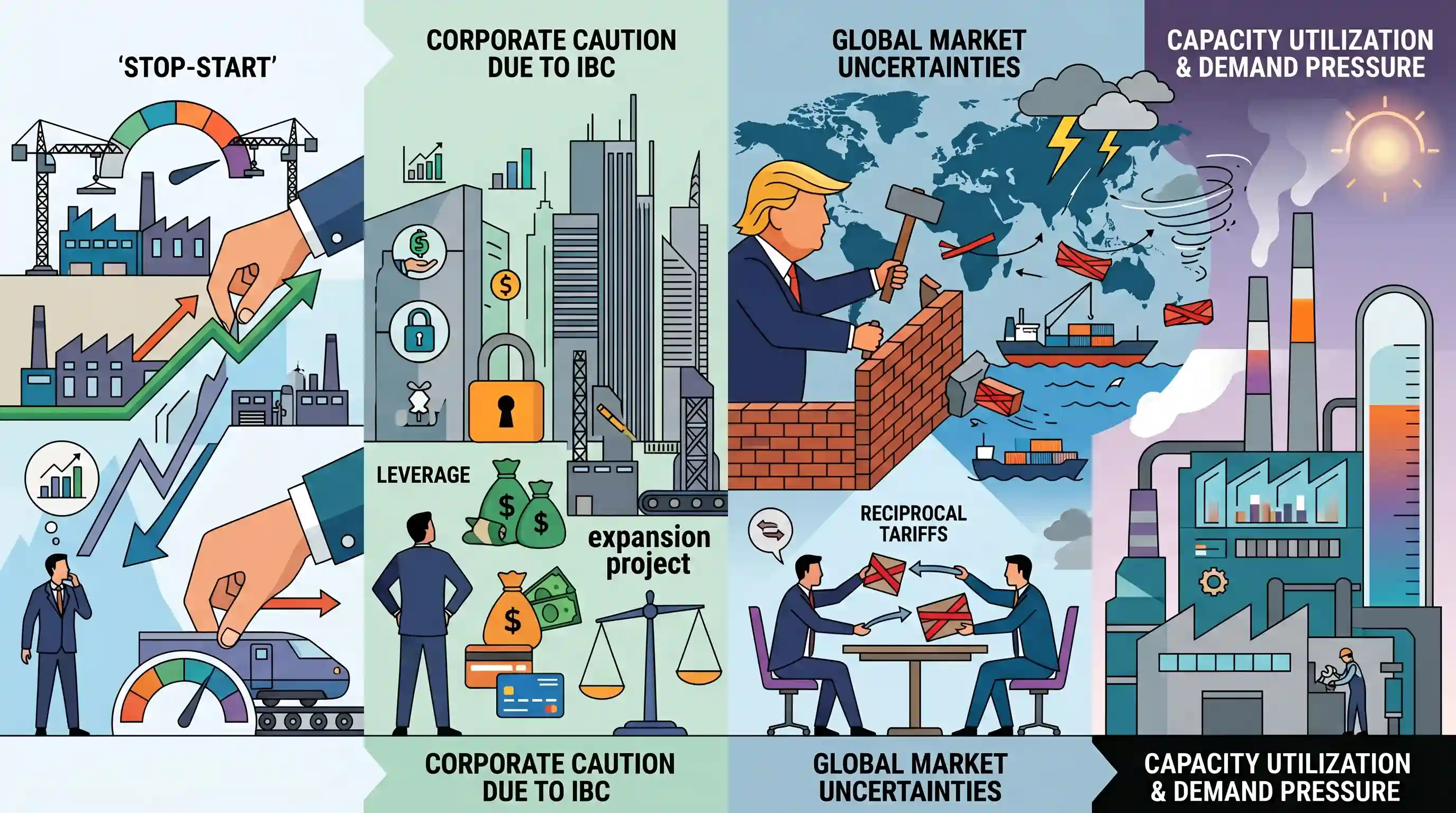
Former FICCI President Subhrakant Panda attributes the 'stop-start' nature of India's private capital expenditure (capex) to two major factors: corporate caution driven by the Insolvency and Bankruptcy Code (IBC) and global market uncertainties. While the IBC has successfully enforced financial discipline, it makes companies hesitant to over-leverage for expansions. Furthermore, geopolitical turbulence and protectionist policies—characterized by the 'Trump effect' and reciprocal tariffs—dampen global investment sentiment. Lastly, with aggregate capacity utilisation at around 75%, most sectors lack the immediate domestic demand pressure (typically needing >80%) to trigger massive fresh investments.
Key Points
- Private investment in India is ongoing but exhibits a \'stop-start\' pattern, concentrated heavily in sectors like renewables and logistics.
- The Insolvency and Bankruptcy Code (IBC) has instilled financial discipline; the stark consequences of wrong capital expenditure decisions have made companies more cautious.
- Investment in reviving dead or underutilised assets through the IBC might not be captured in private capex metrics, causing potential undercounting of productive capacity enhancement.
- Geopolitical tensions and protectionist trade disputes (the \'Trump effect\' and reciprocal tariffs) continue to create global market turmoil and delay major investment commitments.
- Aggregate private sector capacity utilisation currently hovers around 75%; fresh replacement investments typically require crossing the 80% threshold.
Important Terms
Insolvency and Bankruptcy Code (IBC)

A 2016 legal framework providing a time-bound process for resolving insolvency of companies and individuals to maximize asset value and improve credit availability.
UPSC context
GS-III: Indian Economy; tests understanding of NPA resolution, Ease of Doing Business, and financial sector reforms.
Federation of Indian Chambers of Commerce & Industry (FICCI)
Established in 1927, it is India’s oldest and largest apex business organization, serving as a non-government platform for industry advocacy and policy dialogue with the government.
UPSC context
GS-II: Role of pressure groups and formal associations; GS-III: Industrial growth and policy.
Capacity Utilisation
A metric measuring the extent to which an economy or firm uses its installed productive potential; a 75-80% threshold typically signals the need for fresh private investment.
UPSC context
GS-III: Investment models and economic growth; used to analyze the "output gap" and investment cycles.
Private Capital Expenditure (Capex)
Funds used by private firms to acquire, upgrade, or maintain physical assets like machinery and infrastructure, serving as a critical driver for long-term GDP growth.
UPSC context
GS-III: Mobilization of resources and investment models; essential for understanding the "virtuous cycle" of the economy.
Protectionism
Economic policies of restricting imports through tariffs or quotas to protect domestic industries, which can create global trade uncertainties and affect export-oriented growth.
UPSC context
GS-II: Effect of policies of developed countries on India's interests; GS-III: Effects of liberalization on the economy.
Prelims Trap
Investments used to revive underutilised assets through the IBC are directly counted as new private capital expenditure.
Reviving existing distressed assets is a transfer of ownership and operational revival, not the creation of 'new' gross fixed capital formation (GFCF) in national accounts.
Static Concepts Connected
What is 'Capacity Utilisation' and how does it trigger private capex?
- Definition: The ratio of an industry's actual output to its maximum potential output at a given time.
- The 80% Threshold: Firms typically wait until aggregate capacity utilisation breaches the 80% mark before committing massive funds for new greenfield factories.
- Current Stagnation: As measured by RBI's OBICUS survey, India's current utilisation hovers around 75%, explaining why immediate, broad-based domestic manufacturing investments remain sluggish.
How does the IBC framework alter corporate borrowing behaviour?
- Shift in Control: The code shifts the resolution process from a 'debtor-in-possession' model to a 'creditor-in-control' model.
- Loss of Ownership: Section 29A bars defaulting promoters from bidding for their own distressed assets, instilling a genuine fear of permanently losing their companies.
- Financial Discipline: This severe consequence for default acts as a deterrent against reckless over-leveraging, inducing a cautious, 'stop-start' approach to debt-funded expansion.
Cross-Topic Patterns
Public Capex Push vs Corporate Deleveraging
Despite massive public infrastructure spending meant to 'crowd in' private capital, corporate fear of IBC defaults has prioritized debt reduction and balance-sheet repair over aggressive new expansions.
Global Protectionism & Sectoral Skew
Rising global tariff wars and reciprocal protectionism discourage export-oriented manufacturing investments, forcing private capital to concentrate heavily in domestic-focused sectors like renewables and logistics.

Expect a Mains question linking IBC’s behavioral impact on corporate deleveraging with the delayed crowding-in of private capex in India.
Linked PYQs · 2
Linked PYQs · 2
- 2020MainsGS3
Explain the meaning of investment in an economy in terms of capital formation. Discuss the factors to be considered while designing a concession agreement between a public entity and a private entity.
- 2025MainsGS3
What are the challenges before the Indian economy when the world is moving away from free trade and multilateralism to protectionism and bilateralism? How can these challenges be met?
