Balancing RTI Transparency with Data Privacy Laws
Source:The Hindu ↗
આ શા માટે મહત્વનું છે
This topic is crucial for GS2 (Governance, Transparency, Accountability, and Statutory/Constitutional Frameworks) as it addresses the evolving friction between transparency rights (RTI) and data privacy protections (DPDP Act).
સારાંશ
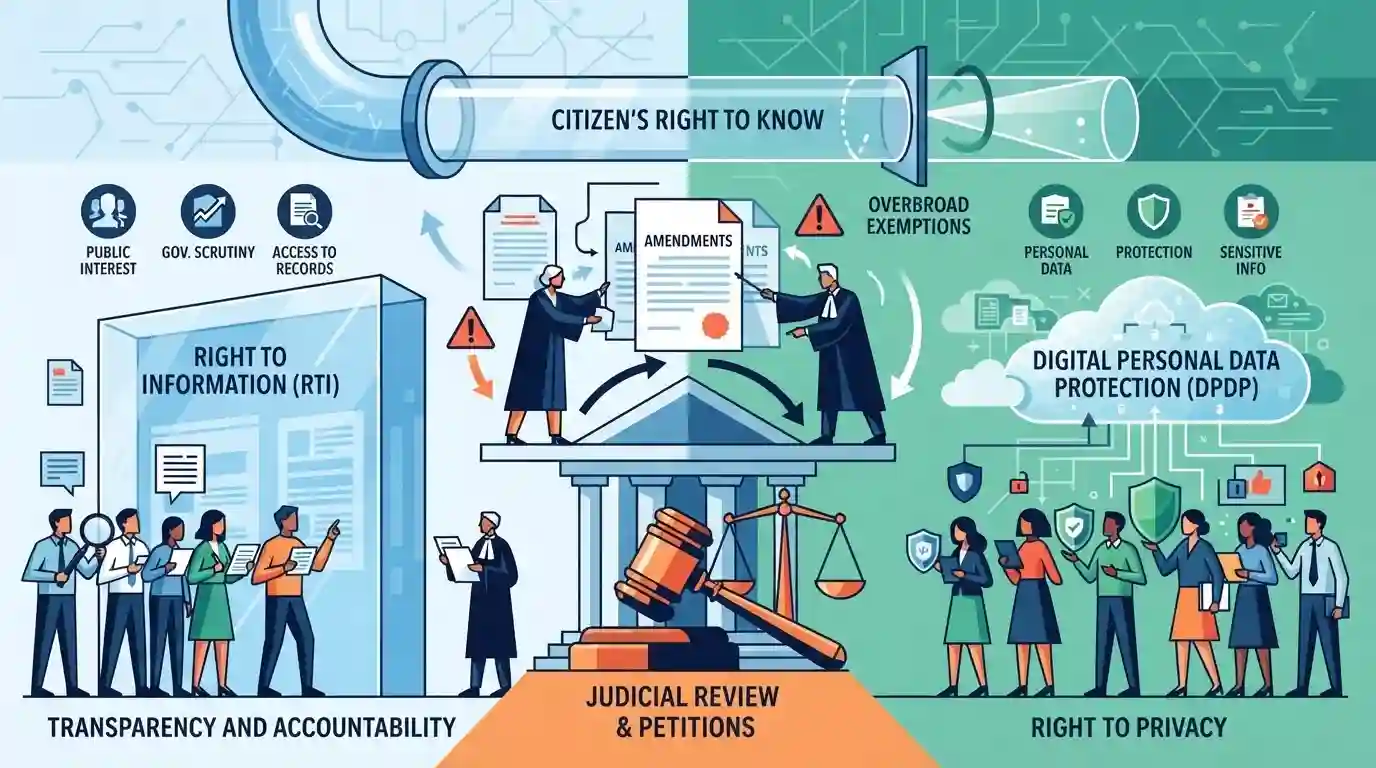
The editorial discusses petitions challenging amendments to the Right to Information (RTI) Act, which widen exemptions on personal information under the Digital Personal Data Protection (DPDP) framework. It emphasizes the complex judicial and legislative challenge of balancing citizens' right to know and hold public authorities accountable with the fundamental right to privacy, warning against overbroad restrictions that could weaken transparency.
મુખ્ય મુદ્દા
- The debate over balancing the Right to Information (RTI) with the Right to Privacy has intensified with petitions challenging amendments to the RTI Act under the Digital Personal Data Protection (DPDP) Act.
- Section 8(1)(j) of the RTI Act previously exempted personal information unless larger public interest justified disclosure, but amendments have altered exemptions related to all personal information.
- Critics argue that a blanket restriction on disclosing personal data could shield public servants from accountability and undermine transparency.
- Harmonising transparency legislation with data privacy laws requires a calibrated, case-by-case evaluation of public interest versus private harm rather than absolute exemptions.
મહત્વપૂર્ણ શબ્દો
Right to Information (RTI) Act

A landmark 2005 Indian legislation empowering citizens to request information from public authorities, promoting transparency, curbing corruption, and ensuring accountability across government bodies.
UPSC context
GS Paper II (Polity & Governance). Essential for questions on transparency, accountability, and citizen-state relations.
Digital Personal Data Protection (DPDP) Act
A 2023 legislative framework enacted to govern the processing of digital personal data, balancing individual privacy rights with lawful data processing needs.
UPSC context
GS Paper II (Polity & Governance) and GS Paper III (Security & Technology). Tests understanding of data privacy and statutory reforms.
Supreme Court of India
The apex judicial body of India vested with the power of judicial review, responsible for interpreting the Constitution and adjudicating conflicts between statutory laws and fundamental rights.
UPSC context
GS Paper II (Indian Constitution & Polity). Crucial for topics on judicial review, separation of powers, and the balance of fundamental rights.
પ્રિલિમ્સ ટ્રેપ
The RTI Act provides an absolute bar on the disclosure of any personal information belonging to public officials.
Aspirants often assume RTI Act exemptions under Section 8 are absolute. In reality, the unamended RTI law permitted disclosure of personal information if a larger public interest justified it.
સંલગ્ન સ્થિર ખ્યાલો
What are the key statutory exemptions under Section 8 of the Right to Information Act, 2005?
- Sovereignty & Security: Exemptions cover matters prejudicing national security, sovereignty, strategic economic interests, foreign relations, and incitement to an offence.
- Judicial & Commercial: Information expressly forbidden by courts, breach of parliamentary privilege, and commercial confidence or trade secrets are protected.
- Fiduciary & Privacy: Fiduciary relationships and personal information whose disclosure has no relationship to any public activity or interest can be exempted.
આંતર-વિષય પેટર્ન
RTI transparency vs DPDP data privacy
The friction between statutory transparency and data privacy laws directly impacts anti-corruption mechanisms, testing the boundaries of Article 19(1)(a) versus Article 21.

RTI-DPDP legislative conflict + Right to Privacy (Art 21) vs Freedom of Speech (Art 19) likely as a high-yield Mains analytical question.
સંલગ્ન PYQ · 3
સંલગ્ન PYQ · 3
- 2020MainsGS2
Recent amendments to the Right to Information Act will have profound impact on the autonomy and independence of the Information Commission". Discuss.
- 2024MainsGS2
Right to privacy is intrinsic to life and personal liberty and is inherently protected under Article 21 of the constitution. Explain. In this reference discuss the law relating to D.N.A. testing of child in the womb to establish its paternity.
- 2021PrelimsGS1
'Right to Privacy' is protected under which Article of the Constitution of India?
